What does this sign warn you about?
NWT Class 7: Guide, service and construction signs
Route markers, direction and distance signs, service signs, orange construction signs, doubled fines with workers present, the slow-moving vehicle sign and disabled parking.
- No sign-up
- Every answer explained
- Independent · not a government site
- 15 questions
- Topic drill
Study reference: NWT Driver's Manual (rev. August 2022), Ch. 2 Traffic Controls — Information and guide signs, Road construction, Other signs, pp. 35–37, 40
All 15 questions in this test
Every question and its answer choices. The correct answers and explanations appear when you take the test above.
What does this sign warn you about?
- A parade route ahead
- A school crossing guard is just ahead
- A border crossing ahead
- A flag person ahead directing traffic
Where can you get an application for a disabled parking placard in the NWT?
- The RCMP detachment
- The municipal parking office in your community
- A Driver and Vehicle office or your doctor
- Any insurance broker
What does this sign warn of?
- A pedestrian crossing ahead
- A playground beside the road
- A survey crew ahead
- People working on the road ahead
You see an orange diamond sign that says road construction is ahead. What should you be ready to do?
- Change lanes right away
- Turn on your high beams
- Slow down and stop if required
- Speed up to clear the area
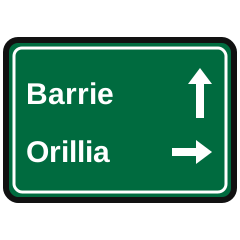
What kind of sign is this?
- A detour sign
- A highway lane control sign
- A destination guide sign
- A route marker
When may a vehicle park or stop in a stall reserved for persons with disabilities?
- When it stops for under five minutes
- When the driver stays in the vehicle
- When it displays the placard or licence plate
- When every other stall is full
What do route markers show?
- The number or name of a road
- The distance to the next town
- The posted speed limit
- Where services are located
What happens to speeding fines in a construction zone when workers are present?
- They stay the same
- They are tripled
- They are doubled
- They are reduced by half
What is the main job of green information and guide signs?
- To warn of hazards on the road
- To mark construction zones
- To help you choose a route and find places
- To state traffic laws you must obey
You drive through a construction zone on a Sunday and no workers or machines are there. What speed must you obey?
- The posted construction zone limit
- Any safe speed you choose
- The normal highway limit
- The limit only applies on weekdays
What does this sign tell you?
- Construction has ended
- A lane is closed ahead
- The road ends ahead
- Follow a detour route
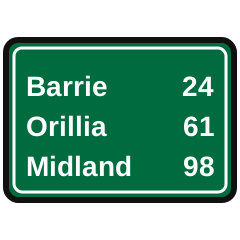
What does this sign give you?
- Exit numbers for each town
- Directions to services
- Distances to places ahead
- Speed limits for each town
Vehicles displaying the slow-moving vehicle sign are designed to travel at speeds below what?
- 60 km/h
- 40 km/h
- 30 km/h
- 50 km/h
You see this sign on the back of a vehicle ahead. What does it tell you?

- It is carrying dangerous goods
- It is about to stop
- It is a wide load
- It is a slow-moving vehicle
A truck ahead displays an over-dimensional load sign. What should you keep in mind?
- It has the right-of-way everywhere
- You must not pass it at all
- Use caution if you pass it
- It must travel in the left lane
Guide, service and construction signs: key rules to remember
Our summary of what the official handbook says on this topic, in our own words. Read it before or after the practice questions above, then check the original chapter. Read the official chapter ↗
Information and guide signs (Ch. 2 Traffic Controls)
- Purpose: help with route selection, finding off-road facilities, and identifying geographic features or points of interest.
- Route markers show the number, name or other designation of a road (highway route marker, Trans-Canada Highway, Yellowhead Highway).
- Destination guide signs give direction and distance to a destination (directional, distance, or both combined).
- Off-road facility signs show availability and direction of services or recreation.
Services and off-road facilities
- Service examples: hospital, airport, parking.
- Off-road facilities: fuel, food, trailer campground, telephone, accommodation, RCMP or city police, recreation area ahead, territorial park.
Road construction
- Construction signs warn of road work ahead: be ready to slow down and stop if required.
- Obey the flag person's signals.
- Construction zone speed limits must be obeyed at all times, even when no people or equipment are working, because bumps, fresh oil and loose gravel may be present.
- If workers are present, speeding fines in these areas are doubled. (p. 108 repeats: fines for speeding are doubled in construction zones.)
- Construction sign examples: people working, flag person, survey crew ahead, uneven pavement, detour next # km, construction zone ends.
Other signs
- Slow moving vehicle sign: on the back of farm tractors, machinery or construction equipment built for speeds under 40 km/h. Reduce your speed when you see it.
- Disabled parking sign: it is illegal for a vehicle to park or stop in a stall reserved for persons with disabilities unless it displays an identifying placard or licence plate.
- Placard applications: any Driver and Vehicle office or your family physician.
TTY and over-dimensional loads
- TTY sign: pay phones with a teletypewriter device for people who are deaf, hard of hearing or speech-impaired.
- Over-dimensional load signs: a wide load is being moved; use caution when passing such vehicles.
Study the Guide, service and construction signs rules as flashcards →
Other topics
- Regulatory signs and speed limitsSign shapes and colours, stop and yield signs, permissive green-circle and prohibitive red-slash signs, lane-use, parking and stopping signs, and NWT default speed limits.
- Warning signsYellow diamond warning signs for stops and signals ahead, curves, crossings, intersections, merging, narrowing roads, lane endings, divided highways and other road conditions.
- School and playground zonesSchool and playground area versus zone signs, the 30 km/h speed, 24-hour default times, municipal bylaws, no passing and where zones end.
- Traffic lights and signalsLight order, steady and flashing red, amber and green lights, green arrows, turns on red, pedestrian signals and lane control signals.
- Pavement markingsYellow and white lines, broken and solid lines, passing rules, arrows, two-way left-turn lanes, diamonds, railway X markings, painted islands, crosswalks and stop lines.
- Licences, GDL and registrationClass 7 learner conditions, probationary and full stages, licence classes, new residents and visitors, vision and medical rules, exams, renewals, registration and insurance.
- Starting, steering and stoppingPre-drive checks, seat, mirrors, seat belts and head restraints, transmissions, steering, stopping distances, braking technique and backing up.
- ParkingParallel, angle and hill parking, getting in and out of a parked vehicle, and the distances and places where you may not park.
- Intersections and right-of-wayWhere to stop at stop signs, four-way stops, yield signs, traffic circles, controlled and uncontrolled intersections and keeping intersections clear.
- Signalling and turningWhen to signal, hand signals, right and left turns, turning lanes, dual turns, two-way left-turn lanes, U-turns and free-flow lanes.
- Lane driving, passing and mergingLane position, shoulders, blind spots and lane changes, passing lanes, passing on two-lane highways, when passing is illegal, merging, exiting, curves and hills.
- Emergencies, skids and collisionsBreakdowns, brake, steering, tire and headlight failure, emergency braking and ABS, skids, off-road recovery, collision duties and slowing for emergency vehicles.
- Night, weather and animalsHeadlight rules and distances, glare, winter kits, hydroplaning, ice and snow, black ice, smoke and fog, deep water and avoiding animals.
- Defensive and responsible drivingScanning, space cushions, the two-second rule, fatigue, cellphones, child restraints, fuel efficiency, refuelling and other traffic laws.
- Sharing the roadPedestrians, cyclists, motorcycles, large and log-haul vehicles, school buses, emergency vehicles, snowplows, railway crossings, LRT and funeral processions.
- Impaired and distracted drivingZero BAC for new drivers, 50 and 80 mg limits, administrative suspensions, Criminal Code disqualifications, ignition interlock, drugs and distracted-driving penalties.
- Demerit points and suspensionsDemerit thresholds for GDL and fully licensed drivers, interviews, suspension lengths, driver improvement courses, reinstatement and Registrar suspensions.