How close may you follow a fire truck that has its siren or lights on?
NWT Class 7 overview
NWT Class 7 Mock Exam 3
Same format as the real test. Answers stay hidden until you submit.
- No sign-up
- Every answer explained
- Independent · not a government site
- 40 questions
- 30 min
- Pass mark 16/20 per section
0/40
All 40 questions in this test
Every question and its answer choices. The correct answers and explanations appear when you take the test above.
How close may you follow a fire truck that has its siren or lights on?
- No closer than 50 m
- No closer than 100 m
- No closer than 150 m
- No closer than 300 m
About how far may a train need to stop under full emergency braking?
- About 50 metres
- About 100 metres
- A kilometre or more
- About 300 metres
What is "riding the clutch"?
- Releasing the clutch pedal too quickly
- Leaving your foot on the clutch pedal
- Shifting without the clutch
- Starting in second gear
A truck ahead displays an over-dimensional load sign. What should you keep in mind?
- It has the right-of-way everywhere
- You must not pass it at all
- Use caution if you pass it
- It must travel in the left lane
What does this sign tell you?

- Construction has ended
- A lane is closed ahead
- The road ends ahead
- Follow a detour route
What kind of sign is this?
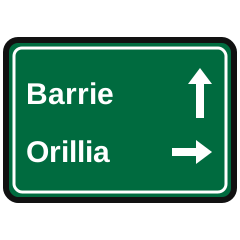
- A detour sign
- A highway lane control sign
- A destination guide sign
- A route marker
What does this sign mean?

- No left turn
- No U-turn
- Road curves sharply ahead
- U-turn allowed here
What do arrows painted in a lane tell you?
- Where the lane will end
- Which movements are allowed from that lane
- Which way the wind is blowing
- How fast you should travel while in the lane
Who must yield at a public railway crossing?
- Whoever arrives first
- Trains yield on rural roads
- Drivers must always yield to trains
- Trains yield to vehicles already crossing
Which of these is NOT allowed for a Class 5P probationary driver?
- Carrying a passenger in the back seat
- Driving after 11:00 p.m.
- Supervising a Class 7 learner
- Driving on a primary highway
With an ignition interlock, what BAC reading lets the vehicle start with no violation?
- Below 50 mg per 100 mL
- Below 80 mg per 100 mL
- Below 20 mg per 100 mL
- Below 30 mg per 100 mL
On a limited-access highway, what is a weave zone?
- A lane for passing slow vehicles
- A winding section of highway
- A construction zone where the lanes shift over
- Where entering and exiting traffic cross paths
Driving fast on a very wet road, what is hydroplaning?
- Ice forming under the vehicle
- Tires riding on a layer of water
- Brakes overheating on a hill
- Wheels spinning on gravel
What does this sign warn of?

- Rumble strips on the shoulder
- A bump in the road
- A railway crossing
- A hill ahead
What does this sign give you?
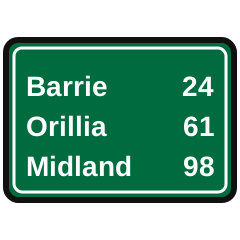
- Exit numbers for each town
- Directions to services
- Distances to places ahead
- Speed limits for each town
You are getting out of your parked car on the street side. What should you check first?
- Only for pedestrians walking on the sidewalk beside you
- Only the inside rear-view mirror
- Only that the engine is off
- Mirrors and a left shoulder check for cars and cyclists
You damage a parked car and cannot find its owner. What must you do?
- Wait one hour, then leave
- Securely attach your name, address, licence and plate number
- Leave and phone the police later
- Leave a note with only your phone number under the wiper blade
On a rural highway the centre line is solid yellow on your side. May you pass the slow vehicle ahead?
- Yes, if you stay under the limit
- Yes, but only during daylight
- Yes, if the road ahead looks clear
- No, passing is not allowed
What does this sign warn of?

- A pedestrian crossing ahead
- A playground beside the road
- A survey crew ahead
- People working on the road ahead
What do route markers show?
- The number or name of a road
- The distance to the next town
- The posted speed limit
- Where services are located
You come to a flashing red light at an intersection. What must you do?
- Go if no one is directly ahead
- Stop, then go only when it is safe
- Slow down and go with caution
- Stop and wait until it turns green
You are driving toward this sign at an intersection. What must you do?

- Yield only to traffic coming from the right
- Slow down and go if the road looks clear
- Stop only if other vehicles are present
- Stop completely and go only when it is safe
You are on a rural two-lane highway with a broken yellow centre line. What does it tell you?
- Passing is never allowed here
- You must pass within 10 seconds
- Only trucks may pass here
- There is enough sight distance to pass
What does the speed plate under this curve sign tell you?

- The recommended top speed for the curve
- The new speed limit for the highway
- The speed for trucks only
- The minimum speed through the curve
You have a steady green light and want to turn left. What must you do?
- Sound your horn and turn
- Wait for the light to turn amber
- Yield to vehicles and people lawfully in the intersection
- Turn first, since the green light gives you the right of way
What is the difference between a playground area sign and a playground zone sign?
- An area sign has a speed sign on its post
- A zone sign has a speed sign on its post
- A zone sign is used only near schools
- An area sign applies only on weekends
What makes up total stopping distance?
- Following distance and braking distance
- Braking distance only
- Reaction and braking distance only
- Perception, reaction and braking distance
What does a flashing amber light at an intersection require?
- Go with caution after yielding
- Speed up to clear the area
- Stop completely, then go
- Stop and wait for green
Does a GDL driver charged with an alcohol offence get the 7-day temporary permit?
- Only if they need to drive for work
- Yes, every driver charged gets it
- Yes, but it lasts only 3 days
- No, it does not apply to GDL drivers
What is the heaviest total weight of towed vehicles a Class 5 licence allows?
- 2,500 kg gross
- 5,500 kg gross
- 3,500 kg gross
- 4,500 kg gross
You are stranded in your vehicle during a winter storm. What does the manual generally advise?
- Leave the vehicle and stand on the road
- Run the engine non-stop with windows shut
- Stay with the vehicle and keep it ventilated
- Walk to the nearest town for help
When may you turn left on a red light in the NWT?
- Only when a green arrow is also lit
- From a two-way street onto a one-way street, after stopping
- From any street when no traffic is coming
- From a one-way street onto a one-way street, after stopping
Which of these can lead to a departmental or ministerial suspension?
- Changing your address
- Renewing your licence late by a day
- Buying a new car
- Failure to pay a judgment
You have started a new prescription medicine. What should you do before driving?
- Learn how it affects you; ask your doctor or pharmacist
- Take a double dose to be safe
- Drive normally, since prescribed drugs are legal to use
- Drink coffee to stay alert
Why are daytime running lights not enough in poor visibility?
- They light only the rear of the vehicle
- They light only the front; taillights stay off
- They drain the battery quickly
- They are too bright for other drivers
A white square sign has a green circle around a symbol. What does the green circle tell you?
- The action shown is permitted
- The action shown is prohibited
- A school is close by
- The action is allowed only at night
You move to a new address in Yellowknife. When must you tell the Government of the NWT?
- Immediately
- Within 30 days
- Within 90 days
- At your next renewal
A front tire goes flat while you are driving. What will the vehicle most likely do?
- Pull strongly toward the good side
- Pull strongly toward the flat side
- Weave from side to side
- Speed up suddenly
On a horizontal traffic signal, which light is on the far right?
- Green
- The arrow
- Amber
- Red
How does the NWT manual define nighttime for headlight use?
- 30 minutes after sunset to 30 minutes before sunrise
- Whenever streetlights are on
- One hour after sunset to one hour before sunrise
- Sunset to sunrise
Keep practising
- NWT Class 7 Mock Exam 1 – 40 QuestionsTimed practice · 30 minutes · answers explained
- NWT Class 7 Mock Exam 2 – 40 QuestionsTimed practice · 30 minutes · answers explained
- NWT Class 7 Mock Exam 4 – 40 QuestionsTimed practice · 30 minutes · answers explained
- NWT Class 7 Mock Exam 5 – 40 QuestionsTimed practice · 30 minutes · answers explained
- NWT Class 7 Practice Test 140 questions with explanations
- NWT Class 7 Practice Test 240 questions with explanations
- NWT Class 7 Practice Test 340 questions with explanations
- NWT Class 7 Practice Test 440 questions with explanations