You come up behind a snowplow on the highway. What is the safest choice?
NWT Class 7 overview
NWT Class 7 Practice Test 1
40 questions on sharing the road, demerit points and suspensions, licences, gdl and registration, emergencies, skids and collisions, lane driving, passing and merging and more.
- No sign-up
- Every answer explained
- Independent · not a government site
- Set 1 of 9
- 40 questions
- Instant feedback
0/40
All 40 questions in this test
Every question and its answer choices. The correct answers and explanations appear when you take the test above.
You come up behind a snowplow on the highway. What is the safest choice?
- Stay well back until it pulls over
- Flash your lights so it moves over
- Pass it right away
- Follow closely to use its cleared path
A Class 7 learner reaches 6 demerit points. What happens?
- A six-month suspension
- An interview with an examiner
- A warning letter only
- A one-month suspension
While a Class 7 learner is driving, what blood alcohol level must the learner and the supervisor have?
- Under 80 mg for the supervisor
- Under 50 mg for both
- Zero for the learner only
- Zero for both
Above what total damage amount must an NWT collision be reported to police?
- $1,000
- $2,000
- $5,000
- $500
Someone is passing you on a two-lane highway. How can you help?
- Slow down, keep your lane, move slightly right
- Move onto the shoulder
- Speed up slightly so that the pass takes less time
- Flash your high beams
What does this sign mean?

- Passing is permitted
- Two lanes merge ahead
- Keep a safe distance
- Do not pass
Driving fast on a very wet road, what is hydroplaning?
- Ice forming under the vehicle
- Tires riding on a layer of water
- Brakes overheating on a hill
- Wheels spinning on gravel
You pass this sign and there is a speed sign attached below it on the same post. What must you do?

- Stay within the posted maximum speed
- Slow down only if you see children
- Keep the normal limit until a crosswalk
- Stop at the next crosswalk
A court gives a 3-month driving prohibition and the NWT suspension is one year. How long is left after the court prohibition ends?
- One year
- Nine months
- Three months
- None
You accelerate too hard on ice and the drive wheels spin. What type of skid is this, and what do you do?
- A cornering skid; steer hard left
- A power skid; ease up on the gas
- A power skid; press the gas harder
- A braking skid; press the brake
You face a double red light. How should you treat it?
- As a flashing red light
- As a red light for trucks only
- The same as a single red light
- As a sign that the signal is broken
You damage a parked car and cannot find its owner. What must you do?
- Wait one hour, then leave
- Securely attach your name, address, licence and plate number
- Leave and phone the police later
- Leave a note with only your phone number under the wiper blade
You are at the end of an acceleration lane and the gap you wanted closes. What should you avoid?
- Checking your mirrors again
- Keeping your signal on
- Adjusting your speed to find a gap
- Stopping at the end of the lane
You are on a two-way street at a red light and want to turn left onto a one-way street. May you turn?
- Yes, after a full stop
- Yes, with your hazard lights on
- No, not on a red light
- Yes, if no traffic is coming
What does a broken white line between lanes mean?
- You may change lanes
- The lane ends ahead
- Oncoming traffic uses the next lane
- You may not change lanes
Smoke from a forest fire makes it unsafe to keep driving. What should you do?
- Pull well off the road and use four-way flashers
- Stop in your lane with lights on
- Follow the taillights of the vehicle ahead closely
- Speed up to get through it
What does a chevron sign like this one indicate?
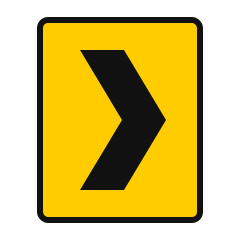
- A change in the road's direction
- A one-way road
- A passing lane is coming up ahead
- An exit lane
You see this sign with no speed sign attached to its post. What does it mean?
- The school zone has ended
- Children must cross only here
- You must slow to 30 km/h right away
- A school is near; drive with extra caution
Traffic is backed up past the intersection ahead and your light is green. What should you do?
- Enter and wait inside the intersection
- Go and stop in the crosswalk
- Wait until there is room to clear it
- Enter if your front end will fit
It is 10 p.m. on a Saturday and you enter a playground zone that has no times posted. What speed applies?
- Any speed if the park is empty
- The posted playground speed
- The normal street limit
- Only half the normal limit
In an automatic transmission, which position locks the transmission and is used for starting and parking?
- P (Park)
- D (Drive)
- 1 (Low gear)
- N (Neutral)
You drive through a construction zone on a Sunday and no workers or machines are there. What speed must you obey?
- The posted construction zone limit
- Any safe speed you choose
- The normal highway limit
- The limit only applies on weekdays
On a rural highway, about how far ahead should you scan?
- About 12 seconds
- About 60 seconds
- About 25 seconds
- About 5 seconds
You approach this sign. To whom must you give the right-of-way?

- Only pedestrians waiting on the corner
- Only large trucks and buses on the cross road
- Traffic not facing the sign and all pedestrians crossing
- Only vehicles approaching from your left side
What speed is good practice when backing up?
- About 20 km/h
- About normal walking speed
- As fast as is comfortable
- About 30 km/h
When you are driving correctly on a two-way road, where should the yellow line be?
- On your right
- On your left
- On either side
- Under the middle of your vehicle
You face a steady red light. There is no stop line or crosswalk. Where must you stop?
- Beside the signal pole
- In the middle of the intersection
- Past the first crosswalk
- Before entering the intersection
Besides turning your wheels, what must you always do when parking on a hill?
- Leave the engine idling in drive
- Turn on your four-way flashers
- Leave the transmission in neutral for easy restart
- Set the park brake and use park or low gear
A crash cannot be avoided. Which choice does the manual rate as better?
- Hitting a cyclist instead of a parked car
- Hitting a parked truck head-on instead of glancing it
- Hitting a snowbank instead of a light pole
- Hitting an oncoming car instead of a tree
How long do demerit points for a conviction stay on your NWT record?
- One year
- Five years
- Three years
- Two years
Outside an urban area, where are U-turns not permitted?
- At any intersection
- Anywhere in daylight
- On a curve or near the top of a hill
- On any paved highway with two lanes or more
A peace officer stops you and asks for proof of insurance. What do you show?
- Your pink financial responsibility card
- Your registration renewal notice
- Your driver's abstract
- Your bill of sale
What does this sign mean?

- The road narrows ahead
- The road widens ahead
- A bridge is closed
- A divided highway begins
A truck ahead displays an over-dimensional load sign. What should you keep in mind?
- It has the right-of-way everywhere
- You must not pass it at all
- Use caution if you pass it
- It must travel in the left lane
You are approaching the crest of a hill on a two-lane road. Where should you keep your vehicle?
- On the shoulder
- In the centre of the road
- To the left of your lane
- To the right of your lane
The light turns amber as you approach. You can stop safely before the stop line. What should you do?
- Stop inside the intersection
- Speed up to clear the intersection
- Continue at the same speed
- Stop before the stop line
How close to a fire hydrant may you park?
- No closer than 3 m
- No closer than 10 m
- No closer than 1 m
- No closer than 5 m
A school bus ahead turns on its alternating flashing amber lights. What should you do?
- Be ready to stop
- Speed up to pass it
- Stop immediately where you are
- Change lanes and continue
You are entering a traffic circle. Who has the right-of-way?
- You do, as the entering driver
- Traffic already in the circle
- The largest vehicle
- Traffic on your right
A driver is convicted of impaired driving a second time within 10 years. How long are they disqualified under the MVA?
- Three years
- One year
- Ten years
- Five years
All NWT Class 7 practice tests
- NWT Class 7 Mock Exam 1 – 40 QuestionsTimed practice · 30 minutes · answers explained
- NWT Class 7 Mock Exam 2 – 40 QuestionsTimed practice · 30 minutes · answers explained
- NWT Class 7 Mock Exam 3 – 40 QuestionsTimed practice · 30 minutes · answers explained
- NWT Class 7 Mock Exam 4 – 40 QuestionsTimed practice · 30 minutes · answers explained
- NWT Class 7 Mock Exam 5 – 40 QuestionsTimed practice · 30 minutes · answers explained
- Regulatory signs and speed limitsSign shapes and colours, stop and yield signs, permissive green-circle and prohibitive red-slash signs, lane-use, parking and stopping signs, and NWT default speed limits.
- Warning signsYellow diamond warning signs for stops and signals ahead, curves, crossings, intersections, merging, narrowing roads, lane endings, divided highways and other road conditions.
- Guide, service and construction signsRoute markers, direction and distance signs, service signs, orange construction signs, doubled fines with workers present, the slow-moving vehicle sign and disabled parking.
- School and playground zonesSchool and playground area versus zone signs, the 30 km/h speed, 24-hour default times, municipal bylaws, no passing and where zones end.
- Traffic lights and signalsLight order, steady and flashing red, amber and green lights, green arrows, turns on red, pedestrian signals and lane control signals.
About this practice test
How many questions are in NWT Class 7 practice test 1?
40 original multiple-choice practice questions covering sharing the road, demerit points and suspensions, licences, gdl and registration, emergencies, skids and collisions, lane driving, passing and merging, regulatory signs and speed limits, night, weather and animals, school and playground zones, impaired and distracted driving, traffic lights and signals, signalling and turning, pavement markings, warning signs, intersections and right-of-way, starting, steering and stopping, guide, service and construction signs, defensive and responsible driving, parking. Each answer includes an explanation. This mixed practice set does not reproduce the official exam format or predict an official score.
Are the questions the same every time?
Yes. Practice test 1 always has the same 40 questions, so you can repeat it until you get them all right. The other 8 sets use different questions.
Are these real test questions?
No. The official question bank is not published. These are original questions written from the official handbook, which is what the real NWT Class 7 test is based on.