Northwest Territories Road Signs and Their Meanings
Every road sign in our NWT Class 7 bank on one page, including snowmobile and animal crossings, with what each one means for the 20-question signs test.
- No sign-up
- Every answer explained
- Independent · not a government site
- 42 signs
- Free, no sign-up
In the Northwest Territories, road signs are not a small slice of the learner's exam: they are a separate 20-question test, and you can miss no more than four of them however well you do on the rules side. This chart collects every sign drawing in our NWT question bank on one page, in the order Chapter 2 of the NWT Driver's Manual teaches them: regulatory signs, warning signs, guide and construction signs, and the school zone sign. Each entry gives the meaning and, where it matters, what you must do.
The manual starts with shape and colour, because they tell you what kind of message to expect before you can read the words: a red octagon is stop, a fluorescent yellow-green pentagon marks a school area, a yellow diamond warns, an orange diamond means construction and a green rectangle gives directions. Several signs reflect northern roads, such as the ones allowing motorized snow vehicles or warning that they may cross, along with animal crossings and falling rock. Go through the chart, then sit the sign topic tests linked below. Our drawings are simplified, and the manual itself notes that real signs can differ slightly from its examples.
Regulatory signs and speed limits
Practise: Regulatory signs and speed limits
Stop completely and go only when it is safe
A red eight-sided sign means stop. You must come to a full stop and stay stopped until you can go safely.

Traffic not facing the sign and all pedestrians crossing
At a yield sign you let traffic that is not facing the sign go first, along with every pedestrian in the intersection or crosswalk.

Do not enter
A white square with a red circle and a white horizontal bar means you must not enter that road or lane.

Traffic may move only in the arrow's direction
A black rectangle with a white arrow marks a one-way road: travel only the way the arrow points.

A divider is ahead, keep to the right
This traffic direction sign warns of a divider ahead and tells you to pass it on the right side.
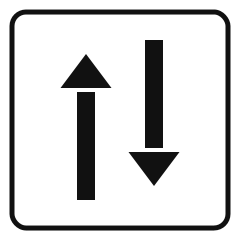
Traffic is moving in both directions
The two-way traffic sign tells you that traffic on this road also travels in the oncoming direction.

Only as fast as is safe for the conditions
A posted limit is the maximum in ideal conditions. Driving at a speed that is unsafe for the conditions is illegal, even if it is under the limit.
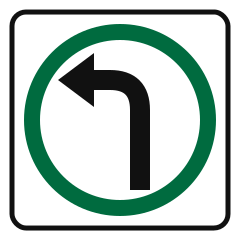
Left turn only
A green circle around a left-turn arrow is a permissive sign: the only movement allowed is a left turn.
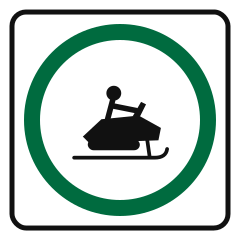
Motorized snow vehicles are allowed
The green circle makes this a permissive route sign: snow vehicles may use this route.

No U-turn
The red circle and slash over a U-shaped arrow prohibits U-turns.

Do not pass
Two vehicles side by side with a red circle and slash is a prohibitive sign: passing is not allowed.
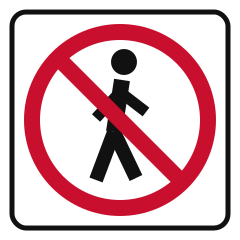
Pedestrians, who are not allowed here
The red circle and slash over a walking figure is a prohibitive access sign: pedestrians may not use this road.
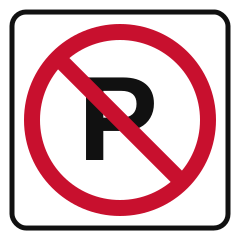
No parking
A letter P inside a red circle with a slash means parking is not allowed where the sign applies.
Warning signs
Practise: Warning signs
A stop sign is ahead
A small red octagon on a yellow diamond warns that you will soon have to stop at a stop sign.
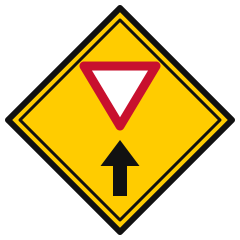
A yield sign is ahead
A small triangle with a red border on a yellow diamond gives advance warning of a yield sign.

Traffic control signals
This advance warning sign shows a traffic light: a signalized intersection is coming, so be ready to stop.

The recommended top speed for the curve
The plate shows the recommended maximum speed through that curve under ideal driving conditions.
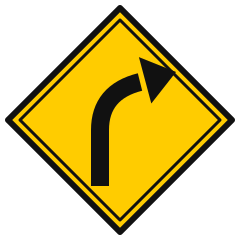
A curve to the right
A yellow diamond with an arrow bending gently to the right warns of a curve to the right ahead.

A winding road ahead
The wavy arrow warns that the road ahead winds through a series of curves.

Animals that may cross the road
Animal crossing signs warn that animals may be on or crossing the road, so slow down and scan ahead.
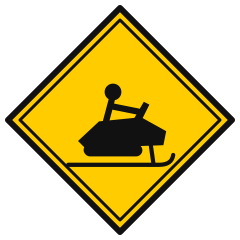
Motorized snow vehicles may cross
A yellow diamond with a snowmobile is a crossing warning: snow vehicles may cross the road here.
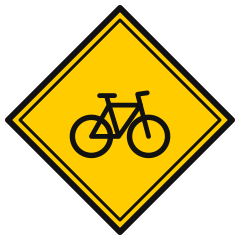
A bicycle crossing ahead
A yellow diamond with a bicycle warns that cyclists may cross the road ahead.
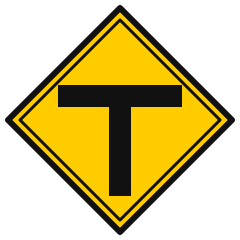
A T intersection ahead
The T shape warns that the road you are on ends at a crossroad and you must turn left or right.
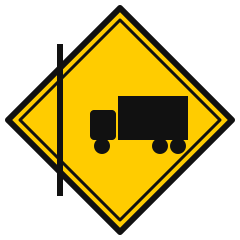
Trucks entering from the right
This intersection warning shows a truck beside a road: trucks may enter the highway from the right.

Traffic merging ahead
A straight line joined by a curved one warns that traffic from another road is merging with yours.

The road narrows ahead
Two lines moving toward each other warn that the road gets narrower ahead.

Be ready to merge left as the lane ends
This sign warns of the loss of the right lane; drivers in that lane must merge safely into the lane to the left.
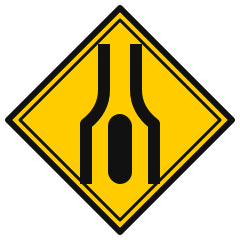
A divided highway ends
Lines coming together after a centre island warn that the divided highway is ending, so expect the median to stop.

A steep hill ahead
A truck on a slope warns of a hill ahead; adjust your speed and gear before going down.

The road may be slippery when wet
A car with wavy tire marks warns that the surface can become slippery when it is wet.

To mark an object near the road
Hazard markers warn of an object on or close to the edge of the road, on the right or the left, so you can steer clear of it.
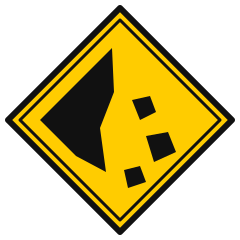
Falling rocks
This sign warns that rocks may fall onto the road from the slope beside it.
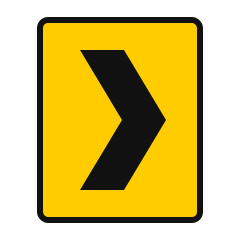
A change in the road's direction
Chevrons mark a change in road alignment, guiding you through a sharp curve or turn.

Two-way traffic ahead
This warning sign tells you that oncoming traffic will soon share the road with you.

A bump in the road
This sign warns of a bump in the road surface, so slow down before you reach it.
Guide, service and construction signs
Practise: Guide, service and construction signs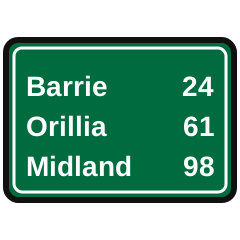
Distances to places ahead
A distance sign lists destinations with the distance to each one, so you can plan your trip.
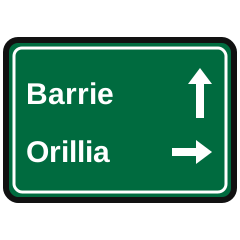
A destination guide sign
Green destination guide signs give the direction to places; arrows show which way to go for each one.

A flag person ahead directing traffic
This construction sign warns of a flag person ahead. You must obey the flag person's signals.

People working on the road ahead
An orange diamond showing a worker means people are working ahead, so slow down and watch for them.

Follow a detour route
A detour sign directs you onto a temporary route around a closed section of road.

It is a slow-moving vehicle
This sign is placed on the back of farm tractors, machinery and construction equipment. Reduce your speed when you see it.
School and playground zones
Practise: School and playground zones
A school is near; drive with extra caution
Without a speed sign, this is a school area warning: a school is nearby and children may be walking or crossing.
FAQ
NWT road signs chart: common questions
How many sign questions are on the NWT learner's test?
Driver and Vehicle Services describes a separate 20-question road signs test taken alongside the 20 rules questions. You may miss no more than four on each, so you need at least 16 of the 20 sign questions right.
What do sign shapes and colours mean in the NWT?
The manual lists a red octagon for stop, a red-bordered triangle for yield, a red circle and slash for something prohibited, a green circle for something permitted, white rectangles for regulations, yellow diamonds for warnings, orange diamonds for construction and green rectangles for directions.
Is this chart the same as the NWT Driver's Manual?
It covers the signs in our question bank, described in our own words with simplified drawings. The full set is in Chapter 2, Traffic Controls, of the NWT Driver's Manual, a free PDF; a printed copy costs $11.55 at Driver and Vehicle offices.
Keep practising
- NWT learner's practice test (printable PDF)100 NWT Class 7 practice questions, signs and rules mixed, with a separate answer key citing the Driver's Manual page. Print it or save it as a PDF. Free.
- NWT Class 7 study guide
- NWT Class 7 Mock Exam 1 – 40 QuestionsTimed practice · 30 minutes · answers explained
- NWT Class 7 Mock Exam 2 – 40 QuestionsTimed practice · 30 minutes · answers explained
- NWT Class 7 Practice Test 140 questions with explanations
- NWT Class 7 Practice Test 240 questions with explanations
- NWT Class 7 Practice Test 340 questions with explanations
Practice by topic
- Regulatory signs and speed limitsSign shapes and colours, stop and yield signs, permissive green-circle and prohibitive red-slash signs, lane-use, parking and stopping signs, and NWT default speed limits.
- Warning signsYellow diamond warning signs for stops and signals ahead, curves, crossings, intersections, merging, narrowing roads, lane endings, divided highways and other road conditions.
- Guide, service and construction signsRoute markers, direction and distance signs, service signs, orange construction signs, doubled fines with workers present, the slow-moving vehicle sign and disabled parking.
- School and playground zonesSchool and playground area versus zone signs, the 30 km/h speed, 24-hour default times, municipal bylaws, no passing and where zones end.
- Traffic lights and signalsLight order, steady and flashing red, amber and green lights, green arrows, turns on red, pedestrian signals and lane control signals.
- Pavement markingsYellow and white lines, broken and solid lines, passing rules, arrows, two-way left-turn lanes, diamonds, railway X markings, painted islands, crosswalks and stop lines.
- Licences, GDL and registrationClass 7 learner conditions, probationary and full stages, licence classes, new residents and visitors, vision and medical rules, exams, renewals, registration and insurance.
- Starting, steering and stoppingPre-drive checks, seat, mirrors, seat belts and head restraints, transmissions, steering, stopping distances, braking technique and backing up.
- ParkingParallel, angle and hill parking, getting in and out of a parked vehicle, and the distances and places where you may not park.
- Intersections and right-of-wayWhere to stop at stop signs, four-way stops, yield signs, traffic circles, controlled and uncontrolled intersections and keeping intersections clear.
- Signalling and turningWhen to signal, hand signals, right and left turns, turning lanes, dual turns, two-way left-turn lanes, U-turns and free-flow lanes.
- Lane driving, passing and mergingLane position, shoulders, blind spots and lane changes, passing lanes, passing on two-lane highways, when passing is illegal, merging, exiting, curves and hills.
- Emergencies, skids and collisionsBreakdowns, brake, steering, tire and headlight failure, emergency braking and ABS, skids, off-road recovery, collision duties and slowing for emergency vehicles.
- Night, weather and animalsHeadlight rules and distances, glare, winter kits, hydroplaning, ice and snow, black ice, smoke and fog, deep water and avoiding animals.
- Defensive and responsible drivingScanning, space cushions, the two-second rule, fatigue, cellphones, child restraints, fuel efficiency, refuelling and other traffic laws.
- Sharing the roadPedestrians, cyclists, motorcycles, large and log-haul vehicles, school buses, emergency vehicles, snowplows, railway crossings, LRT and funeral processions.
- Impaired and distracted drivingZero BAC for new drivers, 50 and 80 mg limits, administrative suspensions, Criminal Code disqualifications, ignition interlock, drugs and distracted-driving penalties.
- Demerit points and suspensionsDemerit thresholds for GDL and fully licensed drivers, interviews, suspension lengths, driver improvement courses, reinstatement and Registrar suspensions.