What is the heaviest total weight of towed vehicles a Class 5 licence allows?
NWT Class 7 overview
NWT Class 7 Practice Test 7
40 questions on licences, gdl and registration, signalling and turning, parking, sharing the road, emergencies, skids and collisions and more.
- No sign-up
- Every answer explained
- Independent · not a government site
- Set 7 of 9
- 40 questions
- Instant feedback
0/40
All 40 questions in this test
Every question and its answer choices. The correct answers and explanations appear when you take the test above.
What is the heaviest total weight of towed vehicles a Class 5 licence allows?
- 2,500 kg gross
- 5,500 kg gross
- 3,500 kg gross
- 4,500 kg gross
You are turning right and a car is parked just around the corner. Which lane do you turn into?
- The curb lane, then go around
- Behind the parked car, then wait for it to move
- The first lane to the left of the parked car
- The centre lane of the road
You park facing uphill on a gravel road with no curb. Which way should your front wheels point?
- To the right, toward the road's edge
- Left, then roll back
- Straight ahead
- To the left, toward the centre
What following distance should you keep behind a log-haul truck?
- At least two seconds
- At least ten seconds
- At least four seconds
- At least six seconds
The brake warning light on your dashboard comes on while you are driving. What should you do?
- Pump the brakes hard
- Pull over as soon as it is safe
- Keep driving and check it later
- Turn the engine off right away
You are on a road that has been one-way. What does this sign warn you about?

- A divided highway begins
- Passing is allowed in both lanes
- Two-way traffic ahead
- Traffic must keep right
How many demerit points does a distracted driving conviction carry in the NWT?
- 3
- 2
- 6
- 4
You are stopped at a red light and want to turn right. No sign prohibits it. What may you do?
- Turn only with a green arrow
- Turn without stopping if the way is clear
- Turn after a full stop, yielding first
- Wait for the green light
What does this sign mean?
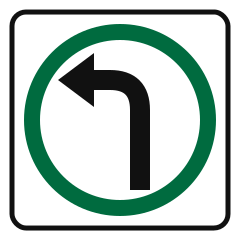
- Sharp curve to the left
- Left lane ends ahead
- No left turn
- Left turn only
What is the legal blood alcohol limit for a Class 7 learner in the NWT?
- Under 20 mg per 100 mL
- Under 50 mg per 100 mL
- Zero
- Under 80 mg per 100 mL
An oncoming vehicle is approaching at night. Within what distance must you switch to low beams?
- 150 m
- 500 m
- 300 m
- 100 m
A sign is a white square with a red circle and a diagonal red slash. What kind of message does it give?
- The action shown is prohibited
- The action shown is permitted
- A hazard is ahead on the road
- Road work is ahead
Your friend wants to ride in the open box of your pickup for a short trip. What does the law say?
- It is fine on gravel roads
- It is fine under 50 km/h
- It is not allowed; both of you can be charged
- It is allowed, but only the rider can be charged
You must drive through deep water on the road. What does the manual suggest doing before you enter it?
- Shift into neutral
- Speed up so you can push through it
- Apply a slight drag on the brakes
- Turn off the engine
How close may you park in front of a stop sign at the side of the road?
- No closer than 5 m
- No closer than 3 m
- No closer than 10 m
- No closer than 15 m
What does this sign mean?

- No left turn
- No U-turn
- Road curves sharply ahead
- U-turn allowed here
A passenger tucks the shoulder belt behind their back because it is uncomfortable. What does the manual say?
- It is fine on short trips
- Do not do it; the belt must cross the chest
- It is fine if the lap belt is on
- It is fine in a car that has front air bags
What does this sign warn you about?
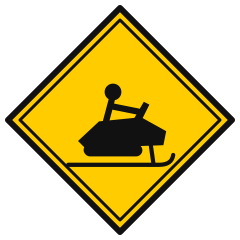
- Snowmobiles are allowed on the road
- Motorized snow vehicles may cross
- Snow-clearing equipment is ahead
- The road is closed in winter
A Class 5P driver piles up tickets until their record shows 15 points. For how long will the Registrar suspend their licence?
- Three months
- Six months
- Two years
- One year
How should you drive through a curve?
- Slow down before it, accelerate slightly in it
- Speed up before it, brake in it
- Keep your full speed and steer smoothly through it
- Brake hard in the middle of it
You turn right onto a street with several lanes. Which lane should you turn into?
- The first available lane on the right
- The lane nearest the centre
- The left lane, then move right
- Any lane that is open
Does a GDL driver charged with an alcohol offence get the 7-day temporary permit?
- Only if they need to drive for work
- Yes, every driver charged gets it
- Yes, but it lasts only 3 days
- No, it does not apply to GDL drivers
A driver has already served three demerit suspensions and reaches 15 points again. What is the longest suspension the Registrar may impose?
- 24 months
- 6 months
- 12 months
- 5 years
What do yellow lines on the road separate?
- Traffic moving in opposite directions
- Traffic moving in the same direction
- Bicycle lanes from car lanes
- Parking lanes from travel lanes
A motorcycle ahead is riding in the left part of its lane. What does that usually mean?
- The rider wants you to pass on the right
- The rider is making themselves more visible
- The rider is about to turn left
- The rider is about to stop
What does "over-driving" your headlights mean?
- Driving too fast to stop within the lit distance
- Driving with dirty headlights
- Using high beams in fog
- Leaving your high beams on during daytime driving
Your right wheels drop off the pavement onto the gravel shoulder. What should you do?
- Steer sharply back onto the road right away
- Ease off the gas and return when it is safe
- Speed up to get back on the road
- Brake hard right away
You see this sign on the back of a vehicle ahead. What does it tell you?

- It is carrying dangerous goods
- It is about to stop
- It is a wide load
- It is a slow-moving vehicle
A 15-year-old is learning to ride a motorcycle on a Class 7. Where may the supervising rider be?
- On the motorcycle or following in another vehicle
- Only standing at the roadside
- Anywhere within one kilometre
- Only on the motorcycle, seated behind as a passenger
On a limited-access highway, what is a weave zone?
- A lane for passing slow vehicles
- A winding section of highway
- A construction zone where the lanes shift over
- Where entering and exiting traffic cross paths
Which of these is unsafe while refuelling?
- Using your cellphone
- Staying by the nozzle
- Placing a gas can on the ground
- Turning the ignition off
You are about to turn left off a two-lane highway. What extra check does the manual recommend?
- Flashing your brake lights
- A look in the inside mirror only
- A quick left shoulder check
- A quick right shoulder check
You and another car arrive at a four-way stop at the same time. The other car is on your right. Who goes first?
- The car turning left
- Whoever signals first
- You do
- The car on your right
During which hours may a Class 7 learner not drive?
- 9:00 p.m. to 5:00 a.m.
- Midnight to 5:00 a.m.
- 11:00 p.m. to 6:00 a.m.
- 10:00 p.m. to 6:00 a.m.
What does a flashing amber light at an intersection require?
- Go with caution after yielding
- Speed up to clear the area
- Stop completely, then go
- Stop and wait for green
Your load sticks out 2 m past the back of your truck in daylight. What is required?
- A red flag at least 30 cm square
- A red light only
- Nothing under 3 m
- A yellow flag at least 15 cm square
Your steering wheel has an air bag. How far back from it does Transport Canada recommend you sit?
- At least 10 cm
- At least 15 cm
- At least 25 cm
- At least 50 cm
What does this sign warn you about?

- A parade route ahead
- A school crossing guard is just ahead
- A border crossing ahead
- A flag person ahead directing traffic
What makes up total stopping distance?
- Following distance and braking distance
- Braking distance only
- Reaction and braking distance only
- Perception, reaction and braking distance
You reach an intersection with no signs or signals. Another car is coming from your right. Who should yield?
- You should yield to the car on your right
- The car on your right yields to you
- Whoever is going faster
- The car turning left
All NWT Class 7 practice tests
- NWT Class 7 Mock Exam 1 – 40 QuestionsTimed practice · 30 minutes · answers explained
- NWT Class 7 Mock Exam 2 – 40 QuestionsTimed practice · 30 minutes · answers explained
- NWT Class 7 Mock Exam 3 – 40 QuestionsTimed practice · 30 minutes · answers explained
- NWT Class 7 Mock Exam 4 – 40 QuestionsTimed practice · 30 minutes · answers explained
- NWT Class 7 Mock Exam 5 – 40 QuestionsTimed practice · 30 minutes · answers explained
- Regulatory signs and speed limitsSign shapes and colours, stop and yield signs, permissive green-circle and prohibitive red-slash signs, lane-use, parking and stopping signs, and NWT default speed limits.
- Warning signsYellow diamond warning signs for stops and signals ahead, curves, crossings, intersections, merging, narrowing roads, lane endings, divided highways and other road conditions.
- Guide, service and construction signsRoute markers, direction and distance signs, service signs, orange construction signs, doubled fines with workers present, the slow-moving vehicle sign and disabled parking.
- School and playground zonesSchool and playground area versus zone signs, the 30 km/h speed, 24-hour default times, municipal bylaws, no passing and where zones end.
- Traffic lights and signalsLight order, steady and flashing red, amber and green lights, green arrows, turns on red, pedestrian signals and lane control signals.
About this practice test
How many questions are in NWT Class 7 practice test 7?
40 original multiple-choice practice questions covering licences, gdl and registration, signalling and turning, parking, sharing the road, emergencies, skids and collisions, warning signs, impaired and distracted driving, traffic lights and signals, regulatory signs and speed limits, night, weather and animals, defensive and responsible driving, starting, steering and stopping, demerit points and suspensions, lane driving, passing and merging, pavement markings, guide, service and construction signs, intersections and right-of-way. Each answer includes an explanation. This mixed practice set does not reproduce the official exam format or predict an official score.
Are the questions the same every time?
Yes. Practice test 7 always has the same 40 questions, so you can repeat it until you get them all right. The other 8 sets use different questions.
Are these real test questions?
No. The official question bank is not published. These are original questions written from the official handbook, which is what the real NWT Class 7 test is based on.