What do you need to move from a Class 7 to a Class 5P probationary licence?
NWT Class 7 overview
NWT Class 7 Mock Exam 5
Same format as the real test. Answers stay hidden until you submit.
- No sign-up
- Every answer explained
- Independent · not a government site
- 40 questions
- 30 min
- Pass mark 16/20 per section
0/40
All 40 questions in this test
Every question and its answer choices. The correct answers and explanations appear when you take the test above.
What do you need to move from a Class 7 to a Class 5P probationary licence?
- Be 16 and pass a second knowledge test
- Be 15, finish 6 months as a learner, pass a written test
- Be 16, finish 12 months as a learner, pass the road test
- Be 17, finish 24 months as a learner, pass a medical
What does a chevron sign like this one indicate?
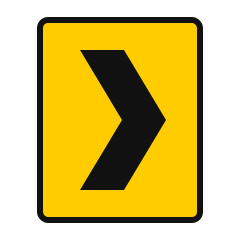
- A change in the road's direction
- A one-way road
- A passing lane is coming up ahead
- An exit lane
You see diamond shapes painted in a lane. What do they mean?
- Pedestrians cross here
- The lane is closed ahead for road repairs
- A railway crossing is ahead
- The lane is reserved for certain vehicles
What is this tall striped sign used for?

- To warn of a school crossing
- To mark the end of a road
- To show where a detour starts
- To mark an object near the road
You are stopped behind a large truck on a hill. Why leave extra space in front of you?
- Trucks must stop at every hill
- Its exhaust is dangerous
- It may roll back when it starts
- It needs room to back up
Flashing amber lights are mounted with a school zone sign. What does the manual say you must do?
- Slow down only if children are near the road
- Stop, then go when the lights stop
- Reduce to the posted speed and yield to pedestrians
- Keep your speed but sound your horn
What is the centre lane of a two-way left-turn lane reserved for?
- Buses and taxis
- Left turns from either direction
- Passing slow traffic
- Emergency vehicles and police only
A large X is painted on the road ahead of you. What is it warning about?
- An intersection with no signs
- A school crossing ahead
- A railway crossing ahead
- A lane closure ahead
A no parking sign has an arrow under the symbol. What does the arrow show?
- Where parking is not allowed
- Which way traffic flows
- Which side has free parking
- Where the nearest lot is
You face a steady green arrow pointing straight ahead. What may you do?
- Turn in any direction
- Turn right or go straight
- Turn left after yielding
- Go straight only
What does the speed plate under this curve sign tell you?

- The recommended top speed for the curve
- The new speed limit for the highway
- The speed for trucks only
- The minimum speed through the curve
Which of these is NOT allowed for a Class 5P probationary driver?
- Carrying a passenger in the back seat
- Driving after 11:00 p.m.
- Supervising a Class 7 learner
- Driving on a primary highway
A Class 5P driver's licence is suspended for reaching 6 demerit points. What else happens to their GDL stage?
- They stay in it one extra month
- They move back to Class 7
- Nothing else changes
- They restart the stage from zero
You are about to go down a very steep hill. What should you do first?
- Turn on your high beams
- Speed up to keep momentum
- Shift to neutral and coast down the hill
- Slow down and shift to a lower gear
You are turning right and a car is parked just around the corner. Which lane do you turn into?
- The curb lane, then go around
- Behind the parked car, then wait for it to move
- The first lane to the left of the parked car
- The centre lane of the road
You see an added lane (free flow) sign where two roads join. What does it mean for you?
- No stopping, yielding or merging is needed
- You must yield to traffic on the left
- You must stop before joining
- You must merge within 100 m
Vehicles displaying the slow-moving vehicle sign are designed to travel at speeds below what?
- 60 km/h
- 40 km/h
- 30 km/h
- 50 km/h
What speed is good practice when backing up?
- About 20 km/h
- About normal walking speed
- As fast as is comfortable
- About 30 km/h
You have a steady green light and want to turn left. What must you do?
- Sound your horn and turn
- Wait for the light to turn amber
- Yield to vehicles and people lawfully in the intersection
- Turn first, since the green light gives you the right of way
After moving to the NWT, how long do you have to register your vehicle?
- 14 days
- 30 days
- 60 days
- 90 days
A peace officer stops you and asks for proof of insurance. What do you show?
- Your pink financial responsibility card
- Your registration renewal notice
- Your driver's abstract
- Your bill of sale
The brake warning light on your dashboard comes on while you are driving. What should you do?
- Pump the brakes hard
- Pull over as soon as it is safe
- Keep driving and check it later
- Turn the engine off right away
What does this sign give you?
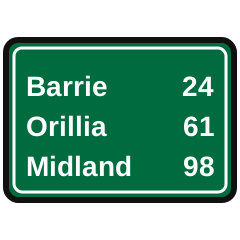
- Exit numbers for each town
- Directions to services
- Distances to places ahead
- Speed limits for each town
What does this sign warn of?
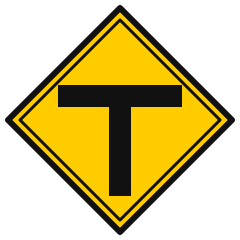
- A side road on the right
- A Y intersection ahead
- A dead end ahead
- A T intersection ahead
What does "over-driving" your headlights mean?
- Driving too fast to stop within the lit distance
- Driving with dirty headlights
- Using high beams in fog
- Leaving your high beams on during daytime driving
How should an adjustable head restraint be set?
- Its centre level with the back of your neck
- Its top level with your chin
- As low as it will go
- Its centre level with the top of your ears
Where are lane control signals most often used?
- On reversible lanes
- At four-way stops
- At railway crossings
- In school zones
What must happen to your licence from another jurisdiction before you get an NWT licence?
- It must be renewed first
- You must surrender it
- You may keep both licences
- It must be translated
You are on a rural two-lane highway with a broken yellow centre line. What does it tell you?
- Passing is never allowed here
- You must pass within 10 seconds
- Only trucks may pass here
- There is enough sight distance to pass
A 21-year-old with a full Class 5 licence has one beer and drives. What happens if police find alcohol in their system?
- Nothing; the limit is 50 mg
- A warning letter only
- An automatic 30-day suspension
- A 7-day temporary permit
Which of these is unsafe while refuelling?
- Using your cellphone
- Staying by the nozzle
- Placing a gas can on the ground
- Turning the ignition off
You face a red light together with a flashing green arrow pointing left. What may you do?
- Wait until the red light changes
- Turn left without stopping, but yield if needed
- Go straight or turn left
- Stop fully, then turn left only once the way is clear
Smoke from a forest fire makes it unsafe to keep driving. What should you do?
- Pull well off the road and use four-way flashers
- Stop in your lane with lights on
- Follow the taillights of the vehicle ahead closely
- Speed up to get through it
Unless posted otherwise, what is the speed limit in a playground zone?
- 40 km/h
- 50 km/h
- 30 km/h
- 20 km/h
On a rural highway, about how far ahead should you scan?
- About 12 seconds
- About 60 seconds
- About 25 seconds
- About 5 seconds
A railway crossing has a stop sign. How far from the nearest rail must you stop?
- Right at the rail
- Between 2 m and 5 m
- Between 10 m and 30 m
- Between 5 m and 15 m
What does this regulatory sign indicate?
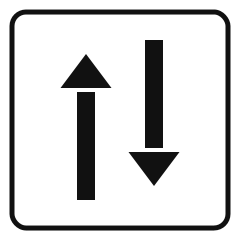
- The road ahead is one way
- You may pass in either lane
- Traffic must merge into one lane
- Traffic is moving in both directions
On a rural highway the centre line is solid yellow on your side. May you pass the slow vehicle ahead?
- Yes, if you stay under the limit
- Yes, but only during daylight
- Yes, if the road ahead looks clear
- No, passing is not allowed
A driver is charged with having a BAC over .08. What happens to their licence under NWT law?
- An automatic 90-day suspension
- A 24-hour suspension
- Nothing until convicted
- An automatic 30-day suspension
What does this sign warn of?
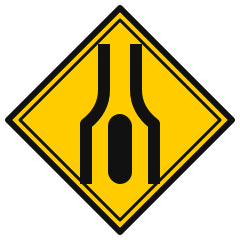
- The road narrows on both sides
- A divided highway begins
- A painted island ahead
- A divided highway ends
Keep practising
- NWT Class 7 Mock Exam 1 – 40 QuestionsTimed practice · 30 minutes · answers explained
- NWT Class 7 Mock Exam 2 – 40 QuestionsTimed practice · 30 minutes · answers explained
- NWT Class 7 Mock Exam 3 – 40 QuestionsTimed practice · 30 minutes · answers explained
- NWT Class 7 Mock Exam 4 – 40 QuestionsTimed practice · 30 minutes · answers explained
- NWT Class 7 Practice Test 140 questions with explanations
- NWT Class 7 Practice Test 240 questions with explanations
- NWT Class 7 Practice Test 340 questions with explanations
- NWT Class 7 Practice Test 440 questions with explanations