You see an orange diamond sign that says road construction is ahead. What should you be ready to do?
NWT Class 7 overview
NWT Class 7 Mock Exam 2
Same format as the real test. Answers stay hidden until you submit.
- No sign-up
- Every answer explained
- Independent · not a government site
- 40 questions
- 30 min
- Pass mark 16/20 per section
0/40
All 40 questions in this test
Every question and its answer choices. The correct answers and explanations appear when you take the test above.
You see an orange diamond sign that says road construction is ahead. What should you be ready to do?
- Change lanes right away
- Turn on your high beams
- Slow down and stop if required
- Speed up to clear the area
You drive through a construction zone on a Sunday and no workers or machines are there. What speed must you obey?
- The posted construction zone limit
- Any safe speed you choose
- The normal highway limit
- The limit only applies on weekdays
Your vehicle develops a mechanical problem on the highway. What should you do?
- Keep driving until it stops
- Stop in your lane and wait there for help to come
- Stop on the nearest bridge
- Move safely off the road and use hazard lights
You park facing uphill on a gravel road with no curb. Which way should your front wheels point?
- To the right, toward the road's edge
- Left, then roll back
- Straight ahead
- To the left, toward the centre
At an intersection you see a solid white line painted across your lane. What does it show?
- Where parking is allowed
- Where vehicles must stop
- Where passing ends
- Where pedestrians must wait
A white square sign has a green circle around a symbol. What does the green circle tell you?
- The action shown is permitted
- The action shown is prohibited
- A school is close by
- The action is allowed only at night
You run into a store and leave your car running with the doors unlocked. Is that legal in the NWT?
- Yes, if it is in park
- No, it is illegal
- Yes, in winter only
- Yes, for under five minutes
What does this sign warn of?
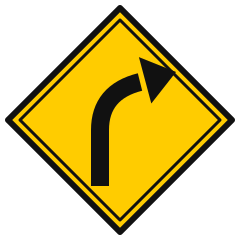
- The right lane ends
- A road joins from the right
- A curve to the right
- A right turn is required
When may you turn left on a red light in the NWT?
- Only when a green arrow is also lit
- From a two-way street onto a one-way street, after stopping
- From any street when no traffic is coming
- From a one-way street onto a one-way street, after stopping
What does this sign warn of?

- A runaway lane ahead
- A steep hill ahead
- Trucks entering the road
- A truck route
You must swerve suddenly to avoid something in your lane. Which way should you go if possible?
- To the right
- Into the oncoming lane
- To the left
- Straight ahead while braking
After moving to the NWT, how long do you have to register your vehicle?
- 14 days
- 30 days
- 60 days
- 90 days
You are in a school zone while it is in effect and a slow car is ahead of you in your lane. May you pass it?
- No, passing is not allowed in the zone
- Yes, if the line is broken
- Yes, if you stay under 30 km/h
- Yes, if no children are in sight
A stop sign has no stop line, but there is a marked crosswalk. Where must you stop?
- Just past the crosswalk
- Before the marked crosswalk
- Inside the crosswalk
- Even with the stop sign
You are on a road that has been one-way. What does this sign warn you about?

- A divided highway begins
- Passing is allowed in both lanes
- Two-way traffic ahead
- Traffic must keep right
You are on a rural two-lane highway with a broken yellow centre line. What does it tell you?
- Passing is never allowed here
- You must pass within 10 seconds
- Only trucks may pass here
- There is enough sight distance to pass
You are backing out of a driveway onto a two-lane street. How far may you back?
- Into any lane with no traffic
- Only into the nearest lane
- Across both lanes if clear
- To the far curb
A sign is a white square with a red circle and a diagonal red slash. What kind of message does it give?
- The action shown is prohibited
- The action shown is permitted
- A hazard is ahead on the road
- Road work is ahead
The power steering fails while you are driving. What happens?
- You can still steer, but it takes more effort
- The steering wheel locks up completely in place
- The vehicle stops automatically
- The wheels turn by themselves
What do yellow lines on the road separate?
- Traffic moving in opposite directions
- Traffic moving in the same direction
- Bicycle lanes from car lanes
- Parking lanes from travel lanes
You are in a lane marked by a designated lane sign with a left-turn arrow only. What must you do?
- Turn left as the arrow shows
- Go straight if the road is clear
- Turn either way after signalling
- Change lanes inside the intersection
You are about to turn left off a two-lane highway. What extra check does the manual recommend?
- Flashing your brake lights
- A look in the inside mirror only
- A quick left shoulder check
- A quick right shoulder check
According to the manual's chart, about how far does it take to stop from 100 km/h on dry pavement?
- About 76 m
- About 108 m
- About 126 m
- About 66 m
Your friend wants to ride in the open box of your pickup for a short trip. What does the law say?
- It is fine on gravel roads
- It is fine under 50 km/h
- It is not allowed; both of you can be charged
- It is allowed, but only the rider can be charged
Can you appeal a demerit point suspension in the NWT?
- No, never
- Only if the points were assigned in error
- Yes, always within 90 days
- Yes, if you need to drive for work
How long is the suspension for a GDL driver who reaches 12 or more demerit points?
- Six months
- One year
- One month
- Three months
You are leaving a parking lot onto a main street and there is no sign. What must you do?
- Stop before the sidewalk and yield
- Sound your horn and pull out
- Stop only if a car is coming
- Slow down and merge into traffic
A cyclist gets off and walks their bicycle across the street. How does the law treat them?
- As an obstruction
- As a cyclist with right-of-way
- As a vehicle
- As a pedestrian
A truck ahead displays an over-dimensional load sign. What should you keep in mind?
- It has the right-of-way everywhere
- You must not pass it at all
- Use caution if you pass it
- It must travel in the left lane
Which of these is unsafe while refuelling?
- Using your cellphone
- Staying by the nozzle
- Placing a gas can on the ground
- Turning the ignition off
A court gives a 3-month driving prohibition and the NWT suspension is one year. How long is left after the court prohibition ends?
- One year
- Nine months
- Three months
- None
You see this sign on a two-lane road. What should you do?

- Move right to make room for passing
- Be ready to merge left as the lane ends
- Stop and wait for a gap
- Speed up to pass before the merge
Where are lane control signals most often used?
- On reversible lanes
- At four-way stops
- At railway crossings
- In school zones
Entering an angle parking space on the right, how far should you stay from the rear of the parked vehicles?
- At least 0.5 m
- At least 3 m
- At least 5 m
- At least 1.5 m
When may a vehicle park or stop in a stall reserved for persons with disabilities?
- When it stops for under five minutes
- When the driver stays in the vehicle
- When it displays the placard or licence plate
- When every other stall is full
Flashing amber lights are mounted with a school zone sign. What does the manual say you must do?
- Slow down only if children are near the road
- Stop, then go when the lights stop
- Reduce to the posted speed and yield to pedestrians
- Keep your speed but sound your horn
You face a double red light. How should you treat it?
- As a flashing red light
- As a red light for trucks only
- The same as a single red light
- As a sign that the signal is broken
What does this sign warn of?

- Rumble strips on the shoulder
- A bump in the road
- A railway crossing
- A hill ahead
Your car has broken down and a stranger stops and offers you a ride. What does the manual advise?
- Let your passengers go with them
- Accept the ride to the next town
- Ride along if they seem friendly
- Ask them to call for help instead
In an NWT traffic circle, two vehicles are side by side in the circle. Which one must yield?
- The vehicle on the right
- The vehicle on the left
- Neither; they go together
- The vehicle that entered last
Keep practising
- NWT Class 7 Mock Exam 1 – 40 QuestionsTimed practice · 30 minutes · answers explained
- NWT Class 7 Mock Exam 3 – 40 QuestionsTimed practice · 30 minutes · answers explained
- NWT Class 7 Mock Exam 4 – 40 QuestionsTimed practice · 30 minutes · answers explained
- NWT Class 7 Mock Exam 5 – 40 QuestionsTimed practice · 30 minutes · answers explained
- NWT Class 7 Practice Test 140 questions with explanations
- NWT Class 7 Practice Test 240 questions with explanations
- NWT Class 7 Practice Test 340 questions with explanations
- NWT Class 7 Practice Test 440 questions with explanations