Who must you obey at all times near a school?
NWT Class 7 overview
NWT Class 7 Practice Test 4
40 questions on school and playground zones, emergencies, skids and collisions, demerit points and suspensions, guide, service and construction signs, traffic lights and signals and more.
- No sign-up
- Every answer explained
- Independent · not a government site
- Set 4 of 9
- 40 questions
- Instant feedback
0/40
All 40 questions in this test
Every question and its answer choices. The correct answers and explanations appear when you take the test above.
Who must you obey at all times near a school?
- School patrols
- Teachers on the sidewalk
- Parents waiting at the curb
- Older students crossing
Your car begins to skid. What does the manual say to do with your feet and hands?
- Brake hard and hold the wheel straight
- Keep off the brake; steer where you want to go
- Brake hard and steer into the ditch
- Accelerate and steer away from the skid
How are demerit suspension notices sent in the NWT?
- By registered or certified mail
- By text message to your phone
- By email to your address on file
- In person from an RCMP officer
What is the main job of green information and guide signs?
- To warn of hazards on the road
- To mark construction zones
- To help you choose a route and find places
- To state traffic laws you must obey
When may you turn left on a red light in the NWT?
- Only when a green arrow is also lit
- From a two-way street onto a one-way street, after stopping
- From any street when no traffic is coming
- From a one-way street onto a one-way street, after stopping
What does a solid white line between lanes mean?
- Lane changes are allowed
- Do not change lanes
- Passing on the left is allowed
- The road is one way
In a city, town or village, where are you not allowed to back a vehicle?
- Into a marked parking stall on a street
- Into an intersection or crosswalk
- Into a garage
- Out of a driveway
What is the disqualification for a third impaired driving conviction within 10 years?
- Three years
- Five years
- Ten years
- Life
What minimum following distance should drivers of large commercial vehicles use in traffic?
- Two seconds
- Three seconds
- Four seconds
- Six seconds
What do white lane lines separate?
- Passing zones from no-passing zones
- Railway tracks from the road
- Traffic moving in the same direction
- Traffic moving in opposite directions
A stop sign has no stop line, but there is a marked crosswalk. Where must you stop?
- Just past the crosswalk
- Before the marked crosswalk
- Inside the crosswalk
- Even with the stop sign
What does this sign give you?
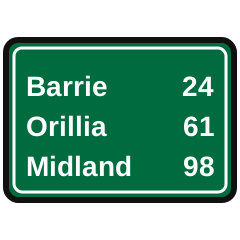
- Exit numbers for each town
- Directions to services
- Distances to places ahead
- Speed limits for each town
You see this sign before a median. What does it mean?

- The road narrows to one lane
- A divider is ahead, keep to the right
- Turn right at the next corner
- Passing on the right is allowed
A four-year-old weighs 16 kg. What must they ride in?
- A child safety seat
- Any rear seat position
- A seat belt alone
- A booster seat or seat belt
As you approach a green light, the pedestrian signal changes from walk to don't walk. What does that suggest?
- Pedestrians have the right-of-way
- You must stop immediately
- The light will stay green longer
- The light may soon turn amber
You are passing a slow truck on a two-lane highway posted at 90 km/h. How fast may you go while passing?
- Up to 110 km/h briefly
- As fast as needed to finish
- No faster than 90 km/h
- Up to 100 km/h briefly
Your car breaks down on a rural primary highway and you must leave it on the shoulder. What else must be true?
- It must be visible for 30 m both ways
- It must have its engine running
- It must be visible for 60 m both ways
- It must be more than 3 m from the road
What can happen if you drive while under an administrative licence suspension?
- 5 demerits and a 30-day vehicle seizure
- 3 demerits and a warning
- A 7-day vehicle seizure and no demerits
- A $100 fine only
Is it legal to put an automatic transmission in neutral and coast down a long hill?
- Yes, under 50 km/h
- No, it is illegal and unsafe
- Yes, if the road is dry
- Yes, it saves fuel
According to the manual's chart, about how far does it take to stop from 100 km/h on dry pavement?
- About 76 m
- About 108 m
- About 126 m
- About 66 m
Your vehicle stalls on a railway crossing and a train is coming. What should you do?
- Get everyone out and move away from the track
- Stay inside with seat belts on
- Try to restart the engine
- Push the vehicle off the tracks as fast as you can
How far ahead of your licence expiry is a renewal notice sent?
- 30 days
- 45 days
- 14 days
- 90 days
Your turn signal did not switch off after a turn. What should you do?
- Signal the other way
- Switch on your hazard lights
- Turn it off yourself
- Leave it, it will reset
Can you appeal a demerit point suspension in the NWT?
- No, never
- Only if the points were assigned in error
- Yes, always within 90 days
- Yes, if you need to drive for work
You sell your car in the NWT. What happens to the licence plates?
- They are returned to the dealer
- They are destroyed
- They go with the car
- They stay with you
In an NWT traffic circle, two vehicles are side by side in the circle. Which one must yield?
- The vehicle on the right
- The vehicle on the left
- Neither; they go together
- The vehicle that entered last
You must swerve suddenly to avoid something in your lane. Which way should you go if possible?
- To the right
- Into the oncoming lane
- To the left
- Straight ahead while braking
Which action counts as using a restricted electronic device?
- Phone stored in a closed glovebox
- Holding your phone, even without talking
- Phone left at home
- Phone switched off in a bag
You see this sign on a two-lane road. What should you do?

- Move right to make room for passing
- Be ready to merge left as the lane ends
- Stop and wait for a gap
- Speed up to pass before the merge
What do brown or blue square signs usually show?
- Direction and distance
- Roadside facilities
- Construction zones
- Lane use rules
An animal suddenly appears in front of you. What should you avoid?
- Slamming on your brakes
- Checking oncoming traffic
- Looking for a way around
- Slowing down
Flashing amber lights are mounted with a school zone sign. What does the manual say you must do?
- Slow down only if children are near the road
- Stop, then go when the lights stop
- Reduce to the posted speed and yield to pedestrians
- Keep your speed but sound your horn
You see an added lane (free flow) sign where two roads join. What does it mean for you?
- No stopping, yielding or merging is needed
- You must yield to traffic on the left
- You must stop before joining
- You must merge within 100 m
What is this tall striped sign used for?

- To warn of a school crossing
- To mark the end of a road
- To show where a detour starts
- To mark an object near the road
You are following another vehicle at night. Within what distance should you use low beams?
- 150 m
- 50 m
- 500 m
- 300 m
You are behind a large truck and cannot see either of its side mirrors. What does that mean?
- The truck driver can see you
- You should pass immediately
- You are too close
- You are in a safe position
You back into a parking meter and cause $300 of damage. Must you report it to police?
- No, only injuries are reported
- Yes, damage to public property must be reported
- No, since the damage is under the $2,000 threshold
- Only if a witness saw it
You park facing downhill on the right side of the road. Which way do you turn your front wheels?
- To the right
- Left if there is no curb
- Straight ahead
- To the left
You are stranded in your vehicle during a winter storm. What does the manual generally advise?
- Leave the vehicle and stand on the road
- Run the engine non-stop with windows shut
- Stay with the vehicle and keep it ventilated
- Walk to the nearest town for help
What does this sign tell you?

- Traffic may move only in the arrow's direction
- A sharp curve to the right is ahead
- You must turn right at the very next intersection
- Traffic merges from the right
All NWT Class 7 practice tests
- NWT Class 7 Mock Exam 1 – 40 QuestionsTimed practice · 30 minutes · answers explained
- NWT Class 7 Mock Exam 2 – 40 QuestionsTimed practice · 30 minutes · answers explained
- NWT Class 7 Mock Exam 3 – 40 QuestionsTimed practice · 30 minutes · answers explained
- NWT Class 7 Mock Exam 4 – 40 QuestionsTimed practice · 30 minutes · answers explained
- NWT Class 7 Mock Exam 5 – 40 QuestionsTimed practice · 30 minutes · answers explained
- Regulatory signs and speed limitsSign shapes and colours, stop and yield signs, permissive green-circle and prohibitive red-slash signs, lane-use, parking and stopping signs, and NWT default speed limits.
- Warning signsYellow diamond warning signs for stops and signals ahead, curves, crossings, intersections, merging, narrowing roads, lane endings, divided highways and other road conditions.
- Guide, service and construction signsRoute markers, direction and distance signs, service signs, orange construction signs, doubled fines with workers present, the slow-moving vehicle sign and disabled parking.
- School and playground zonesSchool and playground area versus zone signs, the 30 km/h speed, 24-hour default times, municipal bylaws, no passing and where zones end.
- Traffic lights and signalsLight order, steady and flashing red, amber and green lights, green arrows, turns on red, pedestrian signals and lane control signals.
About this practice test
How many questions are in NWT Class 7 practice test 4?
40 original multiple-choice practice questions covering school and playground zones, emergencies, skids and collisions, demerit points and suspensions, guide, service and construction signs, traffic lights and signals, pavement markings, starting, steering and stopping, impaired and distracted driving, defensive and responsible driving, intersections and right-of-way, regulatory signs and speed limits, lane driving, passing and merging, parking, sharing the road, licences, gdl and registration, signalling and turning, warning signs, night, weather and animals. Each answer includes an explanation. This mixed practice set does not reproduce the official exam format or predict an official score.
Are the questions the same every time?
Yes. Practice test 4 always has the same 40 questions, so you can repeat it until you get them all right. The other 8 sets use different questions.
Are these real test questions?
No. The official question bank is not published. These are original questions written from the official handbook, which is what the real NWT Class 7 test is based on.