On a highway with marked lanes, where should you position your vehicle?
NWT Class 7 overview
NWT Class 7 Practice Test 2
40 questions on lane driving, passing and merging, guide, service and construction signs, signalling and turning, school and playground zones, intersections and right-of-way and more.
- No sign-up
- Every answer explained
- Independent · not a government site
- Set 2 of 9
- 40 questions
- Instant feedback
0/40
All 40 questions in this test
Every question and its answer choices. The correct answers and explanations appear when you take the test above.
On a highway with marked lanes, where should you position your vehicle?
- Close to the right edge of your lane, near the shoulder
- Close to the left line of your lane
- Straddling two lanes for visibility
- As close as practical to the centre of your lane
What does this sign warn of?

- A pedestrian crossing ahead
- A playground beside the road
- A survey crew ahead
- People working on the road ahead
How far before an intersection should you be in the proper lane for a turn?
- At least 5 m
- At least 30 m
- At least 15 m
- At least 50 m
What is the difference between a playground area sign and a playground zone sign?
- An area sign has a speed sign on its post
- A zone sign has a speed sign on its post
- A zone sign is used only near schools
- An area sign applies only on weekends
How are intersections in a parking lot treated, unless there is a sign?
- As four-way stops
- As yield intersections
- As private property with no rules
- As uncontrolled intersections
About how long is the average driver's reaction time, moving the foot from gas to brake?
- 3/4 of a second
- 3 seconds
- 1/4 of a second
- 2 seconds
Your turn signal lights are not working. What may you do?
- Turn without signalling
- Turn on your hazard lights
- Flash your headlights
- Use the proper hand signal
A large X is painted on the road ahead of you. What is it warning about?
- An intersection with no signs
- A school crossing ahead
- A railway crossing ahead
- A lane closure ahead
You are backing out of a driveway onto a two-lane street. How far may you back?
- Into any lane with no traffic
- Only into the nearest lane
- Across both lanes if clear
- To the far curb
A driver is convicted of impaired driving under the Criminal Code. What is the shortest driving prohibition?
- Two years
- One year
- Six months
- Three months
You see an orange diamond-shaped sign ahead. What should you expect?
- Construction ahead
- A roadside service area
- A permitted turn
- A school zone
An international tourist from a country without reciprocity has a valid home licence and an international driving permit. How long may they drive in the NWT?
- Up to 6 months
- Up to 12 months
- Up to 30 days
- Up to 90 days
Your tires start to lose traction as you enter a left-hand curve. What does the manual advise?
- Brake firmly and hold the steering wheel straight
- Steer hard to the right shoulder
- Steer slightly toward, but not over, the centre
- Steer over the centre line
You face a flashing green light. Opposing traffic has a red. What must you still do?
- Yield to pedestrians and vehicles in the intersection
- Nothing, since the flashing green gives you full right-of-way
- Stop before going straight
- Turn right only
What should you do as you leave a traffic circle?
- Use your right turn signal
- Use your hazard lights
- Signal only if traffic is behind you
- Use your left turn signal
How should you get into a car that is parallel parked on a street?
- Enter from the passenger side always
- Approach from the front, facing traffic
- Approach from behind, back to traffic
- Open the door wide and wait
How close may you park to the near side of a marked crosswalk?
- No closer than 9 m
- No closer than 5 m
- No closer than 6 m
- No closer than 3 m
It is daytime, but heavy snow means you cannot clearly see 150 m ahead. What must you do?
- Use only your daytime running lights
- Turn on your hazard lights only
- Keep your lights off until dark
- Turn on your headlights
What kind of sign is this?
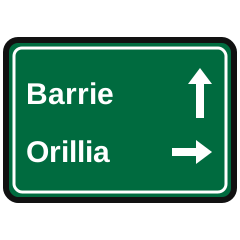
- A detour sign
- A highway lane control sign
- A destination guide sign
- A route marker
Your suspension term is over. What must you still do before you can drive?
- Nothing; your licence is reinstated automatically by mail
- Mail in your old licence
- Take a new knowledge test
- Pay a fee at an office and prove you met the conditions
You have started a new prescription medicine. What should you do before driving?
- Learn how it affects you; ask your doctor or pharmacist
- Take a double dose to be safe
- Drive normally, since prescribed drugs are legal to use
- Drink coffee to stay alert
How many passengers may a Class 5P driver carry in the front seat?
- None
- As many as there are seats
- Two
- No more than one
A long train has just cleared the crossing and the lights are still flashing. What should you watch for?
- The train backing up
- Pedestrians running across
- A second train on another track
- The gates closing again
About how far may a train need to stop under full emergency braking?
- About 50 metres
- About 100 metres
- A kilometre or more
- About 300 metres
Frost covers most of your windshield. May you drive if you can see through a small patch?
- No, it is illegal with an obstructed windshield
- Yes, if the side windows are fully clear of frost
- Yes, if you drive slowly
- Yes, on short trips only
Your licence expires while you are under suspension. What happens to the suspension?
- It becomes a warning
- It remains in effect
- It is cut in half
- It ends when the licence expires
You see diamond shapes painted in a lane. What do they mean?
- Pedestrians cross here
- The lane is closed ahead for road repairs
- A railway crossing is ahead
- The lane is reserved for certain vehicles
How do you measure your following distance?
- Count car lengths between you
- Count seconds after the car ahead passes a fixed object
- Watch the other car's brake lights
- Estimate the gap in metres based on how fast you are going
The power steering fails while you are driving. What happens?
- You can still steer, but it takes more effort
- The steering wheel locks up completely in place
- The vehicle stops automatically
- The wheels turn by themselves
A white square sign has a green circle around a symbol. What does the green circle tell you?
- The action shown is permitted
- The action shown is prohibited
- A school is close by
- The action is allowed only at night
In town, a pedestrian at the curb raises an arm and points to the other side of the street. What does it mean?
- They want you to sound your horn as you drive by
- They are waving you through
- They intend to cross; you must stop and let them
- They are asking for a ride
Your vehicle develops a mechanical problem on the highway. What should you do?
- Keep driving until it stops
- Stop in your lane and wait there for help to come
- Stop on the nearest bridge
- Move safely off the road and use hazard lights
What does the speed plate under this curve sign tell you?

- The recommended top speed for the curve
- The new speed limit for the highway
- The speed for trucks only
- The minimum speed through the curve
You see this sign on a northern highway. What should you watch for?

- A hunting area beside the road
- A wildlife viewing area
- Animals that may cross the road
- A park entrance ahead
What licence suspension range does the manual list for using a restricted electronic device while driving?
- 24 hours to 30 days
- 1 to 7 days
- 30 to 90 days
- 6 months to 1 year
You are leaving a parking lot onto a main street and there is no sign. What must you do?
- Stop before the sidewalk and yield
- Sound your horn and pull out
- Stop only if a car is coming
- Slow down and merge into traffic
A fully licensed driver reaches 13 demerit points. What must they do?
- Complete an interview with a driver examiner
- Retake the road test
- Nothing until they reach 15
- Serve an automatic 30-day licence suspension
What does this sign warn you about?

- A traffic signal is ahead
- A four-way stop is behind you
- A school bus stop is ahead
- A stop sign is ahead
Where does a school zone end?
- At the far edge of the school grounds, in either direction
- One block past the last crosswalk
- Wherever you no longer see children
- At a sign showing a higher speed or the zone's end
A pedestrian began crossing on a walk signal, and the signal changes to don't walk. What may the pedestrian do?
- Return to the starting curb
- Finish crossing
- Wait for traffic to stop
- Stop in the middle of the road
All NWT Class 7 practice tests
- NWT Class 7 Mock Exam 1 – 40 QuestionsTimed practice · 30 minutes · answers explained
- NWT Class 7 Mock Exam 2 – 40 QuestionsTimed practice · 30 minutes · answers explained
- NWT Class 7 Mock Exam 3 – 40 QuestionsTimed practice · 30 minutes · answers explained
- NWT Class 7 Mock Exam 4 – 40 QuestionsTimed practice · 30 minutes · answers explained
- NWT Class 7 Mock Exam 5 – 40 QuestionsTimed practice · 30 minutes · answers explained
- Regulatory signs and speed limitsSign shapes and colours, stop and yield signs, permissive green-circle and prohibitive red-slash signs, lane-use, parking and stopping signs, and NWT default speed limits.
- Warning signsYellow diamond warning signs for stops and signals ahead, curves, crossings, intersections, merging, narrowing roads, lane endings, divided highways and other road conditions.
- Guide, service and construction signsRoute markers, direction and distance signs, service signs, orange construction signs, doubled fines with workers present, the slow-moving vehicle sign and disabled parking.
- School and playground zonesSchool and playground area versus zone signs, the 30 km/h speed, 24-hour default times, municipal bylaws, no passing and where zones end.
- Traffic lights and signalsLight order, steady and flashing red, amber and green lights, green arrows, turns on red, pedestrian signals and lane control signals.
About this practice test
How many questions are in NWT Class 7 practice test 2?
40 original multiple-choice practice questions covering lane driving, passing and merging, guide, service and construction signs, signalling and turning, school and playground zones, intersections and right-of-way, starting, steering and stopping, pavement markings, impaired and distracted driving, regulatory signs and speed limits, licences, gdl and registration, traffic lights and signals, parking, night, weather and animals, demerit points and suspensions, sharing the road, defensive and responsible driving, emergencies, skids and collisions, warning signs. Each answer includes an explanation. This mixed practice set does not reproduce the official exam format or predict an official score.
Are the questions the same every time?
Yes. Practice test 2 always has the same 40 questions, so you can repeat it until you get them all right. The other 8 sets use different questions.
Are these real test questions?
No. The official question bank is not published. These are original questions written from the official handbook, which is what the real NWT Class 7 test is based on.