After a minor collision, what should you avoid discussing at the scene?
NWT Class 7 overview
NWT Class 7 Practice Test 3
40 questions on emergencies, skids and collisions, traffic lights and signals, signalling and turning, defensive and responsible driving, regulatory signs and speed limits and more.
- No sign-up
- Every answer explained
- Independent · not a government site
- Set 3 of 9
- 40 questions
- Instant feedback
0/40
All 40 questions in this test
Every question and its answer choices. The correct answers and explanations appear when you take the test above.
After a minor collision, what should you avoid discussing at the scene?
- The time and weather
- Insurance details
- Witness names
- Who was at fault
On a horizontal traffic signal, which light is on the far right?
- Green
- The arrow
- Amber
- Red
You see a steady red X over the lane you are driving in. What must you do?
- Turn on hazard lights and continue
- Move safely to a lane with a green arrow
- Stay in the lane and slow down
- Stop in the lane right away
You turn left from a two-way road onto another two-way road. Which lane should you end up in?
- The lane on the far left
- The curb lane on the right
- The lane nearest the centre line
- Any open lane
A driver is following you much too closely. What does the manual suggest?
- Move onto the shoulder
- Brake hard suddenly so they back off
- Speed up to get away
- Slow down and encourage them to pass
Unless a sign says otherwise, what is the maximum speed on a primary highway outside a settlement or municipality in the NWT?
- 100 km/h
- 110 km/h
- 90 km/h
- 80 km/h
On a rural highway the centre line is solid yellow on your side. May you pass the slow vehicle ahead?
- Yes, if you stay under the limit
- Yes, but only during daylight
- Yes, if the road ahead looks clear
- No, passing is not allowed
You are backing out of an angle parking stall. Who has the right-of-way?
- You do, if your lights are on
- You do, once you signal
- Whoever moves first
- Traffic in the lane behind you
What do you need to move from Class 5P to a full Class 5?
- Pass a second road test at 16
- Be at least 17 with fewer than 6 demerits
- Hold the 5P for six months
- Be at least 18 with no demerit points at all
Vehicles displaying the slow-moving vehicle sign are designed to travel at speeds below what?
- 60 km/h
- 40 km/h
- 30 km/h
- 50 km/h
How many demerit points can lead the Registrar to suspend a Class 7 learner's driving privileges?
- 8 or more
- 12 or more
- 6 or more
- 4 or more
You are in the right lane of a passing lane section and the passing lane is ending. What must you do?
- Move onto the shoulder
- Merge safely into traffic on the left
- Speed up to stay ahead of traffic
- Stop and wait for traffic to clear
What does this sign warn of?

- A runaway lane ahead
- A steep hill ahead
- Trucks entering the road
- A truck route
The temperature is rising to the melting point after a cold night. How does this affect the road?
- It only affects gravel roads
- It becomes less slippery
- It can become more slippery
- It has no effect on traction
May you drive in the same lane alongside a motorcycle?
- No, it needs the whole lane
- Yes, if the rider waves you on
- Yes, if the lane is wide
- Yes, on multi-lane highways
Why are daytime running lights not enough in poor visibility?
- They light only the rear of the vehicle
- They light only the front; taillights stay off
- They drain the battery quickly
- They are too bright for other drivers
What does this sign warn of?

- A divided highway ends
- A lane is added on the right
- The road curves left
- Traffic merging ahead
A collision has happened on the other side of a divided highway. What should you do?
- Slow to half the speed limit
- Stop on the shoulder to help
- Change to the left lane and stop
- Keep going without slowing to look
In normal conditions, what is the minimum following distance for a car?
- One second
- Six seconds
- Four seconds
- Two seconds
A school zone sign shows no times. When does the reduced speed apply?
- Only on school days, 8 a.m. to 5 p.m.
- Only when children are visible
- Only from September to June
- 24 hours a day, 7 days a week
A Class 5P driver's licence is suspended for reaching 6 demerit points. What else happens to their GDL stage?
- They stay in it one extra month
- They move back to Class 7
- Nothing else changes
- They restart the stage from zero
You stop in the intersection waiting to turn left. How should your front wheels be?
- Pointed straight ahead
- Turned right, toward the curb
- It does not matter
- Turned left, ready to go
Who may set the hours and speed of a school zone in an NWT community?
- Each school principal, through a notice
- The RCMP detachment
- The school bus operator
- The municipality, through bylaws
What is the centre lane of a two-way left-turn lane reserved for?
- Buses and taxis
- Left turns from either direction
- Passing slow traffic
- Emergency vehicles and police only
What is the base fine for using a cellphone while driving in the NWT?
- $172
- $1,000
- $322
- $500
What happens to speeding fines in a construction zone when workers are present?
- They stay the same
- They are tripled
- They are doubled
- They are reduced by half
The car in the lane beside you has stopped at a crosswalk. You cannot see why. What must you do?
- Sound your horn and continue
- Change lanes and pass
- Do not pass it; be ready to stop
- Pass carefully in your lane
A fully licensed NWT driver has a BAC over 50 mg per 100 mL but under 80 mg. What does the manual say?
- They get a warning only
- Nothing, it is under the limit
- They face Criminal Code charges only
- They may face charges
Which of these is a situation where passing is illegal?
- When the vehicle ahead is a truck
- On a broken yellow line with a clear road
- In a school zone while its limits are in effect
- On a multi-lane highway in the left lane
You stop at a stop sign where a stop line is painted before a marked crosswalk. Where do you stop?
- Past the crosswalk
- At the stop line
- At the edge of the cross street
- In the crosswalk
On a two-way street you see an empty angle stall on the left side. What does the manual say?
- Back into it from the far lane
- Never enter a stall on the left of a two-way road
- Enter only if no car is behind you
- Turn in after checking oncoming traffic
How close may you follow a fire truck that has its siren or lights on?
- No closer than 50 m
- No closer than 100 m
- No closer than 150 m
- No closer than 300 m
What is threshold braking?
- Pumping the brakes quickly
- Braking only with the parking brake to avoid a skid
- Braking until the wheels lock
- Braking almost to the point of locking the wheels
Who is this sign aimed at?
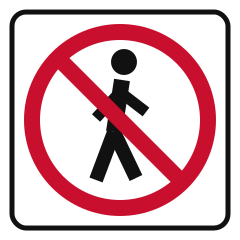
- Pedestrians, who have priority here
- Drivers, who must stop for walkers
- Drivers approaching a school
- Pedestrians, who are not allowed here
For best control, where should your hands be on the steering wheel?
- Both hands at 12 o'clock
- At 9 o'clock and 3 o'clock
- At 12 o'clock and 6 o'clock
- At 10 o'clock and 6 o'clock
Which of these can lead to a departmental or ministerial suspension?
- Changing your address
- Renewing your licence late by a day
- Buying a new car
- Failure to pay a judgment
You see an orange diamond sign that says road construction is ahead. What should you be ready to do?
- Change lanes right away
- Turn on your high beams
- Slow down and stop if required
- Speed up to clear the area
Backing straight up, which way do you turn the wheel for a small correction?
- You should not turn it at all
- The way you want the back to go
- Always to the right
- Opposite to where you want to go
Besides being old enough, what must you pass to get a Class 7 learner's licence?
- A vision screening and a knowledge exam
- A first aid course and a vision screening
- A driving school course and a road test
- A road test and a medical exam
You want to turn left at a light and one car is already waiting in the intersection to turn. Where should you wait?
- In the oncoming lane
- Behind the crosswalk
- Right behind it in the intersection
- In the intersection beside it
All NWT Class 7 practice tests
- NWT Class 7 Mock Exam 1 – 40 QuestionsTimed practice · 30 minutes · answers explained
- NWT Class 7 Mock Exam 2 – 40 QuestionsTimed practice · 30 minutes · answers explained
- NWT Class 7 Mock Exam 3 – 40 QuestionsTimed practice · 30 minutes · answers explained
- NWT Class 7 Mock Exam 4 – 40 QuestionsTimed practice · 30 minutes · answers explained
- NWT Class 7 Mock Exam 5 – 40 QuestionsTimed practice · 30 minutes · answers explained
- Regulatory signs and speed limitsSign shapes and colours, stop and yield signs, permissive green-circle and prohibitive red-slash signs, lane-use, parking and stopping signs, and NWT default speed limits.
- Warning signsYellow diamond warning signs for stops and signals ahead, curves, crossings, intersections, merging, narrowing roads, lane endings, divided highways and other road conditions.
- Guide, service and construction signsRoute markers, direction and distance signs, service signs, orange construction signs, doubled fines with workers present, the slow-moving vehicle sign and disabled parking.
- School and playground zonesSchool and playground area versus zone signs, the 30 km/h speed, 24-hour default times, municipal bylaws, no passing and where zones end.
- Traffic lights and signalsLight order, steady and flashing red, amber and green lights, green arrows, turns on red, pedestrian signals and lane control signals.
About this practice test
How many questions are in NWT Class 7 practice test 3?
40 original multiple-choice practice questions covering emergencies, skids and collisions, traffic lights and signals, signalling and turning, defensive and responsible driving, regulatory signs and speed limits, pavement markings, parking, licences, gdl and registration, guide, service and construction signs, lane driving, passing and merging, warning signs, night, weather and animals, sharing the road, school and playground zones, demerit points and suspensions, impaired and distracted driving, intersections and right-of-way, starting, steering and stopping. Each answer includes an explanation. This mixed practice set does not reproduce the official exam format or predict an official score.
Are the questions the same every time?
Yes. Practice test 3 always has the same 40 questions, so you can repeat it until you get them all right. The other 8 sets use different questions.
Are these real test questions?
No. The official question bank is not published. These are original questions written from the official handbook, which is what the real NWT Class 7 test is based on.