On a long drive, how often should you stop to rest and walk around?
NWT Class 7 overview
NWT Class 7 Practice Test 5
40 questions on defensive and responsible driving, demerit points and suspensions, emergencies, skids and collisions, signalling and turning, school and playground zones and more.
- No sign-up
- Every answer explained
- Independent · not a government site
- Set 5 of 9
- 40 questions
- Instant feedback
0/40
All 40 questions in this test
Every question and its answer choices. The correct answers and explanations appear when you take the test above.
On a long drive, how often should you stop to rest and walk around?
- At least every four hours
- At least every two hours
- Only when you feel sleepy
- At least every six hours
A driver with 10 demerit points passes an approved driver improvement course. How many points are removed?
- Two points
- All ten points
- None; the course only teaches
- Half, so five points
Your car has broken down and a stranger stops and offers you a ride. What does the manual advise?
- Let your passengers go with them
- Accept the ride to the next town
- Ride along if they seem friendly
- Ask them to call for help instead
Before turning right on a red light, what should you check over your right shoulder for?
- Road users who moved up on your right
- Vehicles parked on the far side
- Signs on the left corner
- Traffic coming from behind on the left
Unless another speed is posted, what is the speed limit in an NWT school zone?
- 30 km/h
- 50 km/h
- 20 km/h
- 40 km/h
A railway crossing has a stop sign. How far from the nearest rail must you stop?
- Right at the rail
- Between 2 m and 5 m
- Between 10 m and 30 m
- Between 5 m and 15 m
Your aunt has held a full Class 5 licence for 18 months. Can she supervise you while you drive on your Class 7?
- Yes, 12 months is enough
- No, she needs at least 24 months
- No, she needs at least five years
- Yes, any full licence holder can
The centre line is a solid yellow line beside a broken yellow line. The broken line is on your side. What does this mean for you?
- Only oncoming drivers may pass
- You may pass when it is safe
- You may not pass
- You may pass only on the right
You are stopped behind another vehicle in traffic. How much space should you leave?
- As little as possible, so the line of traffic stays tight
- Enough to see its rear tires only
- About half a metre
- Enough to pull into another lane without backing up
Traffic is slow and there is a painted island beside your lane. May you drive across it to get past?
- Yes, but only to turn left
- Yes, if traffic is stopped in your lane
- Yes, if you signal first
- No, never drive over a painted island
You are about to parallel park. How much space should you leave beside the vehicle in front when you stop to begin?
- About three metres
- About 30 centimetres
- About half a car length
- About one metre
Why do bridge decks and overpasses need extra caution in winter?
- They have lower speed limits
- They are always gravel
- They are cleared less often by snowplows
- They form slippery patches more readily
Unless otherwise posted, what is the maximum speed on a highway inside a settlement or municipality?
- 30 km/h
- 70 km/h
- 60 km/h
- 50 km/h
Unless posted otherwise, what is the speed limit in a playground zone?
- 40 km/h
- 50 km/h
- 30 km/h
- 20 km/h
You plan to leave a two-lane traffic circle at the first exit. Which lane should you use?
- The right-hand lane
- The left-hand lane
- The inside lane, then move over
- Either lane
Traffic is building up behind you because you are driving well below the limit. What does the manual suggest?
- Speed up past the limit
- Turn on your hazard lights
- Drive on the shoulder
- Pull over and let traffic pass
How does the NWT manual define nighttime for headlight use?
- 30 minutes after sunset to 30 minutes before sunrise
- Whenever streetlights are on
- One hour after sunset to one hour before sunrise
- Sunset to sunrise
You have a blowout at highway speed. What should you do first?
- Brake hard right away
- Ease off the gas and hold the wheel firmly
- Shift into neutral
- Steer quickly onto the shoulder and brake hard
What is the purpose of a steady amber light?
- To allow turns from any lane
- To let pedestrians start crossing
- To warn that the light will turn green
- To clear the intersection safely
You reach a yield sign and there are no vehicles or pedestrians to yield to. What may you do?
- Go through without stopping
- Wait three seconds, then go
- Stop fully, then go
- Sound your horn, then go
What does this sign tell you?

- Construction has ended
- A lane is closed ahead
- The road ends ahead
- Follow a detour route
Entering an angle parking space on the right, how far should you stay from the rear of the parked vehicles?
- At least 0.5 m
- At least 3 m
- At least 5 m
- At least 1.5 m
You have a Class 7 licence and your supervisor is in the front seat. Your friend wants to ride in the back. Is that allowed?
- Yes, one passenger in the back is fine
- Yes, if the friend wears a seat belt
- No, only the supervisor may ride along
- Yes, if the friend also has a licence
Your mirrors are properly adjusted. Can you skip the shoulder check before changing lanes?
- Yes, on a multi-lane highway
- No, mirrors never replace a shoulder check
- Yes, if your mirrors are adjusted properly
- Yes, if you signal early
You are making a turn where dual turning lanes are marked. What must you avoid?
- Slowing down before the turn
- Swinging wide or changing lanes during the turn
- Turning into the matching lane
- Using your turn signal at any point during the turn
On smooth, dry pavement, about how far does a car at 50 km/h travel before it stops, counting perception and reaction?
- About 108 m
- About 37 m
- About 18 m
- About 76 m
What does this sign warn of?
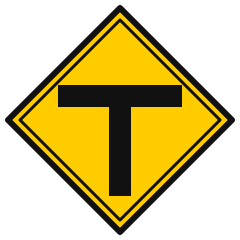
- A side road on the right
- A Y intersection ahead
- A dead end ahead
- A T intersection ahead
What does this sign warn of?

- The road may be slippery when wet
- Do not stop on the shoulder
- Watch for ice on bridges
- The road curves sharply
A police officer at an intersection waves you through, but the traffic light facing you is red. What do you do?
- Sound your horn and wait
- Stop, then turn right only
- Follow the officer's direction
- Wait for the light to turn green
A faster vehicle wants to pass you on a highway. May you move onto the shoulder to let it by?
- No, the shoulder is for emergency parking
- Yes, but only in daylight
- Yes, if you signal right first and slow down
- Yes, if the shoulder is paved
Where are lane control signals most often used?
- On reversible lanes
- At four-way stops
- At railway crossings
- In school zones
The red lights at a railway crossing start flashing and the bell rings. What must you do?
- Cross quickly before the train
- Slow down, look both ways, then go across
- Stop at least 5 m from the nearest rail
- Stop on the tracks and wait
On a vertical traffic signal, where is the red light?
- On the left side
- At the top
- In the middle
- At the bottom
A fully licensed driver reaches 9 demerit points. What happens?
- A driver improvement course order
- A mandatory interview
- A one-month suspension
- A courtesy notice of point standing
What do arrows painted in a lane tell you?
- Where the lane will end
- Which movements are allowed from that lane
- Which way the wind is blowing
- How fast you should travel while in the lane
An interlock reads 32 mg per 100 mL. What happens?
- A fail is recorded and the vehicle won't start
- The device asks for a retest only
- The vehicle starts normally
- The vehicle starts, but a warning gets recorded
A fully licensed NWT driver refuses a breath demand. What happens before the 90-day suspension starts?
- They may keep driving until court
- They get a 7-day temporary permit
- They get a 30-day temporary permit
- Nothing; it starts immediately
You are in a collision. When may you leave the scene?
- After help is given and information is exchanged
- After 15 minutes, if the police have not arrived
- Right away if no one is hurt
- After you call your insurer
What do route markers show?
- The number or name of a road
- The distance to the next town
- The posted speed limit
- Where services are located
After parallel parking, how close to the curb must your wheels be by law?
- No more than 1 m
- No more than 50 cm
- No more than 30 cm
- Touching the curb
All NWT Class 7 practice tests
- NWT Class 7 Mock Exam 1 – 40 QuestionsTimed practice · 30 minutes · answers explained
- NWT Class 7 Mock Exam 2 – 40 QuestionsTimed practice · 30 minutes · answers explained
- NWT Class 7 Mock Exam 3 – 40 QuestionsTimed practice · 30 minutes · answers explained
- NWT Class 7 Mock Exam 4 – 40 QuestionsTimed practice · 30 minutes · answers explained
- NWT Class 7 Mock Exam 5 – 40 QuestionsTimed practice · 30 minutes · answers explained
- Regulatory signs and speed limitsSign shapes and colours, stop and yield signs, permissive green-circle and prohibitive red-slash signs, lane-use, parking and stopping signs, and NWT default speed limits.
- Warning signsYellow diamond warning signs for stops and signals ahead, curves, crossings, intersections, merging, narrowing roads, lane endings, divided highways and other road conditions.
- Guide, service and construction signsRoute markers, direction and distance signs, service signs, orange construction signs, doubled fines with workers present, the slow-moving vehicle sign and disabled parking.
- School and playground zonesSchool and playground area versus zone signs, the 30 km/h speed, 24-hour default times, municipal bylaws, no passing and where zones end.
- Traffic lights and signalsLight order, steady and flashing red, amber and green lights, green arrows, turns on red, pedestrian signals and lane control signals.
About this practice test
How many questions are in NWT Class 7 practice test 5?
40 original multiple-choice practice questions covering defensive and responsible driving, demerit points and suspensions, emergencies, skids and collisions, signalling and turning, school and playground zones, sharing the road, licences, gdl and registration, pavement markings, parking, night, weather and animals, regulatory signs and speed limits, intersections and right-of-way, starting, steering and stopping, traffic lights and signals, guide, service and construction signs, lane driving, passing and merging, warning signs, impaired and distracted driving. Each answer includes an explanation. This mixed practice set does not reproduce the official exam format or predict an official score.
Are the questions the same every time?
Yes. Practice test 5 always has the same 40 questions, so you can repeat it until you get them all right. The other 8 sets use different questions.
Are these real test questions?
No. The official question bank is not published. These are original questions written from the official handbook, which is what the real NWT Class 7 test is based on.