With an ignition interlock, what BAC reading lets the vehicle start with no violation?
NWT Class 7 overview
NWT Class 7 Practice Test 6
40 questions on impaired and distracted driving, demerit points and suspensions, traffic lights and signals, warning signs, intersections and right-of-way and more.
- No sign-up
- Every answer explained
- Independent · not a government site
- Set 6 of 9
- 40 questions
- Instant feedback
0/40
All 40 questions in this test
Every question and its answer choices. The correct answers and explanations appear when you take the test above.
With an ignition interlock, what BAC reading lets the vehicle start with no violation?
- Below 50 mg per 100 mL
- Below 80 mg per 100 mL
- Below 20 mg per 100 mL
- Below 30 mg per 100 mL
A fully licensed driver collects 15 demerit points within two years. What is the result?
- A six-month suspension
- A courtesy letter
- An automatic one-month suspension
- An automatic three-month suspension
You come to a flashing red light at an intersection. What must you do?
- Go if no one is directly ahead
- Stop, then go only when it is safe
- Slow down and go with caution
- Stop and wait until it turns green
You see this sign. What is ahead?

- Traffic control signals
- A pedestrian crosswalk
- A railway crossing
- A construction zone
What does this sign warn of?
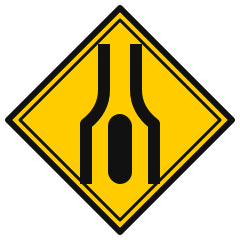
- The road narrows on both sides
- A divided highway begins
- A painted island ahead
- A divided highway ends
Another driver must yield to you, but it is clear they are not going to. What should you do?
- Sound your horn and continue
- Keep going, since you have the right-of-way
- Do what you can to avoid a collision
- Speed up so they see you
You have a steady green light and want to turn left. What must you do?
- Sound your horn and turn
- Wait for the light to turn amber
- Yield to vehicles and people lawfully in the intersection
- Turn first, since the green light gives you the right of way
You are in a school zone while it is in effect and a slow car is ahead of you in your lane. May you pass it?
- No, passing is not allowed in the zone
- Yes, if the line is broken
- Yes, if you stay under 30 km/h
- Yes, if no children are in sight
In a car with anti-lock brakes, how should you brake in an emergency?
- Press hard and steadily without pumping
- Use only the parking brake
- Press lightly and release the pedal often
- Pump the pedal quickly
In the NWT, who is responsible for making sure passengers under 15 are properly restrained?
- The driver
- The vehicle owner
- The child's parent only
- Each passenger
What does this sign tell drivers on a route?
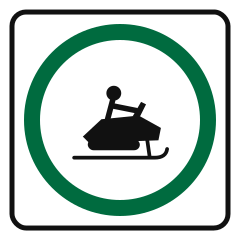
- Motorized snow vehicles are allowed
- The road is closed in winter
- Snowmobiles cross the road ahead
- Motorized snow vehicles are prohibited
What does this sign warn of?
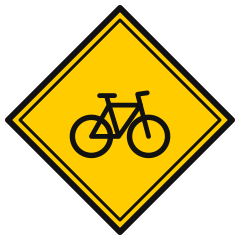
- A bicycle crossing ahead
- A bike shop is nearby
- Bicycles are prohibited
- A bicycle route begins
When should you not use cruise control?
- On long straight highways
- When road conditions are poor
- In clear weather
- At speeds over 80 km/h
A first-time offender's impaired driving causes a death. What is the minimum licence suspension?
- Three years
- One year
- Exactly ten years, then it ends
- Indefinite, at least five years
When merging onto a highway, when may you move into the gap you chose?
- Before the solid white line ends
- As soon as you enter the ramp
- Only when no vehicle is in sight
- After you pass the solid white line
An oncoming driver's headlights are dazzling you. Where should you look?
- Straight at the oncoming headlights
- At the centre line
- Into your rear-view mirror
- Down and toward the right edge of your lane
You park facing uphill beside a curb. Which way should your front wheels point?
- Straight ahead
- To the left, away from the curb
- To the right, toward the curb
- It does not matter with the park brake on
You realize you have just missed your highway exit. What should you do?
- Back up on the shoulder
- Stop and wait for a gap
- Cross the median to turn around
- Continue to the next exit
Which of these is a time when you must signal?
- When driving through a green light
- When going straight at a stop sign
- When pulling away from the curb
- When following a curve in the road
You pass this sign on a snowy evening and the road is icy. How fast may you legally drive?

- Only as fast as is safe for the conditions
- Exactly 50 km/h, as posted
- Any speed up to 50 km/h
- Up to 60 km/h, if traffic on the road is light
When may a vehicle park or stop in a stall reserved for persons with disabilities?
- When it stops for under five minutes
- When the driver stays in the vehicle
- When it displays the placard or licence plate
- When every other stall is full
You are approaching a crosswalk and the vehicle ahead is moving slowly. What should you not do?
- Look for pedestrians
- Keep a safe distance
- Cover your brake
- Pass it
You stop for a pedestrian at a crosswalk on a multi-lane road. Why should you stop well back?
- So the pedestrian has room to turn back
- So you can pull around if needed
- So drivers in other lanes can see the pedestrian
- So you avoid a parking ticket
At an intersection you see a solid white line painted across your lane. What does it show?
- Where parking is allowed
- Where vehicles must stop
- Where passing ends
- Where pedestrians must wait
A fully licensed driver has served a demerit point suspension. With how many points is the licence reinstated?
- Zero
- Five
- Seven
- Ten
You see emergency vehicle lights flashing at an incident ahead on the highway. How much should you slow down?
- To 30 km/h
- To half the posted speed limit
- To 60 km/h, or 40 km/h in towns
- By 10 km/h
How should the lap part of your seat belt fit?
- Under your thighs
- High across your ribs
- Low and snug over your hips
- Loose across your stomach
At a four-way stop, who normally goes first?
- The larger vehicle
- The vehicle on the left
- The vehicle that arrived first
- The vehicle going straight
Where can you get an application for a disabled parking placard in the NWT?
- The RCMP detachment
- The municipal parking office in your community
- A Driver and Vehicle office or your doctor
- Any insurance broker
You are stopped behind a large truck on a hill. Why leave extra space in front of you?
- Trucks must stop at every hill
- Its exhaust is dangerous
- It may roll back when it starts
- It needs room to back up
Where do the knowledge exam questions come from?
- Driving school handouts
- The Criminal Code
- Other provinces' guides
- This driver's manual
When should a block heater be switched on before a winter drive?
- About two hours before
- The night before
- Six hours before
- Ten minutes before
What is "riding the clutch"?
- Releasing the clutch pedal too quickly
- Leaving your foot on the clutch pedal
- Shifting without the clutch
- Starting in second gear
You are on a rural two-lane highway with a broken yellow centre line. What does it tell you?
- Passing is never allowed here
- You must pass within 10 seconds
- Only trucks may pass here
- There is enough sight distance to pass
You run into a store and leave your car running with the doors unlocked. Is that legal in the NWT?
- Yes, if it is in park
- No, it is illegal
- Yes, in winter only
- Yes, for under five minutes
In a town, which of these is a place where a U-turn is not allowed?
- At an uncontrolled intersection
- On a road with no U-turn sign
- At an intersection with traffic lights
- At a four-way stop with clear views
A driver with 4 demerit points passes an approved driver improvement course. What happens?
- Two points are removed
- No points are removed
- One point is removed
- All four points are removed
A Class 5 holder wants to drive a van with 12 seats, including the driver's, and carry friends. May they?
- Yes, any van is allowed
- Yes, as long as the van has no air brakes
- No, not over 10 seats with passengers
- Yes, if no one pays to ride
A rural stop sign has no stop line and no marked crosswalk. Where must you stop?
- Wherever you can see best
- Right beside the sign
- Within 3 m of the intersecting road
- Within 10 m of the intersecting road
You are on a highway and see vehicles merging from an acceleration lane on your right. What is recommended?
- Move to the left lane if it is safe
- Slow down and stop
- Sound your horn to warn them
- Speed up to stay ahead
All NWT Class 7 practice tests
- NWT Class 7 Mock Exam 1 – 40 QuestionsTimed practice · 30 minutes · answers explained
- NWT Class 7 Mock Exam 2 – 40 QuestionsTimed practice · 30 minutes · answers explained
- NWT Class 7 Mock Exam 3 – 40 QuestionsTimed practice · 30 minutes · answers explained
- NWT Class 7 Mock Exam 4 – 40 QuestionsTimed practice · 30 minutes · answers explained
- NWT Class 7 Mock Exam 5 – 40 QuestionsTimed practice · 30 minutes · answers explained
- Regulatory signs and speed limitsSign shapes and colours, stop and yield signs, permissive green-circle and prohibitive red-slash signs, lane-use, parking and stopping signs, and NWT default speed limits.
- Warning signsYellow diamond warning signs for stops and signals ahead, curves, crossings, intersections, merging, narrowing roads, lane endings, divided highways and other road conditions.
- Guide, service and construction signsRoute markers, direction and distance signs, service signs, orange construction signs, doubled fines with workers present, the slow-moving vehicle sign and disabled parking.
- School and playground zonesSchool and playground area versus zone signs, the 30 km/h speed, 24-hour default times, municipal bylaws, no passing and where zones end.
- Traffic lights and signalsLight order, steady and flashing red, amber and green lights, green arrows, turns on red, pedestrian signals and lane control signals.
About this practice test
How many questions are in NWT Class 7 practice test 6?
40 original multiple-choice practice questions covering impaired and distracted driving, demerit points and suspensions, traffic lights and signals, warning signs, intersections and right-of-way, school and playground zones, emergencies, skids and collisions, defensive and responsible driving, regulatory signs and speed limits, night, weather and animals, lane driving, passing and merging, parking, signalling and turning, guide, service and construction signs, sharing the road, pavement markings, starting, steering and stopping, licences, gdl and registration. Each answer includes an explanation. This mixed practice set does not reproduce the official exam format or predict an official score.
Are the questions the same every time?
Yes. Practice test 6 always has the same 40 questions, so you can repeat it until you get them all right. The other 8 sets use different questions.
Are these real test questions?
No. The official question bank is not published. These are original questions written from the official handbook, which is what the real NWT Class 7 test is based on.