On smooth, dry pavement, about how far does a car at 50 km/h travel before it stops, counting perception and reaction?
NWT Class 7 overview
NWT Class 7 Mock Exam 4
Same format as the real test. Answers stay hidden until you submit.
- No sign-up
- Every answer explained
- Independent · not a government site
- 40 questions
- 30 min
- Pass mark 16/20 per section
0/40
All 40 questions in this test
Every question and its answer choices. The correct answers and explanations appear when you take the test above.
On smooth, dry pavement, about how far does a car at 50 km/h travel before it stops, counting perception and reaction?
- About 108 m
- About 37 m
- About 18 m
- About 76 m
What does this sign warn of?
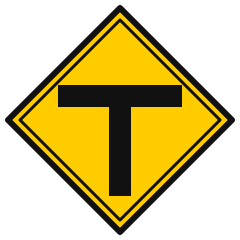
- A side road on the right
- A Y intersection ahead
- A dead end ahead
- A T intersection ahead
Your aunt has held a full Class 5 licence for 18 months. Can she supervise you while you drive on your Class 7?
- Yes, 12 months is enough
- No, she needs at least 24 months
- No, she needs at least five years
- Yes, any full licence holder can
You plan to leave a two-lane traffic circle at the first exit. Which lane should you use?
- The right-hand lane
- The left-hand lane
- The inside lane, then move over
- Either lane
You are at the end of an acceleration lane and the gap you wanted closes. What should you avoid?
- Checking your mirrors again
- Keeping your signal on
- Adjusting your speed to find a gap
- Stopping at the end of the lane
You face a flashing green light. Opposing traffic has a red. What must you still do?
- Yield to pedestrians and vehicles in the intersection
- Nothing, since the flashing green gives you full right-of-way
- Stop before going straight
- Turn right only
What does this sign tell you?

- Traffic may move only in the arrow's direction
- A sharp curve to the right is ahead
- You must turn right at the very next intersection
- Traffic merges from the right
What do you need to move from Class 5P to a full Class 5?
- Pass a second road test at 16
- Be at least 17 with fewer than 6 demerits
- Hold the 5P for six months
- Be at least 18 with no demerit points at all
As you approach a green light, the pedestrian signal changes from walk to don't walk. What does that suggest?
- Pedestrians have the right-of-way
- You must stop immediately
- The light will stay green longer
- The light may soon turn amber
You are passing a slow truck on a two-lane highway posted at 90 km/h. How fast may you go while passing?
- Up to 110 km/h briefly
- As fast as needed to finish
- No faster than 90 km/h
- Up to 100 km/h briefly
You face a steady red light. There is no stop line or crosswalk. Where must you stop?
- Beside the signal pole
- In the middle of the intersection
- Past the first crosswalk
- Before entering the intersection
How close may you park in front of a stop sign at the side of the road?
- No closer than 5 m
- No closer than 3 m
- No closer than 10 m
- No closer than 15 m
What does this sign mean?
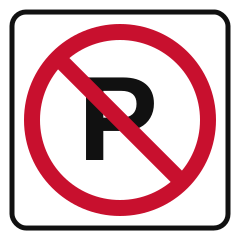
- Parking lot ahead
- No parking
- Parking for permit holders
- Pick-up and drop-off only
On a rural highway the centre line is solid yellow on your side. May you pass the slow vehicle ahead?
- Yes, if you stay under the limit
- Yes, but only during daylight
- Yes, if the road ahead looks clear
- No, passing is not allowed
You reach a yield sign and there are no vehicles or pedestrians to yield to. What may you do?
- Go through without stopping
- Wait three seconds, then go
- Stop fully, then go
- Sound your horn, then go
How should you get into a car that is parallel parked on a street?
- Enter from the passenger side always
- Approach from the front, facing traffic
- Approach from behind, back to traffic
- Open the door wide and wait
When merging onto a highway, when may you move into the gap you chose?
- Before the solid white line ends
- As soon as you enter the ramp
- Only when no vehicle is in sight
- After you pass the solid white line
When driving, what is meant by your vehicle's blind spot?
- A dark section of highway
- A spot hidden by sun glare
- The area right in front of the hood
- An area you cannot see in your mirrors
You see this sign on a two-lane road. What should you do?

- Move right to make room for passing
- Be ready to merge left as the lane ends
- Stop and wait for a gap
- Speed up to pass before the merge
A truck ahead displays an over-dimensional load sign. What should you keep in mind?
- It has the right-of-way everywhere
- You must not pass it at all
- Use caution if you pass it
- It must travel in the left lane
Who may set the hours and speed of a school zone in an NWT community?
- Each school principal, through a notice
- The RCMP detachment
- The school bus operator
- The municipality, through bylaws
Driving fast on a very wet road, what is hydroplaning?
- Ice forming under the vehicle
- Tires riding on a layer of water
- Brakes overheating on a hill
- Wheels spinning on gravel
What does this sign warn of?

- The road may be slippery when wet
- Do not stop on the shoulder
- Watch for ice on bridges
- The road curves sharply
What is the main purpose of yellow warning signs?
- To warn of possible hazards ahead
- To state rules you must obey
- To give direction and distance
- To show roadside services
The brake warning light on your dashboard comes on while you are driving. What should you do?
- Pump the brakes hard
- Pull over as soon as it is safe
- Keep driving and check it later
- Turn the engine off right away
What does this sign warn you about?

- A traffic signal is ahead
- A four-way stop is behind you
- A school bus stop is ahead
- A stop sign is ahead
You are stopped at a red light and want to turn right. No sign prohibits it. What may you do?
- Turn only with a green arrow
- Turn without stopping if the way is clear
- Turn after a full stop, yielding first
- Wait for the green light
Your car has broken down and a stranger stops and offers you a ride. What does the manual advise?
- Let your passengers go with them
- Accept the ride to the next town
- Ride along if they seem friendly
- Ask them to call for help instead
How long is the suspension for a GDL driver who reaches 12 or more demerit points?
- Six months
- One year
- One month
- Three months
Unless a sign says otherwise, what is the maximum speed on a primary highway outside a settlement or municipality in the NWT?
- 100 km/h
- 110 km/h
- 90 km/h
- 80 km/h
Traffic is building up behind you because you are driving well below the limit. What does the manual suggest?
- Speed up past the limit
- Turn on your hazard lights
- Drive on the shoulder
- Pull over and let traffic pass
In a city, town or village, where are you not allowed to back a vehicle?
- Into a marked parking stall on a street
- Into an intersection or crosswalk
- Into a garage
- Out of a driveway
What does this sign warn of?

- A lane shift for construction
- A reverse turn to the left
- A slippery road ahead
- A winding road ahead
When is it hardest to see animals near the road?
- In bright sunshine
- At midday
- At dusk and dawn
- After a rainstorm
A no parking sign has an arrow under the symbol. What does the arrow show?
- Where parking is not allowed
- Which way traffic flows
- Which side has free parking
- Where the nearest lot is
What do arrows painted in a lane tell you?
- Where the lane will end
- Which movements are allowed from that lane
- Which way the wind is blowing
- How fast you should travel while in the lane
You turn right onto a street with several lanes. Which lane should you turn into?
- The first available lane on the right
- The lane nearest the centre
- The left lane, then move right
- Any lane that is open
A reserved lane sign shows a bus symbol along with hours and days. What does that mean?
- Any vehicle may use the lane only at those times
- The lane is reserved for buses only at those times
- Buses must stop in the lane at those times
- The lane is closed to all traffic at those times
What does this sign warn of?

- A runaway lane ahead
- A steep hill ahead
- Trucks entering the road
- A truck route
You trade in your car for a new one and keep your old plate. How soon must you transfer the registration?
- Within 90 days
- Within 30 days
- Within 14 days
- Within 7 days
Keep practising
- NWT Class 7 Mock Exam 1 – 40 QuestionsTimed practice · 30 minutes · answers explained
- NWT Class 7 Mock Exam 2 – 40 QuestionsTimed practice · 30 minutes · answers explained
- NWT Class 7 Mock Exam 3 – 40 QuestionsTimed practice · 30 minutes · answers explained
- NWT Class 7 Mock Exam 5 – 40 QuestionsTimed practice · 30 minutes · answers explained
- NWT Class 7 Practice Test 140 questions with explanations
- NWT Class 7 Practice Test 240 questions with explanations
- NWT Class 7 Practice Test 340 questions with explanations
- NWT Class 7 Practice Test 440 questions with explanations