
Nova Scotia Class 7 overview

Nova Scotia Class 7: Work zone signs

Orange work zone signs, general, arrow, specific and human activity signs, traffic control persons, flashing arrow boards, lane closures and the main causes of work zone collisions.

  • 16 questions
  • Topic drill
0/16
Work zone signs · Question 1Score 0/0
Orange diamond with a black figure holding a shovel

When is a sign like this one put up?

Study reference: Nova Scotia Driver's Handbook (2017 revision), Ch. 3 Signs, Pavement Markings and Work Zones — Construction or work zones, Work zone signs

All 16 questions in this test

Every question and its answer choices. The correct answers and explanations appear when you take the test above.

  1. When is a sign like this one put up?

    Orange diamond with a black figure holding a shovel
    1. Only on 100-series highways
    2. For the full length of the project
    3. Only at night
    4. Only while workers are on the site
  2. What does this sign tell you?

    Orange diamond with a black figure holding up a flag
    1. A railway crossing is ahead
    2. A parade route is ahead
    3. A school crossing is ahead
    4. A traffic control person is ahead
  3. You see someone driving recklessly through a work zone. What does the handbook suggest?

    1. Follow them to get their plate
    2. Report it to the police
    3. Sound your horn until they slow down
    4. Tell the nearest road worker
  4. What should you do when you see an orange sign like this?
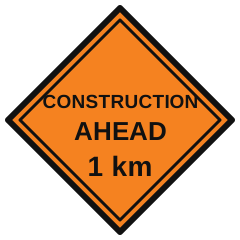
    Orange diamond with three lines of black lettering, the last reading 1 km
    1. Prepare for road work and changing conditions
    2. Expect a toll booth ahead
    3. Prepare to leave the highway
    4. Watch for a school bus loading zone just ahead
  5. Why is a do not pass sign often posted before a work zone lane closure?

    1. To slow traffic to a full stop
    2. To reserve the lane for workers
    3. To set up an orderly merge
    4. To let trucks use both lanes
  6. Why are red or orange flags sometimes attached to human activity signs?

    1. The zone has a lower speed limit
    2. The sign is placed close to the ground
    3. The work zone is ending soon
    4. Workers are about to blast rock
  7. A blasting zone sign is often posted with a sign asking you to do what?

    1. Turn on your high beams
    2. Roll down your windows
    3. Shut off your radio transmitter
    4. Sound your horn as you pass
  8. According to the handbook, what causes the most collisions in work zones?

    1. Vehicles travelling at different speeds
    2. Loose gravel on the road
    3. Workers stepping out into the traffic lanes
    4. Poor lighting at night
  9. An orange sign warns that tar has been sprayed on the road ahead. What risk does the handbook mention?

    1. The lanes may be shifted
    2. The road is closed to cars
    3. The road may be slippery
    4. Your tires may go flat
  10. A work zone sign warns of a difference in height between lanes. Why is this dangerous?

    1. Trucks may not fit under the edge
    2. Your vehicle may scrape its underside on a speed bump
    3. Water may pool and cause hydroplaning
    4. A tire catching the edge can cause loss of control
  11. A flashing light unit shows a straight bar of lights. What does this caution mode mean?

    1. It is safe to pass the hazard on either side now
    2. Traffic must stop and wait
    3. The work zone has ended
    4. A hazard is ahead; judge whether passing is safe
  12. What colour are the signs that usually mark a work zone in Nova Scotia?

    1. White with red letters
    2. Green with white letters
    3. Yellow with black letters
    4. Orange with black letters
  13. A flashing light unit ahead shows a single arrow pointing left. How may you pass it?

    Black rectangular board with a row of yellow lights shaped like an arrow pointing left
    1. Only on the right side
    2. On either side
    3. You may not pass it
    4. Only on the left side
  14. A flashing light unit shows two arrowheads pointing in opposite directions. What does this mean?

    1. The road is closed ahead
    2. You may pass on either side
    3. You must stop before the unit
    4. You may pass on the left only
  15. You see this sign in a work zone. What does it mean?
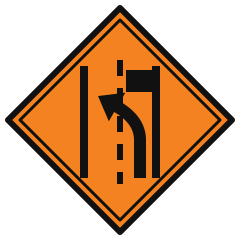
    Orange diamond with two lanes; one lane is blocked and an arrow curves into the other lane
    1. Two lanes join from both sides
    2. A detour leaves the highway at the next exit
    3. Traffic must stop for workers
    4. A lane is closed; move into the open lane
  16. A sign warns that your lane will close ahead. When should you merge?

    1. As soon as it is safe to do so
    2. At the last moment before the cones
    3. Only when a worker waves you over
    4. After passing the slower lane

Work zone signs: key rules to remember

Our summary of what the official handbook says on this topic, in our own words. Read it before or after the practice questions above, then check the original chapter. Read the official chapter ↗

Construction or work zones

  • Work zones: construction or maintenance on or near the road; they disrupt traffic flow and distract drivers.
  • Usually marked with orange warning signs with black letters; when you see them, go on high alert and follow them.
  • Barricades, cones and drums guide drivers through. Traffic control persons may use STOP/SLOW paddles.

Travelling safely through a work zone

  • Respect road workers and follow their directions; it is their workplace.
  • Greatest hazard: differences in speed between vehicles.
  • Hands on wheel, eyes on road, mind on task, cell phone off.
  • Travel no faster than the speed limit; travelling at a different speed from other vehicles causes the most work zone crashes.
  • Slow down safely when directed, watching vehicles ahead and behind.
  • Act promptly when signs direct a lane shift, as soon as safe.
  • Leave extra space ahead so a rear-end hit does not push you into the vehicle in front.

Lane closures and causes of collisions

  • Merge points on multi-lane roads are high-risk.
  • Adjust speed at a merge or lane closure sign; obey the Do Not Pass sign (it sets up an orderly merge).
  • Merge as soon as it is safe. Common mistake: racing to the merge point in the closing lane and pushing in at the last moment.
  • Biggest causes of work zone collisions: (1) vehicles travelling at different speeds, (2) driver inattention.

Work zone signs

  • General signs warn of unusual conditions without saying exactly what; they stay until the road is back to normal. An end sign means no more road work impact (often left out when the end is obvious).
  • Signs with arrows (advance temporary condition signs) give time to prepare.
  • Example: construction begins 1.5 km ahead — choose another route or expect delays.
  • Example: fresh tar sprayed ahead — surface may be slippery; spray can stick tar to your paint.
  • Right lane ending ahead: often used with Do Not Pass; if in the right lane, merge left as soon as safely possible. An equivalent sign exists for the left lane.
  • Specific signs: rutted or grooved surface (bicycles and motorcycles may become unstable); uneven lanes (a tire catching the edge can cause loss of control); road narrows but lane count stays the same.
  • Specific signs stay as long as the condition exists; act before you reach the hazard.

More work zone signs

  • Do Not Pass (regulatory) creates orderly flow before a merge; disobeying it is a ticketable offence.
  • Keep right sign in a work zone: drive to the right of it; regulatory, must be obeyed.
  • Construction traffic entering or leaving on the right (similar sign for left); may be slower than through traffic.
  • Blasting zone: usually with Shut Off Your Radio Transmitter and End Blasting Zone signs; you may need to stop; loud noise, flying debris.

Human activity signs

  • Signs with a person symbol are used only when workers are present.
  • Workers active; traffic control person with STOP/SLOW paddle; survey crew; overhead work on electrical or data cables.
  • Red/orange flags are added when these signs are placed close to the ground.
  • Driving mistakes can fatally injure road workers.
  • Report irresponsible driving in a work zone to the police (p. 97).

Flashing light units (arrow boards)

  • Two arrowheads shown: lane closed or obstruction; safe to pass on either side.
  • Single left or right arrow: pass only on the side the arrow shows.
  • Straight line or bar of lamps = caution mode: warns of a hazard (vehicle in a lane, workers setting signs); it does NOT mean it is safe to pass — judge conditions yourself.
  • Combination sign giving notice that traffic control persons may stop traffic: slow gradually to avoid rear-end collisions (p. 98).

Study the Work zone signs rules as flashcards →

Other topics

Full practice tests
