A fully licensed driver outside GDL is suspended for 6 months at how many points?
Nova Scotia Class 7 overview
Nova Scotia Class 7 Practice Test 7
40 questions on demerit points and losing your licence, graduated licensing: class 7, 5n and restricted stage, highways, school buses and sharing the road, emergencies and collisions, signals, turning, lane changes and passing and more.
- No sign-up
- Every answer explained
- Independent · not a government site
- Set 7 of 8
- 40 questions
- Instant feedback
0/40
All 40 questions in this test
Every question and its answer choices. The correct answers and explanations appear when you take the test above.
A fully licensed driver outside GDL is suspended for 6 months at how many points?
- 6
- 10
- 12
- 8
Which rule applies to a driver in the restricted individual stage?
- They may not drive on 100-series highways
- They may carry only one passenger
- They may not drive after midnight
- They cannot act as a supervising driver
Your car breaks down on a highway. After moving well off the road, what does the handbook suggest?
- Stand behind the car and wave to flag down passing traffic
- Tie a white cloth to the aerial or left door handle
- Raise the hood and walk for help
- Leave your parking lights off
What amount of property damage makes a collision reportable in Nova Scotia?
- $1,000 or more
- $500 or more
- $2,000 or more
- $5,000 or more
You signal a lane change. Does your signal give you the right of way?
- Only on multi-lane highways
- Yes, if the other driver sees it
- Yes, once it has flashed three times
- No, you must still make sure it is safe
What should you do when you see this sign?

- Slow down for a bump or rough road
- Prepare to stop for a crossing
- Keep right of a centre island
- Watch for a hill with poor sight
You see this sign at the entrance to a street. What should you do?

- Do not drive into that street
- Stop, then enter when clear
- Enter slowly and with care
- Enter only to turn right
Where should you never install a rear-facing child seat?
- In the centre rear seat
- Behind the driver's seat in the back
- In any back seat
- In a seat with an active airbag
Why does stopping distance grow so much at higher speeds?
- Your reaction time doubles once you are above 60 km/h
- You cover more ground reacting and need more room to brake
- Tires only grip the road well at low speeds, under 50 km/h
- Brakes work less well when they are warm
You are turning right on a green light and a pedestrian is crossing the street you are turning into, also on green. Who has the right of way?
- You, because you have a green light
- The pedestrian
- Whoever entered the intersection first
- You, because turning traffic has priority
On a long highway trip, how often does the handbook suggest stopping at a rest area?
- At least every 400 km
- Only when you need fuel
- At least every 150–200 km
- At least every 50 km
You parallel park a manual transmission car facing downhill. Which gear should you leave it in?
- Second
- Reverse
- First
- Neutral
Stopping distance on slippery pavement can be how much longer than on dry pavement?
- Twenty times longer
- About the same
- Up to twice as long
- Two to ten times longer
How many demerit points are given for speeding 10 km/h over the posted limit?
- 4
- 3
- 1
- 2
Your car starts to have mechanical trouble on the highway. What should you do first?
- Keep driving to the next town
- Stop in your lane and check the engine
- Stop on the centre line
- Signal, use flashers and pull well off the road
You are driving out of a driveway onto a residential street. Where must you stop first?
- Just before the sidewalk
- Only if a pedestrian is visible
- At the edge of the street
- After crossing the sidewalk
In which direction do you travel around a roundabout in Nova Scotia?
- Either way, depending on your exit
- Counterclockwise, to the right of the island
- Clockwise, to the left of the island
- Straight across the central island
What does this sign warn you about?

- A traffic signal is ahead
- A stop sign is ahead
- The road ends ahead
- You must stop right here
Several of these signs are posted in a row along the outside of a bend. What are they for?
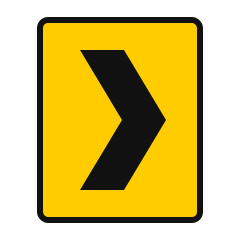
- To guide you around a sharp curve
- To mark the edge of a parking lot
- To mark a passing lane
- To show a lane that is closing
Why is driving slowly especially dangerous just beyond the crest of a hill?
- Your brakes may overheat
- Your engine may stall on the hill
- Faster vehicles may not see you in time
- You will use more fuel going slowly
Several snow plows are clearing all lanes of a highway side by side. What should you do?
- Flash your lights to be let through
- Pass on the right shoulder
- Pass between them carefully
- Stay behind them; do not pass between them
At about what speed can a standard car's tires ride completely on top of water?
- About 85 km/h
- About 120 km/h
- About 55 km/h
- About 40 km/h
How often must you renew the vehicle permit for a passenger car?
- Every 2 years
- Every 5 years
- Every 3 years
- Every year
Your car has anti-lock brakes and you must stop quickly. What should you do?
- Pump the brake pedal rapidly to avoid a skid
- Press firmly and steadily, without pumping
- Press lightly, then let go
- Shift to neutral and brake
You face a flashing green light. What does it allow you to do?
- Turn right only
- Turn left, go straight or turn right
- Turn left only, without yielding
- Go straight only
During which hours may a Class 5N driver not drive alone, unless exempted?
- 1 a.m. to 6 a.m.
- 11 p.m. to 6 a.m.
- Midnight to 5 a.m.
- 10 p.m. to 5 a.m.
Why is a hole in the exhaust system especially dangerous in winter?
- The muffler can freeze solid
- The heater stops working
- The engine will no longer start in very cold weather
- Poisonous gases can build up with windows closed
How many demerit points does failing to yield to a pedestrian carry?
- 6
- 2
- 3
- 4
You see someone driving recklessly through a work zone. What does the handbook suggest?
- Follow them to get their plate
- Report it to the police
- Sound your horn until they slow down
- Tell the nearest road worker
How should you control your speed as you steer into a new lane?
- Speed up sharply to get ahead
- Slow down before you move over
- Brake lightly as you cross the line
- Keep your speed or gently increase it
How should the lap part of a seat belt be worn?
- Under the arm
- Loose, for comfort
- As low on the hips as possible
- Across the stomach, above the hip bones
How long must a learner normally wait before taking the road test?
- At least 30 days
- At least 6 months
- At least 3 months
- At least 12 months
Two cars arrive at an uncontrolled intersection at the same time from different streets. Which car must yield?
- The car on the left
- The car on the right
- The car going faster
- The car that is turning
Traffic has built up behind you because you are driving slowly on a two-lane road. What should you do?
- Pull over where it is safe and let it pass
- Keep going at the same speed
- Wave the cars to pass you on a curve
- Speed up past the speed limit
A police officer asks you for a roadside breath sample and you refuse. What happens?
- You must see a doctor
- You are charged with an offence
- Nothing, since it is voluntary
- You get a warning letter
You see this sign at the end of a traffic island. What must you do?

- Keep to the right of the island
- Turn right at the next street
- Merge left as soon as you can
- Keep to the left of the island
What does the handbook say about using cruise control when you are very tired?
- Use it only on highways
- Use it with the radio loud
- Never use it when overtired
- Use it to rest your legs
An orange sign warns that tar has been sprayed on the road ahead. What risk does the handbook mention?
- The lanes may be shifted
- The road is closed to cars
- The road may be slippery
- Your tires may go flat
You park facing uphill on a street with a curb. Which way should your front wheels point?
- Straight ahead
- Toward the centre line, then straight
- To the right, toward the curb
- To the left, away from the curb
A driver behind you sounds the horn and begins to pass. What does the handbook tell you to do?
- Move toward the right edge of the pavement
- Sound your horn back
- Move toward the centre line
- Speed up slightly so the pass is over sooner
All Nova Scotia Class 7 practice tests
- Nova Scotia Class 7 Mock Exam 1 – 40 QuestionsUntimed practice · answers explained
- Nova Scotia Class 7 Mock Exam 2 – 40 QuestionsUntimed practice · answers explained
- Nova Scotia Class 7 Mock Exam 3 – 40 QuestionsUntimed practice · answers explained
- Nova Scotia Class 7 Mock Exam 4 – 40 QuestionsUntimed practice · answers explained
- Nova Scotia Class 7 Mock Exam 5 – 40 QuestionsUntimed practice · answers explained
- Regulatory signsStop, yield and school zone signs, green-circle and red-slash signs, turn, passing, parking and stopping restrictions, one-way, keep-right, speed limit and accessible parking signs.
- Warning and guide signsYellow diamond warning signs for curves, narrowing roads, merges, lane endings, divided highways, bumps and hidden hazards, chevrons and checkerboards, lane-use arrows and green guide signs.
- Work zone signsOrange work zone signs, general, arrow, specific and human activity signs, traffic control persons, flashing arrow boards, lane closures and the main causes of work zone collisions.
- Railway crossingsThe crossbuck and advance railway warning sign, flashing lights and gates, vehicles that must stop at crossings, what to do if you are stuck on the tracks, and parking near a crossing.
- Traffic signals and crossing guardsGreen, yellow and red lights, right and left turns on red, arrow signals, flashing red, yellow and green signals, lane-control signals, dark signals, pedestrian Walk signals and crossing guards.
About this practice test
How many questions are in Nova Scotia Class 7 practice test 7?
40 original multiple-choice practice questions covering demerit points and losing your licence, graduated licensing: class 7, 5n and restricted stage, highways, school buses and sharing the road, emergencies and collisions, signals, turning, lane changes and passing, warning and guide signs, regulatory signs, seat belts, child seats and safe driving habits, speed, stopping distance and following, right of way, pedestrians and emergency vehicles, parking, roundabouts and driveways, night driving and bad weather, your vehicle: inspection, equipment, registration and insurance, traffic signals and crossing guards, work zone signs, impaired driving and fitness to drive. Each answer includes an explanation. This mixed practice set does not reproduce the official exam format or predict an official score.
Are the questions the same every time?
Yes. Practice test 7 always has the same 40 questions, so you can repeat it until you get them all right. The other 7 sets use different questions.
Are these real test questions?
No. The official question bank is not published. These are original questions written from the official handbook, which is what the real Nova Scotia Class 7 test is based on.