Your car goes into deep water. What is the best way out?
Nova Scotia Class 7 overview
Nova Scotia Class 7 Mock Exam 3
Same format as the real test. Answers stay hidden until you submit. The official time limit is not published; the timer is a practice setting.
- No sign-up
- Every answer explained
- Independent · not a government site
- 40 questions
- untimed
- Pass mark 16/20 per section
0/40
All 40 questions in this test
Every question and its answer choices. The correct answers and explanations appear when you take the test above.
Your car goes into deep water. What is the best way out?
- Through the windows, opened right away
- Through the sunroof only
- Through the door, opened right away
- Wait for the car to settle on the bottom
On a two-lane road, the car ahead of you pulls out to pass a slow truck. What should you do?
- Wait until it finishes before you pass
- Sound your horn so it hurries
- Follow it closely and pass too
- Pass both on the right shoulder
You hold an accessible parking permit and park in a reserved space. Where must the permit be displayed?
- Hanging from the rear-view mirror
- Taped to the rear window
- Clipped to the driver's sun visor
- On the dashboard, face up
Why should you not use water on a vehicle fire?
- Water makes too much smoke
- Water causes electrical shocks
- Water spreads gasoline and oil fires
- Water damages the engine
What does a yellow traffic light mean?
- The light will stay yellow for ten seconds
- Stop before the intersection if you can do so safely
- Speed up to clear the intersection
- Go ahead if no one is coming
You are in the right lane and see this sign. What is happening ahead?

- A right turn lane begins
- The left lane ends
- A side road joins from the right
- The right lane ends
A two-lane road has a broken yellow centre line. What does it allow?
- Passing for trucks only
- Passing for the right lane only
- No passing in either direction
- Passing with care in both directions
You are turning right on a green light and a pedestrian is crossing the street you are turning into, also on green. Who has the right of way?
- You, because you have a green light
- The pedestrian
- Whoever entered the intersection first
- You, because turning traffic has priority
Which vehicles may use a flashing blue light?
- Snow plows, tow trucks and road maintenance vehicles
- Ambulances and fire trucks
- Any volunteer firefighter
- Police and conservation officer vehicles
An oncoming driver at night does not dim their high beams. What should you do?
- Look straight at their headlights
- Flash your high beams at them until they dim theirs
- Keep your low beams on and look slightly right
- Switch to high beams too
How close to the nearest rail of a railway crossing may you park?
- No closer than 30 metres
- No closer than 5 metres
- No closer than 10 metres
- No closer than 15 metres
Your engine dies while driving and you lose power steering and power brakes. What happens?
- You can still steer and brake, with more effort
- The car stops on its own
- The steering wheel locks and can no longer be turned
- The brakes stop working entirely
You are approaching a bridge and see this sign. What does it mean?

- The road narrows ahead
- A divided highway begins
- Two lanes merge from the right
- The road widens to two lanes
According to the handbook, what is the most common cause of highway crashes in Nova Scotia?
- Bad weather
- Wildlife on the road
- Mechanical failure
- Driver inattention
You have parked on a busy street. What should you do before opening your door?
- Open it slowly while looking ahead
- Turn on your hazard lights
- Sound your horn
- Look behind for approaching cyclists
What is the minimum field of vision needed to pass the vision test for a learner's licence?
- 150 degrees
- 100 degrees
- 120 degrees
- 90 degrees
The centre of the road is marked with continuous double solid yellow lines. May you cross them to pass?
- No, not in either direction
- Only to pass a slow vehicle
- Yes, if the road ahead is clear
- Yes, but only in daylight
Why are red or orange flags sometimes attached to human activity signs?
- The zone has a lower speed limit
- The sign is placed close to the ground
- The work zone is ending soon
- Workers are about to blast rock
A curve warning sign has a small plate showing 50 km/h under it. What does the plate tell you?

- The speed limit for trucks only
- The new speed limit after the curve
- The safe speed for that curve
- The minimum speed on the curve
You are in the right lane of a two-lane highway going your way, and a tow truck is stopped at a collision on the shoulder. What else must you do besides slowing down?
- Turn on your high beams
- Sound your horn as you pass
- Move into the left lane if it is safe
- Stop behind the tow truck until it leaves
Which hand positions on the steering wheel does the handbook recommend?
- Eight and four
- Twelve o'clock only
- Ten and two, or nine and three
- One hand at the bottom of the wheel
Under the Nova Scotia Motor Vehicle Act, what rights do cyclists have on the road?
- The same rights and duties as motorists
- Fewer rights than motorists
- More rights than pedestrians on sidewalks
- Rights only on bike paths
The light changes to red while a pedestrian is still in the middle of the street. What must you do?
- Go as soon as your light turns green again
- Sound your horn to warn them
- Let the pedestrian finish crossing safely
- Drive slowly behind them
You are visiting Nova Scotia with a valid licence from another province. How long may you drive on it?
- Up to 6 months
- Up to 90 days
- Up to 60 days
- Up to 30 days
You pass a cyclist and then turn right just in front of them. What is this common collision called?
- A left cross
- Getting doored
- A right hook
- A rear-end
An ambulance with its siren and lights on is approaching from behind. What must you do?
- Pull to the right edge and stop
- Move to the left lane and slow down
- Stop where you are in your lane
- Speed up to get out of its way
There are two left-turn lanes and you start your turn from the right one. Which lane should you end up in?
- Either lane, whichever is empty
- The curb lane, then the left lane
- The right-hand receiving lane
- The left-hand receiving lane
You are stopped at a red light and want to turn right. No sign prohibits it. What may you do?
- Turn only if a green arrow appears
- Turn right after stopping, when it is safe
- Wait for the green light
- Turn right without stopping
You face a green light and a green left-turn arrow. What controls your left turn?
- The oncoming traffic light
- The pedestrian signal
- The solid green light
- The green arrow
You plan to use a two-way-left-turn lane. When should you move into it?
- Close to where you will turn
- As soon as the lane begins
- Only after stopping in your lane
- At least one block before the turn
A regulatory sign shows a symbol inside a green circle. What does the green circle mean?
- The sign is for information only
- The activity shown is permitted
- A hazard is coming up ahead
- The activity shown is not allowed
You park facing downhill next to a curb. Which way do you turn your front wheels?
- Straight ahead
- To the left, away from the curb
- To the right, toward the curb
- It does not matter with a curb
You are passing another vehicle at night. Which headlights should you use?
- High beams once you pull out
- Parking lights only
- Low beams until you finish passing
- High beams the whole time
You arrive at an intersection where the traffic lights are not working. What should you do?
- Treat it as a yield sign
- Follow the car ahead without stopping
- Treat it as a multi-stop intersection
- Go through, since you have no signal
A work zone sign warns of a difference in height between lanes. Why is this dangerous?
- Trucks may not fit under the edge
- Your vehicle may scrape its underside on a speed bump
- Water may pool and cause hydroplaning
- A tire catching the edge can cause loss of control
This sign is posted on the street you want to enter. What does it mean?

- The lane ends in that direction
- Detour in the arrow's direction
- Traffic may travel only in the arrow's direction
- You must turn in the arrow's direction at this corner
You see this sign in a work zone. What does it mean?
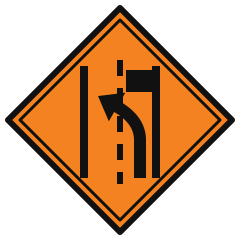
- Two lanes join from both sides
- A detour leaves the highway at the next exit
- Traffic must stop for workers
- A lane is closed; move into the open lane
Unless a different limit is posted, what is the maximum speed on a Nova Scotia highway?
- 90 km/h
- 70 km/h
- 100 km/h
- 80 km/h
You are in one of two lanes that will join under a merge sign. Who is responsible for a smooth merge?

- Whoever is driving faster
- Drivers in both lanes equally
- Only drivers in the lane that ends
- Only drivers in the through lane
When does the reduced school zone speed limit apply in Nova Scotia?
- Only when a crossing guard is on duty
- Whenever children are present, at any time of day
- Only during morning and afternoon recess
- Only on school days from 8 a.m. to 4 p.m.
Keep practising
- Nova Scotia Class 7 Mock Exam 1 – 40 QuestionsUntimed practice · answers explained
- Nova Scotia Class 7 Mock Exam 2 – 40 QuestionsUntimed practice · answers explained
- Nova Scotia Class 7 Mock Exam 4 – 40 QuestionsUntimed practice · answers explained
- Nova Scotia Class 7 Mock Exam 5 – 40 QuestionsUntimed practice · answers explained
- Nova Scotia Class 7 Practice Test 140 questions with explanations
- Nova Scotia Class 7 Practice Test 240 questions with explanations
- Nova Scotia Class 7 Practice Test 340 questions with explanations
- Nova Scotia Class 7 Practice Test 440 questions with explanations