
What does this sign warn you about?
Nova Scotia Class 7 Practice Test 3
40 questions on warning and guide signs, emergencies and collisions, traffic signals and crossing guards, your vehicle: inspection, equipment, registration and insurance, highways, school buses and sharing the road and more.
- No sign-up
- Every answer explained
- Independent · not a government site
- Set 3 of 8
- 40 questions
- Instant feedback
All 40 questions in this test
Every question and its answer choices. The correct answers and explanations appear when you take the test above.
What does this sign warn you about?
- Large animals may cross the road
- A farm vehicle crossing
- A wildlife park entrance is ahead
- A hunting area nearby
You smell smoke and see flames from under the hood. After stopping and turning off the ignition, how far away should everyone move?
- At least 10 metres
- At least 5 metres
- At least 30 metres
- At least 100 metres
What must you do at a flashing red traffic light?
- Stop, then go when it is safe, as at a stop sign
- Go through, since a flashing light means it is broken
- Wait until the light turns green
- Slow down and go with caution
You have just moved to Nova Scotia with your car. Within how many days must you register it here?
- 30 days
- 60 days
- 90 days
- 6 months
What lighting must a cyclist use when riding at night?
- Reflective tape only
- A white front light and a red rear reflector
- A red front light and a white rear light
- A yellow front light and a horn
How should you position your vehicle when going around a curve to the left?
- As far right as you can
- Close to the centre line
- On the right shoulder
- In the middle of your lane
After passing a car, when should you move back into the right lane?
- When its headlights appear in your rear-view mirror
- As soon as your front bumper is past it
- When its driver flashes their headlights to signal you
- When you are one car length ahead
From what age are passengers themselves legally responsible for wearing a seat belt?
- 16
- 12
- 14
- 18
You are in the inside lane of a two-lane roundabout and your exit is next. What should you do?
- Exit directly from the inside lane
- Stop and wait for a gap to exit
- Move to the outside lane first, then exit
- Signal left and exit
On a hill with a climbing lane, a sign says to use four-way flashers below 70 km/h. Your vehicle is slowing to 60 km/h. What should you do?
- Move to the left lane
- Pull onto the shoulder and stop until traffic clears
- Sound your horn as you climb
- Turn on your four-way flashers and keep right
May a Class 5N newly licensed driver use 100-series highways?
- No, not until Class 5
- Only in daylight hours
- Only with an experienced driver
- Yes, there is no highway restriction
Under ideal conditions, about how far does a car travelling at 80 km/h need to stop completely?
- About 200 metres
- About 60 metres
- About 90 metres
- About 140 metres
What is the only thing that removes alcohol from your body?
- Exercise
- Time
- Black coffee
- A cold shower
Which headlights should you use when driving at night in a city?
- High beams
- Fog lights only
- Low beams
- Parking lights
How many demerit points does passing a stopped school bus carry?
- 6
- 3
- 2
- 4
A pedestrian is about to cross at an intersection with no painted crosswalk lines. What must you do?
- Sound your horn and continue
- Keep going, since there is no marked crosswalk here
- Yield only if the pedestrian is a child
- Yield, because every intersection has a crosswalk
How long is a Nova Scotia learner's licence valid?
- Up to 2 years
- Up to 5 years
- 1 year
- 6 months
The red lights at a railway crossing start flashing as you approach. What must you do?
- Speed up to cross before the train
- Stop only if you can see a train
- Stop and go only when it is safe
- Slow down and cross with care
What is the longest you may leave a vehicle parked on a street or highway?
- 24 hours
- 12 hours
- 72 hours
- 48 hours
What is the minimum age to apply for a Class 7 learner's licence in Nova Scotia?
- 18
- 16
- 15
- 17
When are roads most dangerous after rain starts to fall?
- Only after the rain stops
- During the first 10 to 15 minutes
- After an hour of steady rain
- When puddles start to form
What is the maximum speed when you are within 30 metres of a railway crossing?
- 70 km/h
- 50 km/h
- 60 km/h
- 30 km/h
What does a red circle with a diagonal slash across a symbol tell you?
- The action is allowed only at night
- The action shown is allowed
- Watch for the hazard shown
- The action shown is not allowed
How close may you follow a fire truck that is responding to a call?
- No closer than 150 metres
- No closer than 300 metres
- No closer than 100 metres
- No closer than 50 metres
On a commuter route, a red X is lit above the lane you are in. What must you do?
- Use the lane for turning only
- Leave that lane; never drive under a red X
- Slow down and stay in the lane
- Stay in the lane if no other cars are in it
A curve warning sign has a small plate showing 50 km/h under it. What does the plate tell you?

- The speed limit for trucks only
- The new speed limit after the curve
- The safe speed for that curve
- The minimum speed on the curve
Why are red or orange flags sometimes attached to human activity signs?
- The zone has a lower speed limit
- The sign is placed close to the ground
- The work zone is ending soon
- Workers are about to blast rock
A front tire blows out at highway speed. What should you do?
- Speed up to keep control
- Hold the wheel firmly and ease off the gas
- Brake hard right away
- Steer sharply to the shoulder and brake hard
When leaving a controlled-access highway, when should you start slowing down?
- In the right through lane
- After you enter the deceleration lane
- Only once you reach the ramp's end
- Before you signal for the exit
You stop beside a car that is already parked at the curb so a passenger can get out. What is this called, and is it allowed?
- Double parking; it is not allowed
- Loading; it is always allowed
- Angle parking; it is allowed
- Standing; it is allowed briefly
You are taking an allergy medication. What does the handbook advise before driving?
- Nothing, since it is not a prescription
- Read its warnings and ask a pharmacist if unsure
- Drive only in daylight
- Take it with coffee to stay alert
What should you do when you see an orange sign like this?
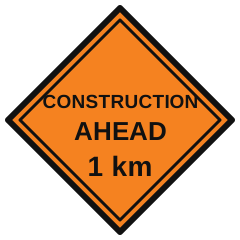
- Prepare for road work and changing conditions
- Expect a toll booth ahead
- Prepare to leave the highway
- Watch for a school bus loading zone just ahead
On a long drive, how often does the handbook suggest a short walking break?
- Every four hours, for 30 minutes
- Only when you feel sleepy
- Every hour, for one or two minutes
- Every 30 minutes, for 10 minutes
You pass this sign on a foggy night. How fast should you drive?

- Up to 60 km/h, since it is a guide
- Slower than 50 km/h, to suit conditions
- At least 50 km/h, to keep traffic moving
- Exactly 50 km/h, as posted
In which situation should you leave more than two seconds of following distance?
- When following a large truck that blocks your view
- When the car ahead is much faster
- When you are driving well below the posted speed limit
- When driving on a dry, clear road
On a two-lane road, the car ahead of you pulls out to pass a slow truck. What should you do?
- Wait until it finishes before you pass
- Sound your horn so it hurries
- Follow it closely and pass too
- Pass both on the right shoulder
Which conviction leads to automatic revocation of your licence?
- Refusing to give a breath sample
- Driving 10 km/h over the limit
- Parking too close to a hydrant
- Failing to signal a lane change
You are approaching a bridge and see this sign. What does it mean?

- The road narrows ahead
- A divided highway begins
- Two lanes merge from the right
- The road widens to two lanes
What is the minimum third-party liability insurance required in Nova Scotia?
- $100,000
- $200,000
- $1,000,000
- $500,000
You are passing in the left lane of a climbing lane and reach the solid line where it ends. What should you do?
- Sound your horn and move right
- Stop trying to pass and stay behind
- Pass on the shoulder instead
- Finish the pass by speeding up
All Nova Scotia Class 7 practice tests
- Nova Scotia Class 7 Mock Exam 1 – 40 QuestionsUntimed practice · answers explained
- Nova Scotia Class 7 Mock Exam 2 – 40 QuestionsUntimed practice · answers explained
- Nova Scotia Class 7 Mock Exam 3 – 40 QuestionsUntimed practice · answers explained
- Nova Scotia Class 7 Mock Exam 4 – 40 QuestionsUntimed practice · answers explained
- Nova Scotia Class 7 Mock Exam 5 – 40 QuestionsUntimed practice · answers explained
- Regulatory signsStop, yield and school zone signs, green-circle and red-slash signs, turn, passing, parking and stopping restrictions, one-way, keep-right, speed limit and accessible parking signs.
- Warning and guide signsYellow diamond warning signs for curves, narrowing roads, merges, lane endings, divided highways, bumps and hidden hazards, chevrons and checkerboards, lane-use arrows and green guide signs.
- Work zone signsOrange work zone signs, general, arrow, specific and human activity signs, traffic control persons, flashing arrow boards, lane closures and the main causes of work zone collisions.
- Railway crossingsThe crossbuck and advance railway warning sign, flashing lights and gates, vehicles that must stop at crossings, what to do if you are stuck on the tracks, and parking near a crossing.
- Traffic signals and crossing guardsGreen, yellow and red lights, right and left turns on red, arrow signals, flashing red, yellow and green signals, lane-control signals, dark signals, pedestrian Walk signals and crossing guards.
About this practice test
How many questions are in Nova Scotia Class 7 practice test 3?
40 original multiple-choice practice questions covering warning and guide signs, emergencies and collisions, traffic signals and crossing guards, your vehicle: inspection, equipment, registration and insurance, highways, school buses and sharing the road, speed, stopping distance and following, signals, turning, lane changes and passing, seat belts, child seats and safe driving habits, parking, roundabouts and driveways, pavement markings and special lanes, graduated licensing: class 7, 5n and restricted stage, impaired driving and fitness to drive, night driving and bad weather, demerit points and losing your licence, right of way, pedestrians and emergency vehicles, railway crossings, regulatory signs, work zone signs. Each answer includes an explanation. This mixed practice set does not reproduce the official exam format or predict an official score.
Are the questions the same every time?
Yes. Practice test 3 always has the same 40 questions, so you can repeat it until you get them all right. The other 7 sets use different questions.
Are these real test questions?
No. The official question bank is not published. These are original questions written from the official handbook, which is what the real Nova Scotia Class 7 test is based on.