Can you be charged with impaired driving if your blood alcohol is below .08?
Nova Scotia Class 7 overview
Nova Scotia Class 7 Practice Test 5
40 questions on impaired driving and fitness to drive, seat belts, child seats and safe driving habits, railway crossings, emergencies and collisions, highways, school buses and sharing the road and more.
- No sign-up
- Every answer explained
- Independent · not a government site
- Set 5 of 8
- 40 questions
- Instant feedback
0/40
All 40 questions in this test
Every question and its answer choices. The correct answers and explanations appear when you take the test above.
Can you be charged with impaired driving if your blood alcohol is below .08?
- Yes, if you show other signs of impairment
- No, .08 is the only legal limit police can use
- Only if you are under 19
- Only if there was a collision
Which hand positions on the steering wheel does the handbook recommend?
- Eight and four
- Twelve o'clock only
- Ten and two, or nine and three
- One hand at the bottom of the wheel
Traffic ahead of you is backed up past the far side of a railway crossing. What should you do?
- Move onto the tracks and wait
- Wait until there is room to clear the tracks
- Cross and stop between the rails
- Drive onto the shoulder to get around the line
Your right wheels drop off the pavement onto the soft shoulder. What should you do?
- Brake hard on the shoulder
- Speed up to climb the edge
- Jerk the wheel to get back on fast
- Steer back smoothly once you have control
Does the rule against passing a school bus with flashing red lights apply on a divided boulevard?
- Only during school hours
- Only for drivers behind the bus
- No, only on undivided roads
- Yes, it applies from either direction
You are passing another vehicle at night. Which headlights should you use?
- High beams once you pull out
- Parking lights only
- Low beams until you finish passing
- High beams the whole time
What colour are the signs that usually mark a work zone in Nova Scotia?
- White with red letters
- Green with white letters
- Yellow with black letters
- Orange with black letters
You are in the right lane and see this sign. What is happening ahead?

- A right turn lane begins
- The left lane ends
- A side road joins from the right
- The right lane ends
You are entering a roundabout. Who has the right of way?
- The vehicle on your right
- You, as the entering driver
- The larger vehicle
- Traffic already in the roundabout
A two-lane road has a broken yellow centre line. What does it allow?
- Passing for trucks only
- Passing for the right lane only
- No passing in either direction
- Passing with care in both directions
What does this sign warn you about?
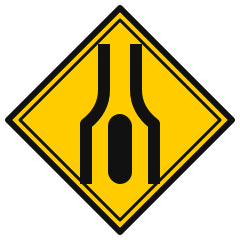
- A traffic island is coming up
- Two lanes merge into one ahead
- The divided highway ends; two-way traffic ahead
- A divided highway begins; lanes split around a median
What is the speed limit in a residential or business district if no other limit is posted?
- 40 km/h
- 60 km/h
- 30 km/h
- 50 km/h
In daylight, a load sticks out more than 1 metre past the rear of your truck. What must you display?
- A red flag at least 300 mm square
- An orange cone on the bumper
- Your four-way flashers
- A white cloth on the load
The light turns yellow just as you reach the intersection and you are too close to stop safely. What should you do?
- Speed up to beat the red light
- Drive through the intersection with caution
- Brake hard to stop in the crosswalk
- Stop in the middle of the intersection
An oncoming driver at night does not dim their high beams. What should you do?
- Look straight at their headlights
- Flash your high beams at them until they dim theirs
- Keep your low beams on and look slightly right
- Switch to high beams too
Police have stopped at a collision scene ahead. How close may you park to their vehicle?
- No closer than 60 metres
- No closer than 150 metres
- No closer than 30 metres
- No closer than 100 metres
Roundabouts are designed for what range of speeds?
- 50 to 70 km/h
- 10 to 20 km/h
- 30 to 50 km/h
- 60 to 80 km/h
You see this yellow sign on a country road. What does it tell you?
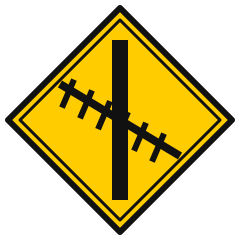
- A one-lane road crosses ahead
- A bridge with a steel grated deck is coming up ahead
- A railway crossing is ahead, at the angle shown
- A side road joins at an angle
You are driving behind a large truck and cannot see the driver in the truck's side mirror. What does that mean?
- The truck driver cannot see you
- You are at a safe distance
- The driver is about to turn
- The mirror is out of adjustment
The centre of the road is marked with continuous double solid yellow lines. May you cross them to pass?
- No, not in either direction
- Only to pass a slow vehicle
- Yes, if the road ahead is clear
- Yes, but only in daylight
What shape and colour is a school zone sign in Nova Scotia?
- Rectangular, white
- Five-sided, orange
- Diamond-shaped, yellow with black figures
- Five-sided, fluorescent yellow-green
A work zone sign warns of a difference in height between lanes. Why is this dangerous?
- Trucks may not fit under the edge
- Your vehicle may scrape its underside on a speed bump
- Water may pool and cause hydroplaning
- A tire catching the edge can cause loss of control
What blood alcohol level must a learner driver have?
- Zero
- Under .05
- Under .08
- Under .02
Who is responsible for making sure a 12-year-old passenger wears a seat belt?
- The child's parent, wherever they sit
- The driver
- The passenger
- The vehicle owner
When may you apply to have your licence restored after a suspension?
- 30 days before the suspension ends
- The day the suspension ends
- 60 days before the suspension ends
- One week after the suspension ends
You are making a right turn at an intersection. Why should you stay close to the right edge of the road?
- So you can see pedestrians coming from behind you
- So oncoming drivers can see you
- So you can turn faster
- So no vehicle can move between you and the curb
How far behind a large truck can its blind spot extend?
- Up to 20 feet
- Up to 500 feet
- Up to 50 feet
- Up to 200 feet
Your car fails its safety inspection. How long do you have to fix it and be re-inspected without paying a second fee?
- 48 hours
- 30 days
- 7 days
- 10 days
How many questions are on each part of the learner's knowledge test, and how many must you get right?
- 30 questions, 24 correct
- 25 questions, 20 correct
- 20 questions, 15 correct
- 20 questions, 16 correct
Which vehicles must display a slow-moving vehicle sign?

- Only farm tractors pulling a load
- Any truck over 4,500 kg
- Those that cannot keep a speed over 60 km/h
- Those that cannot keep a speed over 40 km/h
Your gas pedal sticks down. Which action does the handbook advise?
- Reach down and pull the pedal up by hand
- Turn the key off while still moving fast
- Pump the gas pedal hard
- Shift to neutral and brake firmly
You are walking along a road that has no sidewalk. Which way should you walk?
- In the middle of the lane
- Facing oncoming traffic
- On whichever side is smoother
- With your back to traffic
What happens if you are called in for an interview with a driver enhancement officer because of demerit points?
- You are fully tested again, including a road test
- Your points are cleared
- You must take a defensive driving course
- You pay a fine and keep driving
When is a left turn on a red light legal in Nova Scotia?
- Only when there is no oncoming traffic in either lane
- From a one-way street onto another one-way street
- Never, under any circumstances
- From any street after a full stop
At which temperature are icy road surfaces far more slippery?
- Below -30°C
- Near 0°C
- Around -10°C
- Around -20°C
What is the speed limit in a public park within a city or town, if no other limit is posted?
- 20 km/h
- 50 km/h
- 30 km/h
- 40 km/h
You believe you have the right of way, but another driver is about to pull out in front of you. What does the handbook say?
- Speed up to clear the intersection
- Sound your horn and keep your speed
- Keep going, since you are in the right
- Be ready to yield to avoid a collision
What does this sign require you to do?

- Slow down and give way, stopping if needed
- Give way only to pedestrians
- Speed up to merge ahead of traffic
- Come to a full stop every time
The roadside screening device reads fail. What happens next?
- You pay a fine at the roadside
- You must take a road test
- You receive a 24-hour suspension and are free to go
- You are arrested and given a breathalyzer test
Under the Administrative Licence Suspension Program, what happens if you fail the breathalyzer?
- An immediate 3-month suspension
- An immediate 7-day suspension
- A fine with no suspension
- An immediate 1-year revocation
All Nova Scotia Class 7 practice tests
- Nova Scotia Class 7 Mock Exam 1 – 40 QuestionsUntimed practice · answers explained
- Nova Scotia Class 7 Mock Exam 2 – 40 QuestionsUntimed practice · answers explained
- Nova Scotia Class 7 Mock Exam 3 – 40 QuestionsUntimed practice · answers explained
- Nova Scotia Class 7 Mock Exam 4 – 40 QuestionsUntimed practice · answers explained
- Nova Scotia Class 7 Mock Exam 5 – 40 QuestionsUntimed practice · answers explained
- Regulatory signsStop, yield and school zone signs, green-circle and red-slash signs, turn, passing, parking and stopping restrictions, one-way, keep-right, speed limit and accessible parking signs.
- Warning and guide signsYellow diamond warning signs for curves, narrowing roads, merges, lane endings, divided highways, bumps and hidden hazards, chevrons and checkerboards, lane-use arrows and green guide signs.
- Work zone signsOrange work zone signs, general, arrow, specific and human activity signs, traffic control persons, flashing arrow boards, lane closures and the main causes of work zone collisions.
- Railway crossingsThe crossbuck and advance railway warning sign, flashing lights and gates, vehicles that must stop at crossings, what to do if you are stuck on the tracks, and parking near a crossing.
- Traffic signals and crossing guardsGreen, yellow and red lights, right and left turns on red, arrow signals, flashing red, yellow and green signals, lane-control signals, dark signals, pedestrian Walk signals and crossing guards.
About this practice test
How many questions are in Nova Scotia Class 7 practice test 5?
40 original multiple-choice practice questions covering impaired driving and fitness to drive, seat belts, child seats and safe driving habits, railway crossings, emergencies and collisions, highways, school buses and sharing the road, signals, turning, lane changes and passing, work zone signs, warning and guide signs, parking, roundabouts and driveways, pavement markings and special lanes, speed, stopping distance and following, your vehicle: inspection, equipment, registration and insurance, traffic signals and crossing guards, night driving and bad weather, right of way, pedestrians and emergency vehicles, regulatory signs, graduated licensing: class 7, 5n and restricted stage, demerit points and losing your licence. Each answer includes an explanation. This mixed practice set does not reproduce the official exam format or predict an official score.
Are the questions the same every time?
Yes. Practice test 5 always has the same 40 questions, so you can repeat it until you get them all right. The other 7 sets use different questions.
Are these real test questions?
No. The official question bank is not published. These are original questions written from the official handbook, which is what the real Nova Scotia Class 7 test is based on.