Every question and its answer choices. The correct answers and explanations appear when you take the test above.
You see this sign in a work zone. What does it mean?
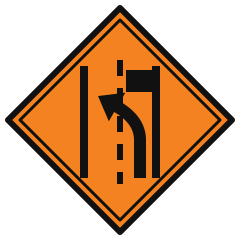
- Two lanes join from both sides
- A detour leaves the highway at the next exit
- Traffic must stop for workers
- A lane is closed; move into the open lane
When must your headlights be on?
- Only when street lights are off
- From one hour after sunset until sunrise the next morning
- From 30 minutes after sunset to 30 minutes before sunrise
- Only on highways at night
What is the maximum speed when you are within 30 metres of a railway crossing?
- 70 km/h
- 50 km/h
- 60 km/h
- 30 km/h
You are in the right lane and see this sign. What is happening ahead?

- A right turn lane begins
- The left lane ends
- A side road joins from the right
- The right lane ends
While driving on your learner's licence with your supervising driver, may your friend ride in the back seat?
- Yes, one passenger is allowed
- No, no other passengers are allowed
- Only if they also hold a licence
- Yes, if they wear a seat belt
On a multi-lane road, what do white lane lines separate?
- Lanes moving in the same direction
- Turning lanes from bus lanes
- The road from the shoulder only
- Lanes moving in opposite directions
The rule to yield to a transit bus re-entering traffic does not apply to which vehicle?
- A bus on a 60 km/h road
- A city bus on a 50 km/h street
- A school bus
- An accessible transit bus
You smell smoke and see flames from under the hood. After stopping and turning off the ignition, how far away should everyone move?
- At least 10 metres
- At least 5 metres
- At least 30 metres
- At least 100 metres
What does this sign require you to do?

- Slow down and give way, stopping if needed
- Give way only to pedestrians
- Speed up to merge ahead of traffic
- Come to a full stop every time
You are stopped at a red light where a sign shows no right turn on red. When may you turn right?
- Only if no pedestrians are waiting
- When the yellow light comes on
- After stopping, if the way is clear
- Only after the light turns green
You are approaching an intersection with this sign. What must you do?

- Stop only if other vehicles or people are present
- Slow down and go if no one is coming
- Give way only to vehicles on your right
- Stop completely and go only when the way is clear
What does this sign tell you at an intersection?

- You may not turn to go back the way you came
- A sharp curve is ahead
- You may not turn left here
- Traffic flows in a circle around an island ahead
How do you check that you are following at a safe distance using the two-second rule?
- Leave two car lengths for every 10 km/h
- Brake two seconds after the car ahead starts braking
- Look ahead two blocks at all times
- Count 2 seconds once the car ahead passes a landmark
You are approaching a bridge and see this sign. What does it mean?

- The road narrows ahead
- A divided highway begins
- Two lanes merge from the right
- The road widens to two lanes
A flashing light unit ahead shows a single arrow pointing left. How may you pass it?

- Only on the right side
- On either side
- You may not pass it
- Only on the left side
What kind of road does a Highway 102 route marker indicate?
- A seasonal gravel road
- A local municipal street in a town or city
- A scenic tourist route
- A controlled-access 100-series highway
During which period are studded tires legal in Nova Scotia?
- November 1 to March 31
- October 15 to April 30
- October 1 to May 31
- December 1 to April 15
On a two-lane road, the car ahead of you pulls out to pass a slow truck. What should you do?
- Wait until it finishes before you pass
- Sound your horn so it hurries
- Follow it closely and pass too
- Pass both on the right shoulder
In which situation should you leave more than two seconds of following distance?
- When following a large truck that blocks your view
- When the car ahead is much faster
- When you are driving well below the posted speed limit
- When driving on a dry, clear road
A school bus ahead has its red lights flashing and stop arm out. You are behind it. What must you do?
- Stop and stay stopped
- Slow down and pass with care
- Stop, then pass if no children
- Pass slowly on the left
What does this sign tell you about the road ahead?

- It has loose gravel only
- It is under construction
- It has sharp curves
- It is slippery when wet
A work zone sign warns of a difference in height between lanes. Why is this dangerous?
- Trucks may not fit under the edge
- Your vehicle may scrape its underside on a speed bump
- Water may pool and cause hydroplaning
- A tire catching the edge can cause loss of control
In daylight, a load sticks out more than 1 metre past the rear of your truck. What must you display?
- A red flag at least 300 mm square
- An orange cone on the bumper
- Your four-way flashers
- A white cloth on the load
What does this warning sign mean?

- A narrow structure such as a bridge is ahead
- A tunnel with low clearance
- Two lanes join from both sides
- A divided highway ends and two-way traffic begins
Your engine dies while driving and you lose power steering and power brakes. What happens?
- You can still steer and brake, with more effort
- The car stops on its own
- The steering wheel locks and can no longer be turned
- The brakes stop working entirely
How should you position your vehicle when going around a curve to the left?
- As far right as you can
- Close to the centre line
- On the right shoulder
- In the middle of your lane
There are two left-turn lanes and you start your turn from the right one. Which lane should you end up in?
- Either lane, whichever is empty
- The curb lane, then the left lane
- The right-hand receiving lane
- The left-hand receiving lane
Your right wheels drop off the pavement onto the soft shoulder. What should you do?
- Brake hard on the shoulder
- Speed up to climb the edge
- Jerk the wheel to get back on fast
- Steer back smoothly once you have control
A newly licensed (Class 5N) driver reaches how many demerit points before a 6-month suspension?
- 8
- 10
- 6
- 4
A flashing light unit shows a straight bar of lights. What does this caution mode mean?
- It is safe to pass the hazard on either side now
- Traffic must stop and wait
- The work zone has ended
- A hazard is ahead; judge whether passing is safe
Does the rule against passing a school bus with flashing red lights apply on a divided boulevard?
- Only during school hours
- Only for drivers behind the bus
- No, only on undivided roads
- Yes, it applies from either direction
You pass this sign on a foggy night. How fast should you drive?

- Up to 60 km/h, since it is a guide
- Slower than 50 km/h, to suit conditions
- At least 50 km/h, to keep traffic moving
- Exactly 50 km/h, as posted
You are driving out of a driveway onto a residential street. Where must you stop first?
- Just before the sidewalk
- Only if a pedestrian is visible
- At the edge of the street
- After crossing the sidewalk
You are in one of two lanes that will join under a merge sign. Who is responsible for a smooth merge?

- Whoever is driving faster
- Drivers in both lanes equally
- Only drivers in the lane that ends
- Only drivers in the through lane
You face a green light and a green left-turn arrow. What controls your left turn?
- The oncoming traffic light
- The pedestrian signal
- The solid green light
- The green arrow
The centre lane is marked as a two-way-left-turn lane. A slow truck is ahead of you. May you use the centre lane to pass it?
- Only if you signal first
- No, the lane is only for left turns
- Yes, if no one is turning
- Yes, if you stay in it for under 100 metres
You are convicted of failing to obey a school crossing guard. How many demerit points are added?
- 6
- 2
- 4
- 3
Why must you never try to beat a train to a crossing?
- Trains always have a whistle
- Some trains need over a kilometre to stop
- Trains are required to slow down at crossings
- The gate will trap your car
Unless a different limit is posted, what is the maximum speed on a Nova Scotia highway?
- 90 km/h
- 70 km/h
- 100 km/h
- 80 km/h
You are within 15 metres of a rural intersection where you can see less than 60 metres along the cross road. You are not on a through highway. What is the maximum speed?
- 70 km/h
- 30 km/h
- 50 km/h
- 60 km/h