Why is a do not pass sign often posted before a work zone lane closure?
Nova Scotia Class 7 overview
Nova Scotia Class 7 Practice Test 1
40 questions on work zone signs, signals, turning, lane changes and passing, seat belts, child seats and safe driving habits, right of way, pedestrians and emergency vehicles, emergencies and collisions and more.
- No sign-up
- Every answer explained
- Independent · not a government site
- Set 1 of 8
- 40 questions
- Instant feedback
0/40
All 40 questions in this test
Every question and its answer choices. The correct answers and explanations appear when you take the test above.
Why is a do not pass sign often posted before a work zone lane closure?
- To slow traffic to a full stop
- To reserve the lane for workers
- To set up an orderly merge
- To let trucks use both lanes
Why does the handbook say you must sound your horn before passing another vehicle?
- It legally obliges that driver to help you pass
- It is only a courtesy and is optional
- It warns oncoming drivers to slow down
- It tells the driver to speed up
At speeds above 40 km/h, why is steering around an object usually better than braking?
- Steering keeps your speed legal
- Steering needs less distance than stopping
- Braking above 40 km/h is illegal
- Hard braking above 40 km/h can damage the ABS
You and an oncoming car arrive at an intersection at the same time. You want to turn left; the other driver is going straight. What do you do?
- Wave the other driver to turn
- Go first, since you are turning
- Turn first, since you signalled
- Yield and turn when it is safe
Within what time must a reportable collision be reported to police or the Registry of Motor Vehicles?
- Within 24 hours
- Within 72 hours
- Within 1 hour
- Within 7 days
Is hitchhiking legal in Nova Scotia?
- No, it is illegal
- Yes, except on 100-series highways
- Only during daylight
- Yes, on any road
Why must you never try to beat a train to a crossing?
- Trains always have a whistle
- Some trains need over a kilometre to stop
- Trains are required to slow down at crossings
- The gate will trap your car
You see this sign in a work zone. What does it mean?
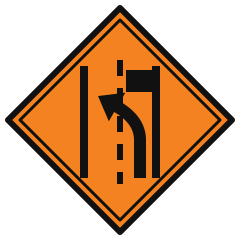
- Two lanes join from both sides
- A detour leaves the highway at the next exit
- Traffic must stop for workers
- A lane is closed; move into the open lane
What does this sign tell you?

- A railway crossing is ahead
- A parade route is ahead
- A school crossing is ahead
- A traffic control person is ahead
A peace officer directing traffic waves you through an intersection that has a stop sign. What do you do?
- Obey whichever you saw first
- Stop at the sign first, then go
- Wait until the officer leaves
- Follow the officer's direction
You have parked on a busy street. What should you do before opening your door?
- Open it slowly while looking ahead
- Turn on your hazard lights
- Sound your horn
- Look behind for approaching cyclists
You are driving at the speed limit in the left lane of a four-lane highway. What should you do?
- Move to the right lane when it is safe
- Speed up so others cannot pass
- Stay left until your exit
- Stay left, since you are at the limit
As a learner, how many demerit points lead to a 6-month suspension?
- 2
- 10
- 4
- 6
While driving on your learner's licence with your supervising driver, may your friend ride in the back seat?
- Yes, one passenger is allowed
- No, no other passengers are allowed
- Only if they also hold a licence
- Yes, if they wear a seat belt
From what distance must a vehicle's brake lights be visible in normal sunlight?
- 30 metres
- 150 metres
- 100 metres
- 60 metres
Your engine dies while driving and you lose power steering and power brakes. What happens?
- You can still steer and brake, with more effort
- The car stops on its own
- The steering wheel locks and can no longer be turned
- The brakes stop working entirely
What do continuity lines at highway ramps show?
- Where the through lane and the ramp separate
- Where you must stop
- Where the speed limit changes for the exit ramp
- Where passing is allowed
A loud argument breaks out among your passengers while you drive. What should you do?
- Drive faster to get home sooner
- Join in to settle it quickly
- Turn up the radio and keep driving
- Pull off the road safely and deal with it
You push down hard on one corner of your car and it bounces more than once. What does this suggest?
- The wheels are out of alignment
- The brakes are wearing out
- The tire pressure is too high
- The shock absorber may need replacing
You are following a vehicle with a hazardous materials placard toward a railway crossing. What should you expect?
- It will pull onto the shoulder
- It must use a different route
- It may stop at the crossing
- It will speed up to cross
What minimum visual acuity is required for a Class 5 or Class 7 licence?
- 20/30 in each eye
- 20/50 in the better eye
- 20/20 in both eyes
- 20/40 in at least one eye
When must your headlights be on?
- Only when street lights are off
- From one hour after sunset until sunrise the next morning
- From 30 minutes after sunset to 30 minutes before sunrise
- Only on highways at night
You are within 15 metres of a rural intersection where you can see less than 60 metres along the cross road. You are not on a through highway. What is the maximum speed?
- 70 km/h
- 30 km/h
- 50 km/h
- 60 km/h
You park facing uphill on a rural road with no curb. Which way should you turn your wheels?
- Toward the oncoming lane
- To the left
- To the right
- Straight ahead
The light turns green as you wait at an intersection. A pedestrian is still in the crosswalk. What do you do?
- Drive around the pedestrian carefully
- Go, since the green gives you the right of way
- Wait for the pedestrian to finish crossing
- Sound your horn so the pedestrian hurries
Outside business and residential districts, how close may a commercial truck driver follow another vehicle on a highway, except when passing?
- No closer than 60 metres
- No closer than 100 metres
- No closer than 150 metres
- No closer than 30 metres
On a divided highway, an ambulance is stopped on the shoulder on the other side of the median. Must you slow down and move over?
- Yes, to 60 km/h
- No, the rule does not apply
- Yes, and you must change lanes
- Only at night
What does a hidden intersection warning sign tell you?
- The intersection has no stop signs
- The intersection is closed to traffic
- You must come to a stop before the intersection
- Side-road drivers cannot clearly see you coming
You see this sign on a rural highway. What should you watch for?
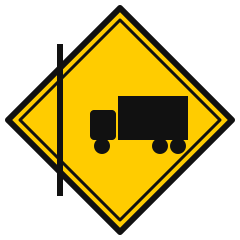
- Trucks entering the road ahead
- A steep hill for trucks
- A lane for trucks only
- A truck weigh station ahead
A learner wants to ride a motorcycle on a public road. Is this allowed?
- Only in daylight hours
- Yes, on roads under 50 km/h
- Yes, with an experienced rider
- No, except during an exam
You pass a cyclist and then turn right just in front of them. What is this common collision called?
- A left cross
- Getting doored
- A right hook
- A rear-end
How close to the nearest rail of a railway crossing may you park?
- No closer than 30 metres
- No closer than 5 metres
- No closer than 10 metres
- No closer than 15 metres
On a multi-lane road, what do white lane lines separate?
- Lanes moving in the same direction
- Turning lanes from bus lanes
- The road from the shoulder only
- Lanes moving in opposite directions
There are two left-turn lanes and you start your turn from the right one. Which lane should you end up in?
- Either lane, whichever is empty
- The curb lane, then the left lane
- The right-hand receiving lane
- The left-hand receiving lane
What does this sign mean?

- Keep a safe following distance
- Do not pass
- Two-way traffic ahead
- Passing is permitted
You are following another car at night. Within what distance must you switch to low beams?
- 200 metres
- 30 metres
- 60 metres
- 150 metres
After a demerit suspension you receive a probationary licence. What happens if you get 3 new points during it?
- Another 6-month suspension
- A required interview
- A 1-month suspension
- A warning letter
You drive into an underground parking garage on a bright sunny day. What does the handbook advise?
- Slow down, remove sunglasses, turn on headlights
- Switch on your four-way flashers
- Keep your sunglasses on until you are fully parked
- Speed up to get out of the glare
You are stopped at a red light and want to turn right. No sign prohibits it. What may you do?
- Turn only if a green arrow appears
- Turn right after stopping, when it is safe
- Wait for the green light
- Turn right without stopping
When you park along a curb, how close must your curbside wheels be?
- Within 1 metre
- Within 15 cm
- Within 50 cm
- Within 30 cm
All Nova Scotia Class 7 practice tests
- Nova Scotia Class 7 Mock Exam 1 – 40 QuestionsUntimed practice · answers explained
- Nova Scotia Class 7 Mock Exam 2 – 40 QuestionsUntimed practice · answers explained
- Nova Scotia Class 7 Mock Exam 3 – 40 QuestionsUntimed practice · answers explained
- Nova Scotia Class 7 Mock Exam 4 – 40 QuestionsUntimed practice · answers explained
- Nova Scotia Class 7 Mock Exam 5 – 40 QuestionsUntimed practice · answers explained
- Regulatory signsStop, yield and school zone signs, green-circle and red-slash signs, turn, passing, parking and stopping restrictions, one-way, keep-right, speed limit and accessible parking signs.
- Warning and guide signsYellow diamond warning signs for curves, narrowing roads, merges, lane endings, divided highways, bumps and hidden hazards, chevrons and checkerboards, lane-use arrows and green guide signs.
- Work zone signsOrange work zone signs, general, arrow, specific and human activity signs, traffic control persons, flashing arrow boards, lane closures and the main causes of work zone collisions.
- Railway crossingsThe crossbuck and advance railway warning sign, flashing lights and gates, vehicles that must stop at crossings, what to do if you are stuck on the tracks, and parking near a crossing.
- Traffic signals and crossing guardsGreen, yellow and red lights, right and left turns on red, arrow signals, flashing red, yellow and green signals, lane-control signals, dark signals, pedestrian Walk signals and crossing guards.
About this practice test
How many questions are in Nova Scotia Class 7 practice test 1?
40 original multiple-choice practice questions covering work zone signs, signals, turning, lane changes and passing, seat belts, child seats and safe driving habits, right of way, pedestrians and emergency vehicles, emergencies and collisions, railway crossings, regulatory signs, highways, school buses and sharing the road, speed, stopping distance and following, demerit points and losing your licence, graduated licensing: class 7, 5n and restricted stage, your vehicle: inspection, equipment, registration and insurance, pavement markings and special lanes, impaired driving and fitness to drive, parking, roundabouts and driveways, traffic signals and crossing guards, warning and guide signs, night driving and bad weather. Each answer includes an explanation. This mixed practice set does not reproduce the official exam format or predict an official score.
Are the questions the same every time?
Yes. Practice test 1 always has the same 40 questions, so you can repeat it until you get them all right. The other 7 sets use different questions.
Are these real test questions?
No. The official question bank is not published. These are original questions written from the official handbook, which is what the real Nova Scotia Class 7 test is based on.