A roadside screening device shows warn, meaning a BAC between .05 and .08. What can police do?
Nova Scotia Class 7 overview
Nova Scotia Class 7 Practice Test 8
40 questions on impaired driving and fitness to drive, your vehicle: inspection, equipment, registration and insurance, right of way, pedestrians and emergency vehicles, demerit points and losing your licence, speed, stopping distance and following and more.
- No sign-up
- Every answer explained
- Independent · not a government site
- Set 8 of 8
- 40 questions
- Instant feedback
0/40
All 40 questions in this test
Every question and its answer choices. The correct answers and explanations appear when you take the test above.
A roadside screening device shows warn, meaning a BAC between .05 and .08. What can police do?
- Suspend your licence for 7, 15 or 30 days
- Give you a warning only
- Revoke your licence for one year, on the spot
- Nothing, since you are under .08
You push down hard on one corner of your car and it bounces more than once. What does this suggest?
- The wheels are out of alignment
- The brakes are wearing out
- The tire pressure is too high
- The shock absorber may need replacing
You are in the right lane of a two-lane highway going your way, and a tow truck is stopped at a collision on the shoulder. What else must you do besides slowing down?
- Turn on your high beams
- Sound your horn as you pass
- Move into the left lane if it is safe
- Stop behind the tow truck until it leaves
How long do demerit points stay on your Nova Scotia driving record?
- 1 year from the offence date
- 5 years from the offence date
- 2 years from the conviction date
- 3 years from the conviction date
Unless a different limit is posted, what is the maximum speed on a Nova Scotia highway?
- 90 km/h
- 70 km/h
- 100 km/h
- 80 km/h
How often must a vehicle registered in Nova Scotia pass a safety inspection?
- Only when it is sold
- Every five years
- Every two years
- Every year
You are stopped in the intersection waiting to turn left. Which way should your front wheels point?
- Turned to the left
- Slightly toward the centre line
- Turned to the right
- Straight ahead
A Class 5N driver must drive to a job that starts at 4 a.m. What can they do?
- Take a passenger aged 18 or older
- Drive, since work trips are always allowed
- Get a letter from the employer to carry
- Apply to the Registry for a curfew exemption
What do green rectangular signs with white letters give you?
- Warnings of hazards ahead
- Construction zone instructions and detours
- Directions, route numbers and distances
- Laws you must obey
You are driving and a car ahead starts pulling out of a parallel parking space. What should you do?
- Change lanes without checking
- Slow down and be ready to stop
- Speed up to pass it first
- Sound your horn and keep going
You are changing lanes on a three-lane highway. Besides the lane you want, which lane should you check?
- Nothing else, once you signal
- Only the lane you are leaving
- The lane beyond it
- The shoulder on your right
You are driving toward a school bus that has stopped with its red lights flashing on the opposite side of an undivided road. What must you do?
- Stop before reaching the bus
- Slow to 30 km/h and pass
- Sound your horn and pass
- Keep going, since it is across the road
What shape and colours do most warning signs in Nova Scotia have?
- Rectangle, white on green
- Diamond, black on yellow
- Diamond, black on orange
- Triangle, red on white
You pass a cyclist and then turn right just in front of them. What is this common collision called?
- A left cross
- Getting doored
- A right hook
- A rear-end
A sign over the centre lane shows two curved arrows pointing in opposite directions. How may that lane be used?
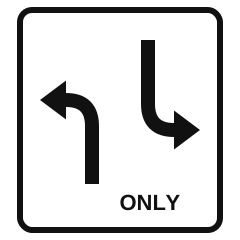
- By buses and taxis only
- By vehicles merging onto the road
- Only by vehicles turning left
- By vehicles passing in either direction
You are backing straight out of a driveway. Where should you look?
- In the left side mirror
- Over your right shoulder, turning your body
- In the rear-view mirror, keeping your head forward
- Out the driver's side window
What does this sign tell you?

- A railway crossing is ahead
- A parade route is ahead
- A school crossing is ahead
- A traffic control person is ahead
A rural school zone is on a road posted at 80 km/h. Children are in the schoolyard. What is the most you may drive through the zone?
- 60 km/h
- 70 km/h
- 50 km/h
- 30 km/h
Who may ride in a travel trailer while it is being towed on the highway?
- Adults wearing seat belts
- No one
- Up to two passengers
- Children under supervision
At which GDL stage may you first upgrade to a higher licence class, such as a truck licence?
- The newly licensed driver stage
- The learner stage
- The restricted individual stage
- Only after leaving GDL
What does this checkered sign with an arrow warn you about?
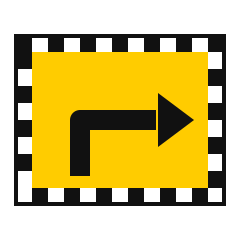
- A detour route for trucks
- A dead end; turn around ahead
- A railway crossing at a sharp angle to the road
- A sharp turn; slow down and follow the arrow
You are 17 and want your learner's licence. What extra document do you need?
- Proof of a driving course
- A letter from your school
- A doctor's certificate
- A signed consent form
You are driving past a church on a road posted at 70 km/h while people are leaving a service. What is your maximum speed?
- 60 km/h
- 70 km/h
- 50 km/h
- 30 km/h
Which sign is the only one in Nova Scotia that uses an eight-sided shape?
- The stop sign
- The yield sign
- The school zone sign
- The railway crossing sign
A child weighs 15 kg. What restraint does the handbook require?
- A rear-facing infant seat
- A booster seat used with the lap belt only
- A forward-facing seat with a tether strap
- An adult seat belt
As a Class 5N newly licensed driver, how many passengers may ride in the front seat?
- Two
- As many as there are seat belts
- None
- One
You hold a Class 7 learner's licence. Who must be in the vehicle when you drive?
- A parent, in any seat
- Nobody, on roads under 80 km/h
- Any licensed adult in the rear seat
- An experienced driver in the front seat
How often must you renew your Nova Scotia driver's licence?
- Every 3 years
- Every 5 years
- Every 2 years
- Every 10 years
You move to Nova Scotia from a country other than Canada or the USA. What must you usually do to get a licence?
- Take only the written tests
- Exchange your licence at a counter
- Take only the road test
- Pass vision, written and road tests
You pass this sign after leaving a divided highway. What does it tell you?

- Normal two-way road rules now apply
- A one-way street is ahead
- Passing is not allowed here
- Two lanes go the same direction
What does this sign tell you at an intersection?

- You may not turn to go back the way you came
- A sharp curve is ahead
- You may not turn left here
- Traffic flows in a circle around an island ahead
What does this sign tell you about the road ahead?

- It has loose gravel only
- It is under construction
- It has sharp curves
- It is slippery when wet
When does the reduced school zone speed limit apply in Nova Scotia?
- Only when a crossing guard is on duty
- Whenever children are present, at any time of day
- Only during morning and afternoon recess
- Only on school days from 8 a.m. to 4 p.m.
This sign is posted on the street you want to enter. What does it mean?

- The lane ends in that direction
- Detour in the arrow's direction
- Traffic may travel only in the arrow's direction
- You must turn in the arrow's direction at this corner
How do you check that you are following at a safe distance using the two-second rule?
- Leave two car lengths for every 10 km/h
- Brake two seconds after the car ahead starts braking
- Look ahead two blocks at all times
- Count 2 seconds once the car ahead passes a landmark
What does the long driver training course involve, which lets a learner take the road test after only 3 months?
- 25 hours of classroom and 10 hours of driving
- 6 hours of classroom time only
- 10 hours of classroom and 25 hours of driving
- 20 hours of classroom and 5 hours of driving
What is the minimum time a driver stays in the newly licensed (Class 5N) stage?
- 3 years
- 1 year
- 2 years
- 6 months
You stop at a stop sign on a street with no stop line and no painted crosswalk. How far back should you stop?
- One full car length past the sign
- Far enough back for a pedestrian to cross safely
- Right at the edge of the cross street you are entering
- Wherever you can see both ways
Before getting your licence back after an alcohol-related revocation, what program must you complete?
- A long driver training course
- A defensive driving course
- An Alcohol Assessment Program
- A first aid course
How high should the top of your head restraint be?
- Just below your eyes
- About 7 cm above eye level
- Level with your neck
- Level with your shoulders
All Nova Scotia Class 7 practice tests
- Nova Scotia Class 7 Mock Exam 1 – 40 QuestionsUntimed practice · answers explained
- Nova Scotia Class 7 Mock Exam 2 – 40 QuestionsUntimed practice · answers explained
- Nova Scotia Class 7 Mock Exam 3 – 40 QuestionsUntimed practice · answers explained
- Nova Scotia Class 7 Mock Exam 4 – 40 QuestionsUntimed practice · answers explained
- Nova Scotia Class 7 Mock Exam 5 – 40 QuestionsUntimed practice · answers explained
- Regulatory signsStop, yield and school zone signs, green-circle and red-slash signs, turn, passing, parking and stopping restrictions, one-way, keep-right, speed limit and accessible parking signs.
- Warning and guide signsYellow diamond warning signs for curves, narrowing roads, merges, lane endings, divided highways, bumps and hidden hazards, chevrons and checkerboards, lane-use arrows and green guide signs.
- Work zone signsOrange work zone signs, general, arrow, specific and human activity signs, traffic control persons, flashing arrow boards, lane closures and the main causes of work zone collisions.
- Railway crossingsThe crossbuck and advance railway warning sign, flashing lights and gates, vehicles that must stop at crossings, what to do if you are stuck on the tracks, and parking near a crossing.
- Traffic signals and crossing guardsGreen, yellow and red lights, right and left turns on red, arrow signals, flashing red, yellow and green signals, lane-control signals, dark signals, pedestrian Walk signals and crossing guards.
About this practice test
How many questions are in Nova Scotia Class 7 practice test 8?
40 original multiple-choice practice questions covering impaired driving and fitness to drive, your vehicle: inspection, equipment, registration and insurance, right of way, pedestrians and emergency vehicles, demerit points and losing your licence, speed, stopping distance and following, signals, turning, lane changes and passing, graduated licensing: class 7, 5n and restricted stage, warning and guide signs, parking, roundabouts and driveways, highways, school buses and sharing the road, work zone signs, regulatory signs, seat belts, child seats and safe driving habits. Each answer includes an explanation. This mixed practice set does not reproduce the official exam format or predict an official score.
Are the questions the same every time?
Yes. Practice test 8 always has the same 40 questions, so you can repeat it until you get them all right. The other 7 sets use different questions.
Are these real test questions?
No. The official question bank is not published. These are original questions written from the official handbook, which is what the real Nova Scotia Class 7 test is based on.