A car ahead of you in the next lane has stopped at a crosswalk. What should you do?
Nova Scotia Class 7 overview
Nova Scotia Class 7 Practice Test 6
40 questions on right of way, pedestrians and emergency vehicles, traffic signals and crossing guards, pavement markings and special lanes, warning and guide signs, work zone signs and more.
- No sign-up
- Every answer explained
- Independent · not a government site
- Set 6 of 8
- 40 questions
- Instant feedback
0/40
All 40 questions in this test
Every question and its answer choices. The correct answers and explanations appear when you take the test above.
A car ahead of you in the next lane has stopped at a crosswalk. What should you do?
- Pass it slowly with care
- Stop; do not pass it
- Sound your horn and pass
- Pass it if no one is visible
A crossing guard near a school holds up a stop paddle facing you. What must you do?
- Stop only if a child is crossing
- Stop and obey the guard
- Slow down and drive around
- Sound your horn and proceed
You plan to use a two-way-left-turn lane. When should you move into it?
- Close to where you will turn
- As soon as the lane begins
- Only after stopping in your lane
- At least one block before the turn
You see this sign before a long downhill stretch. What does the handbook suggest?

- Shift to neutral to save fuel
- You may need to use a lower gear
- Pull over and check your brakes
- Speed up to keep your momentum
A blasting zone sign is often posted with a sign asking you to do what?
- Turn on your high beams
- Roll down your windows
- Shut off your radio transmitter
- Sound your horn as you pass
Why should you use low beams instead of high beams in fog or snow?
- High beams drain the battery
- High beams reflect off the precipitation
- Low beams reach farther ahead
- High beams are illegal from December to March
What is the minimum revocation for a third impaired driving conviction?
- 10 years
- 5 years
- Permanent
- 3 years
When parallel parking, how far from the parked car ahead of the space should you pull up alongside?
- About 3 metres
- About 30 cm
- About 1 metre
- About 2 metres
On a divided highway you notice a solid yellow line on your right and a solid white line on your left. What does this mean?
- You are in a passing lane
- The lanes are about to merge
- You are driving the wrong way
- You are on an exit ramp
You are convicted of failing to obey a school crossing guard. How many demerit points are added?
- 6
- 2
- 4
- 3
You pass your road test. Within what time must you upgrade your licence before you have to take the test again?
- 30 days
- 6 months
- 3 months
- 1 year
What does this sign at an intersection mean?
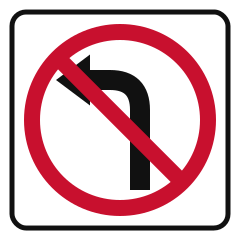
- Right turns are not allowed
- The road curves to the left
- Left turns are allowed only
- Left turns are not allowed
Which parts of the road freeze first in cold weather?
- Roads near the ocean
- Uphill sections of road
- Sunny, open stretches of flat highway
- Bridges, overpasses and shaded areas
Who may have demerit points removed by completing a defensive driving course?
- Learners holding Class 7
- Any driver with a probationary licence
- Newly licensed Class 5N drivers
- Experienced drivers in Classes 1–5
According to the handbook, what causes the most collisions in work zones?
- Vehicles travelling at different speeds
- Loose gravel on the road
- Workers stepping out into the traffic lanes
- Poor lighting at night
You are in one of two lanes that will join under a merge sign. Who is responsible for a smooth merge?

- Whoever is driving faster
- Drivers in both lanes equally
- Only drivers in the lane that ends
- Only drivers in the through lane
A school bus ahead turns on its flashing amber lights. What does this mean?
- It is stopped to unload children
- It is about to stop; take extra care
- It is turning right at the corner
- It is safe to pass at normal speed
For a first impaired driving conviction in Nova Scotia, how long is your licence revoked?
- 3 months from conviction
- 1 year from conviction
- 3 years from conviction
- 6 months from conviction
You are stopped at a red light where a sign shows no right turn on red. When may you turn right?
- Only if no pedestrians are waiting
- When the yellow light comes on
- After stopping, if the way is clear
- Only after the light turns green
From what distance must your horn be heard?
- 30 metres
- 150 metres
- 60 metres
- 15 metres
Why should you leave extra space when following a motorcycle?
- It is not allowed to use its full lane
- It has no brake lights
- It can stop more quickly than your car
- Its rider may wave you past
You are already on the tracks when the warning lights start flashing. What should you do?
- Stop where you are and wait
- Stop and back up off the tracks
- Get out and leave the vehicle
- Keep moving and clear the crossing
A 16-year-old applicant's parents have both died and there is no legal guardian. Who may sign the consent form?
- The applicant's employer
- A school principal
- Any adult relative
- A licensed driving instructor
Signal lights are required instead of hand signals when the vehicle or its load extends how far to the left of the centre of the steering wheel?
- More than 60 cm
- More than 1 metre
- More than 30 cm
- More than 2 metres
Why should you not use water on a vehicle fire?
- Water makes too much smoke
- Water causes electrical shocks
- Water spreads gasoline and oil fires
- Water damages the engine
What is the only item allowed at the lower driver's corner of the windshield?
- The official inspection sticker
- A parking pass
- A GPS mount
- A toll transponder for the highway
You are driving at night with high beams on. Within what distance of an oncoming vehicle must you dim them?
- 300 metres
- 100 metres
- 60 metres
- 150 metres
A flashing light unit ahead shows a single arrow pointing left. How may you pass it?

- Only on the right side
- On either side
- You may not pass it
- Only on the left side
How much of the lane is a motorcycle entitled to use?
- The right third of the lane
- Only the right shoulder
- The full lane
- Half the lane
Your brake pedal suddenly goes to the floor. What should you try first?
- Pull the parking brake hard at once
- Pump the brake pedal several times
- Shift into reverse
- Turn the engine off
Where must you stop for a red light?
- At the stop line or the near side of the crosswalk
- Anywhere inside the intersection, once fully stopped
- Just past the crosswalk
- Beside the traffic light pole
The light changes to red while a pedestrian is still in the middle of the street. What must you do?
- Go as soon as your light turns green again
- Sound your horn to warn them
- Let the pedestrian finish crossing safely
- Drive slowly behind them
You want to park on the approach to a stop sign at the side of the road. How far back from it must you be?
- At least 7.5 metres
- At least 20 metres
- At least 5 metres
- At least 10 metres
On a dim, rainy afternoon you cannot see a person 300 metres ahead. Which lights must you use?
- Headlights
- Parking lights
- Daytime running lights
- Fog lights only
The crossing gates begin to lower as you approach the tracks. Where do you stop?
- Before the gate on your side of the road
- Beside the gate, so you can see
- Just past the first set of rails, then wait
- Wherever you can stop quickly
You see a playground sign ahead. What does the handbook tell you to do?
- Stop and wait for children to cross
- Sound your horn as you pass
- Keep your speed but stay right
- Reduce speed and watch for children
An ambulance with its siren and lights on is approaching from behind. What must you do?
- Pull to the right edge and stop
- Move to the left lane and slow down
- Stop where you are in your lane
- Speed up to get out of its way
What does the handbook say about shifting gears during a turn?
- Do not shift after entering the intersection
- Shift up as soon as you start turning
- Shift down in the middle of the turn
- Shift to neutral to coast through
A baby weighs 8 kg. What kind of car seat must the baby ride in?
- A rear-facing infant seat
- A regular seat belt
- A booster seat
- A forward-facing child seat
Which of these should you never do in a curve?
- Check your mirrors
- Use your turn signal
- Keep both hands on the wheel
- Make a U-turn
All Nova Scotia Class 7 practice tests
- Nova Scotia Class 7 Mock Exam 1 – 40 QuestionsUntimed practice · answers explained
- Nova Scotia Class 7 Mock Exam 2 – 40 QuestionsUntimed practice · answers explained
- Nova Scotia Class 7 Mock Exam 3 – 40 QuestionsUntimed practice · answers explained
- Nova Scotia Class 7 Mock Exam 4 – 40 QuestionsUntimed practice · answers explained
- Nova Scotia Class 7 Mock Exam 5 – 40 QuestionsUntimed practice · answers explained
- Regulatory signsStop, yield and school zone signs, green-circle and red-slash signs, turn, passing, parking and stopping restrictions, one-way, keep-right, speed limit and accessible parking signs.
- Warning and guide signsYellow diamond warning signs for curves, narrowing roads, merges, lane endings, divided highways, bumps and hidden hazards, chevrons and checkerboards, lane-use arrows and green guide signs.
- Work zone signsOrange work zone signs, general, arrow, specific and human activity signs, traffic control persons, flashing arrow boards, lane closures and the main causes of work zone collisions.
- Railway crossingsThe crossbuck and advance railway warning sign, flashing lights and gates, vehicles that must stop at crossings, what to do if you are stuck on the tracks, and parking near a crossing.
- Traffic signals and crossing guardsGreen, yellow and red lights, right and left turns on red, arrow signals, flashing red, yellow and green signals, lane-control signals, dark signals, pedestrian Walk signals and crossing guards.
About this practice test
How many questions are in Nova Scotia Class 7 practice test 6?
40 original multiple-choice practice questions covering right of way, pedestrians and emergency vehicles, traffic signals and crossing guards, pavement markings and special lanes, warning and guide signs, work zone signs, night driving and bad weather, impaired driving and fitness to drive, parking, roundabouts and driveways, demerit points and losing your licence, graduated licensing: class 7, 5n and restricted stage, regulatory signs, highways, school buses and sharing the road, your vehicle: inspection, equipment, registration and insurance, speed, stopping distance and following, railway crossings, signals, turning, lane changes and passing, emergencies and collisions, seat belts, child seats and safe driving habits. Each answer includes an explanation. This mixed practice set does not reproduce the official exam format or predict an official score.
Are the questions the same every time?
Yes. Practice test 6 always has the same 40 questions, so you can repeat it until you get them all right. The other 7 sets use different questions.
Are these real test questions?
No. The official question bank is not published. These are original questions written from the official handbook, which is what the real Nova Scotia Class 7 test is based on.