
This sign is posted on the street you want to enter. What does it mean?
Nova Scotia Class 7: Regulatory signs
Stop, yield and school zone signs, green-circle and red-slash signs, turn, passing, parking and stopping restrictions, one-way, keep-right, speed limit and accessible parking signs.
- No sign-up
- Every answer explained
- Independent · not a government site
- 22 questions
- Topic drill
Study reference: Nova Scotia Driver's Handbook (2017 revision), Ch. 3 Signs, Pavement Markings and Work Zones — Regulatory signs, Examples of signs and their meanings
All 22 questions in this test
Every question and its answer choices. The correct answers and explanations appear when you take the test above.
This sign is posted on the street you want to enter. What does it mean?
- The lane ends in that direction
- Detour in the arrow's direction
- Traffic may travel only in the arrow's direction
- You must turn in the arrow's direction at this corner
At a stop sign there is a white stop line painted across your lane. Where do you stop?
- At the stop line
- Beside the stop sign post
- Past the line, where you can see
- At the edge of the cross street
You see this sign at the entrance to a street. What should you do?

- Do not drive into that street
- Stop, then enter when clear
- Enter slowly and with care
- Enter only to turn right
What does a red circle with a diagonal slash across a symbol tell you?
- The action is allowed only at night
- The action shown is allowed
- Watch for the hazard shown
- The action shown is not allowed
A regulatory sign shows a symbol inside a green circle. What does the green circle mean?
- The sign is for information only
- The activity shown is permitted
- A hazard is coming up ahead
- The activity shown is not allowed
What does this sign tell you at an intersection?

- You may not turn to go back the way you came
- A sharp curve is ahead
- You may not turn left here
- Traffic flows in a circle around an island ahead
You pass this sign on a foggy night. How fast should you drive?

- Up to 60 km/h, since it is a guide
- Slower than 50 km/h, to suit conditions
- At least 50 km/h, to keep traffic moving
- Exactly 50 km/h, as posted
You pass this sign while children are present. The speed limit before the zone was 50 km/h. What is your maximum speed?

- 50 km/h
- 30 km/h
- 40 km/h
- 20 km/h
You hold an accessible parking permit and park in a reserved space. Where must the permit be displayed?
- Hanging from the rear-view mirror
- Taped to the rear window
- Clipped to the driver's sun visor
- On the dashboard, face up
You see a playground sign ahead. What does the handbook tell you to do?
- Stop and wait for children to cross
- Sound your horn as you pass
- Keep your speed but stay right
- Reduce speed and watch for children
You are stopped at a red light where a sign shows no right turn on red. When may you turn right?
- Only if no pedestrians are waiting
- When the yellow light comes on
- After stopping, if the way is clear
- Only after the light turns green
You see this sign at the end of a traffic island. What must you do?

- Keep to the right of the island
- Turn right at the next street
- Merge left as soon as you can
- Keep to the left of the island
You stop at a stop sign on a street with no stop line and no painted crosswalk. How far back should you stop?
- One full car length past the sign
- Far enough back for a pedestrian to cross safely
- Right at the edge of the cross street you are entering
- Wherever you can see both ways
What does this sign at an intersection mean?
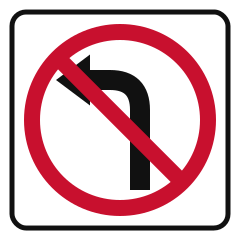
- Right turns are not allowed
- The road curves to the left
- Left turns are allowed only
- Left turns are not allowed
You are approaching an intersection with this sign. What must you do?

- Stop only if other vehicles or people are present
- Slow down and go if no one is coming
- Give way only to vehicles on your right
- Stop completely and go only when the way is clear
What shape and colour is a school zone sign in Nova Scotia?
- Rectangular, white
- Five-sided, orange
- Diamond-shaped, yellow with black figures
- Five-sided, fluorescent yellow-green
Which sign is the only one in Nova Scotia that uses an eight-sided shape?
- The stop sign
- The yield sign
- The school zone sign
- The railway crossing sign
What does this sign require you to do?

- Slow down and give way, stopping if needed
- Give way only to pedestrians
- Speed up to merge ahead of traffic
- Come to a full stop every time
What does this sign mean?
- Keep a safe following distance
- Do not pass
- Two-way traffic ahead
- Passing is permitted
When does the reduced school zone speed limit apply in Nova Scotia?
- Only when a crossing guard is on duty
- Whenever children are present, at any time of day
- Only during morning and afternoon recess
- Only on school days from 8 a.m. to 4 p.m.
A peace officer directing traffic waves you through an intersection that has a stop sign. What do you do?
- Obey whichever you saw first
- Stop at the sign first, then go
- Wait until the officer leaves
- Follow the officer's direction
A rural school zone is on a road posted at 80 km/h. Children are in the schoolyard. What is the most you may drive through the zone?
- 60 km/h
- 70 km/h
- 50 km/h
- 30 km/h
Regulatory signs: key rules to remember
Our summary of what the official handbook says on this topic, in our own words. Read it before or after the practice questions above, then check the original chapter. Read the official chapter ↗
Signs, introduction (Ch. 3)
- Three kinds of signs by function: regulatory (rules of the road), warning, and guidance (information and direction).
- A green circle on a sign gives permission for what is shown; a red circle with a slash denies it.
- Shape, colour and symbol let you recognise a sign from a distance.
Regulatory signs
- Regulatory signs state laws for using the highway; obey them unless a peace officer directs you otherwise.
- Stop sign: eight sides, red background, white STOP. The octagon shape is used only for stop signs.
- At a stop sign: come to a complete stop and make sure the way is clear before going.
- Where to stop: at the marked stop line, or at the nearest crosswalk line. With no stop line or painted crosswalk, stop far enough back to leave room for a pedestrian to cross safely (the unmarked crosswalk).
- Yield sign: triangle, red and white. Slow down as you approach; give the right of way to traffic in or close to the intersection, stopping if necessary.
- School zone sign: five sides, fluorescent yellow-green, two black schoolchildren. Standard design across Nova Scotia since June 1, 2001.
- School zone limit when children are present, at any time of day: 30 km/h where the limit before the zone is 50 km/h; 50 km/h where the limit before the zone is higher than 50 km/h.
- In a school zone also slow down, watch for children and use extreme caution; speed must suit conditions.
Other regulatory signs
- Most common regulatory signs: rectangular or square, white background, black or red lettering, often with symbols.
- Two cars in a green circle = passing permitted. Two cars in a red circle with a line = do not pass.
- Accessible parking sign: space reserved for people with a mobility disability who have a special plate or permit; the permit hangs from the rear-view mirror.
Examples of signs and their meanings
- No turns; no parking on either side of the sign; truck route (trucks go only in the arrow direction).
- Pedestrian crosswalk sign marks a pedestrian crosswalk; school crosswalk sign marks a school crosswalk.
- Playground sign: a playground is ahead; reduce speed and watch for children.
- No right turn on red: wait for the green light before turning right. No left turn. No U-turn (do not turn to go the opposite way). Do not litter.
- No stopping; passing permitted; do not pass; do not enter.
- One-way sign: traffic may travel only in the arrow's direction.
- Keep right: keep to the right of the traffic island or obstruction.
- Lane signs: through or right turn only.
- Change in maximum speed ahead: be ready to adjust speed.
- Maximum speed sign: the most allowed under ideal conditions; slow down when conditions are poor or visibility is limited.
General
- It is an offence to deface, destroy or remove traffic signs or signals.
- Sign shapes to know: guide, stop, yield, school zone, warning, regulatory.
Other topics
- Warning and guide signsYellow diamond warning signs for curves, narrowing roads, merges, lane endings, divided highways, bumps and hidden hazards, chevrons and checkerboards, lane-use arrows and green guide signs.
- Work zone signsOrange work zone signs, general, arrow, specific and human activity signs, traffic control persons, flashing arrow boards, lane closures and the main causes of work zone collisions.
- Railway crossingsThe crossbuck and advance railway warning sign, flashing lights and gates, vehicles that must stop at crossings, what to do if you are stuck on the tracks, and parking near a crossing.
- Traffic signals and crossing guardsGreen, yellow and red lights, right and left turns on red, arrow signals, flashing red, yellow and green signals, lane-control signals, dark signals, pedestrian Walk signals and crossing guards.
- Pavement markings and special lanesYellow and white lines, broken, solid and double solid centre lines, edge lines on divided highways, climbing lanes, continuity lines and two-way-left-turn lanes.
- Graduated licensing: Class 7, 5N and restricted stageApplying for a Class 7 learner's licence, the knowledge and vision tests, learner and newly licensed restrictions, curfew, waiting periods, driver training, the restricted individual stage, visitors and new residents, and licence classes.
- Demerit points and losing your licenceDemerit point values for common offences, warning, interview and suspension thresholds for learners, newly licensed and other drivers, probationary and conditional licences, revocation and suspension.
- Right of way, pedestrians and emergency vehiclesIntersection right-of-way rules, marked and unmarked crosswalks, pedestrians at signals, driveways, emergency vehicles, the slow down and move over rule and yielding to transit buses.
- Speed, stopping distance and followingDefault speed limits, 50 km/h situations, school zone limits, stopping distances, driving too slowly, keeping right, the two-second rule, safety scans, blind spots and curves.
- Signals, turning, lane changes and passingSignal lights, hand signals and the horn, right and left turns, turning lanes, lane changes, overtaking and passing, places where passing is unsafe, being passed and backing up.
- Parking, roundabouts and drivewaysWhere you may not stop or park and the distances involved, parallel and angle parking, parking on a hill, roundabouts and rotaries, and entering or leaving driveways.
- Highways, school buses and sharing the road100-series controlled-access highways and interchanges, large commercial vehicles and truck blind spots, school bus lights, motorcycles and bicycles.
- Your vehicle: inspection, equipment, registration and insuranceAnnual safety inspection, tires and studded tire dates, maintenance checks, lighting and horn rules, special flashing lights, loads and trailers, vehicle permits and plates, and mandatory liability insurance.
- Seat belts, child seats and safe driving habitsSeat belt law, child restraints and booster seats, airbags, carrying passengers, driving position, steering, braking and ABS, defensive driving and highway hypnosis.
- Night driving and bad weatherHeadlight timing and dimming distances, glare, rain, fog and snow, hydroplaning, wet brakes, ice and black ice stopping distances, gravel roads, four-wheel drive and winter driving.
- Emergencies and collisionsBreakdowns, brake failure, blowouts, power and headlight failure, a stuck gas pedal, fires, skids, wheels off the pavement, animals, water, downed wires, snow plows and collision reporting duties.
- Impaired driving and fitness to driveBlood alcohol limits, standard drinks, roadside screening results and suspensions, the administrative licence suspension, penalties by offence, drug impairment, emotions, vision standards and fatigue.
