Where must you stop for a red light?
Nova Scotia Class 7 overview
Nova Scotia Class 7 Mock Exam 1
Same format as the real test. Answers stay hidden until you submit. The official time limit is not published; the timer is a practice setting.
- No sign-up
- Every answer explained
- Independent · not a government site
- 40 questions
- untimed
- Pass mark 16/20 per section
0/40
All 40 questions in this test
Every question and its answer choices. The correct answers and explanations appear when you take the test above.
Where must you stop for a red light?
- At the stop line or the near side of the crosswalk
- Anywhere inside the intersection, once fully stopped
- Just past the crosswalk
- Beside the traffic light pole
You are driving behind a large truck and cannot see the driver in the truck's side mirror. What does that mean?
- The truck driver cannot see you
- You are at a safe distance
- The driver is about to turn
- The mirror is out of adjustment
How should the lap part of a seat belt be worn?
- Under the arm
- Loose, for comfort
- As low on the hips as possible
- Across the stomach, above the hip bones
What does the long driver training course involve, which lets a learner take the road test after only 3 months?
- 25 hours of classroom and 10 hours of driving
- 6 hours of classroom time only
- 10 hours of classroom and 25 hours of driving
- 20 hours of classroom and 5 hours of driving
A peace officer directing traffic waves you through an intersection that has a stop sign. What do you do?
- Obey whichever you saw first
- Stop at the sign first, then go
- Wait until the officer leaves
- Follow the officer's direction
From what distance must your horn be heard?
- 30 metres
- 150 metres
- 60 metres
- 15 metres
What do yellow lines on the road separate?
- Traffic moving in the same direction
- Parking spaces from travel lanes
- Bicycle lanes from car lanes
- Traffic moving in opposite directions
What kind of road does a Highway 102 route marker indicate?
- A seasonal gravel road
- A local municipal street in a town or city
- A scenic tourist route
- A controlled-access 100-series highway
Two cars arrive at an uncontrolled intersection at the same time from different streets. Which car must yield?
- The car on the left
- The car on the right
- The car going faster
- The car that is turning
You park facing uphill on a street with a curb. Which way should your front wheels point?
- Straight ahead
- Toward the centre line, then straight
- To the right, toward the curb
- To the left, away from the curb
How many demerit points does passing a stopped school bus carry?
- 6
- 3
- 2
- 4
Your car stalls on the tracks. What is the first thing to do?
- Push the car off the tracks before anyone gets out
- Try to restart the engine
- Get everyone out and well away from the tracks
- Call the railway company
A blasting zone sign is often posted with a sign asking you to do what?
- Turn on your high beams
- Roll down your windows
- Shut off your radio transmitter
- Sound your horn as you pass
You see a playground sign ahead. What does the handbook tell you to do?
- Stop and wait for children to cross
- Sound your horn as you pass
- Keep your speed but stay right
- Reduce speed and watch for children
At which GDL stage may you first upgrade to a higher licence class, such as a truck licence?
- The newly licensed driver stage
- The learner stage
- The restricted individual stage
- Only after leaving GDL
You are entering a 100-series highway from an on-ramp. How should you use the acceleration lane?
- Drive in it until the next exit
- Merge right away at ramp speed
- Speed up to match traffic, then merge
- Stop at the end and wait for a gap
You are already on the tracks when the warning lights start flashing. What should you do?
- Stop where you are and wait
- Stop and back up off the tracks
- Get out and leave the vehicle
- Keep moving and clear the crossing
What does a hidden intersection warning sign tell you?
- The intersection has no stop signs
- The intersection is closed to traffic
- You must come to a stop before the intersection
- Side-road drivers cannot clearly see you coming
You see someone driving recklessly through a work zone. What does the handbook suggest?
- Follow them to get their plate
- Report it to the police
- Sound your horn until they slow down
- Tell the nearest road worker
Where should you let passengers out of your vehicle?
- At intersections while waiting for lights
- At the curb or side of the road
- In the travel lane if traffic is light
- Wherever they ask, if you stop briefly
You fail your road test. How soon may you take it again?
- After at least one week
- The next day
- After waiting at least 30 days
- After 3 months
On a curve or hill, how far ahead must you be able to see before passing is considered safe?
- At least 50 metres
- At least 300 metres
- At least 150 metres
- At least 100 metres
You stop at a stop sign on a street with no stop line and no painted crosswalk. How far back should you stop?
- One full car length past the sign
- Far enough back for a pedestrian to cross safely
- Right at the edge of the cross street you are entering
- Wherever you can see both ways
You move to Nova Scotia from a country other than Canada or the USA. What must you usually do to get a licence?
- Take only the written tests
- Exchange your licence at a counter
- Take only the road test
- Pass vision, written and road tests
What is the demerit point value for failing to obey a traffic sign or signal?
- 6
- 4
- 2
- 3
Why must you never try to beat a train to a crossing?
- Trains always have a whistle
- Some trains need over a kilometre to stop
- Trains are required to slow down at crossings
- The gate will trap your car
What does this sign warn you about?

- Large animals may cross the road
- A farm vehicle crossing
- A wildlife park entrance is ahead
- A hunting area nearby
You face a flashing green light. What does it allow you to do?
- Turn right only
- Turn left, go straight or turn right
- Turn left only, without yielding
- Go straight only
You plan to use a two-way-left-turn lane. When should you move into it?
- Close to where you will turn
- As soon as the lane begins
- Only after stopping in your lane
- At least one block before the turn
A crossing guard near a school holds up a stop paddle facing you. What must you do?
- Stop only if a child is crossing
- Stop and obey the guard
- Slow down and drive around
- Sound your horn and proceed
What does this warning sign mean?

- A narrow structure such as a bridge is ahead
- A tunnel with low clearance
- Two lanes join from both sides
- A divided highway ends and two-way traffic begins
A curve warning sign has a small plate showing 50 km/h under it. What does the plate tell you?

- The speed limit for trucks only
- The new speed limit after the curve
- The safe speed for that curve
- The minimum speed on the curve
How much following distance should you leave when driving in the rain?
- Three seconds
- Two seconds
- One car length per 10 km/h
- Four seconds or more
On a long drive, how often does the handbook suggest a short walking break?
- Every four hours, for 30 minutes
- Only when you feel sleepy
- Every hour, for one or two minutes
- Every 30 minutes, for 10 minutes
A work zone sign warns of a difference in height between lanes. Why is this dangerous?
- Trucks may not fit under the edge
- Your vehicle may scrape its underside on a speed bump
- Water may pool and cause hydroplaning
- A tire catching the edge can cause loss of control
You are in the inside lane of a two-lane roundabout and your exit is next. What should you do?
- Exit directly from the inside lane
- Stop and wait for a gap to exit
- Move to the outside lane first, then exit
- Signal left and exit
When are roads most dangerous after rain starts to fall?
- Only after the rain stops
- During the first 10 to 15 minutes
- After an hour of steady rain
- When puddles start to form
You see this sign in a work zone. What does it mean?
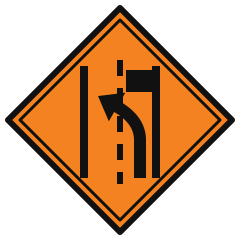
- Two lanes join from both sides
- A detour leaves the highway at the next exit
- Traffic must stop for workers
- A lane is closed; move into the open lane
What is the only item allowed at the lower driver's corner of the windshield?
- The official inspection sticker
- A parking pass
- A GPS mount
- A toll transponder for the highway
What is the minimum time a driver stays in the newly licensed (Class 5N) stage?
- 3 years
- 1 year
- 2 years
- 6 months
Keep practising
- Nova Scotia Class 7 Mock Exam 2 – 40 QuestionsUntimed practice · answers explained
- Nova Scotia Class 7 Mock Exam 3 – 40 QuestionsUntimed practice · answers explained
- Nova Scotia Class 7 Mock Exam 4 – 40 QuestionsUntimed practice · answers explained
- Nova Scotia Class 7 Mock Exam 5 – 40 QuestionsUntimed practice · answers explained
- Nova Scotia Class 7 Practice Test 140 questions with explanations
- Nova Scotia Class 7 Practice Test 240 questions with explanations
- Nova Scotia Class 7 Practice Test 340 questions with explanations
- Nova Scotia Class 7 Practice Test 440 questions with explanations