You come to this sign at a quiet rural intersection. What must you do?
Saskatchewan Class 7: Regulatory road signs
The six basic sign shapes, standard sign colours, and regulatory signs: speed, one-way, do not enter, passing, U-turn, parking and stopping, crosswalk, lane designation and turn control signs.
- No sign-up
- Every answer explained
- Independent · not a government site
- 33 questions
- Topic drill
Study reference: Saskatchewan Driver's Handbook (online edition, Rev. 2026), Ch. 4 Traffic signs and signals — Six basic sign shapes, Standard sign colours, Regulatory signs, Regulatory parking, pedestrian crossing, lane designation and turn control signs
All 33 questions in this test
Every question and its answer choices. The correct answers and explanations appear when you take the test above.
You come to this sign at a quiet rural intersection. What must you do?
- Yield only to traffic on your right
- Stop only if another vehicle is in sight
- Slow down and go if nothing is coming
- Stop fully, then go when the way is clear
What does this sign tell you to do?
- Stop completely every time
- Speed up to merge ahead of traffic
- Give way only to pedestrians
- Slow down and give the right of way
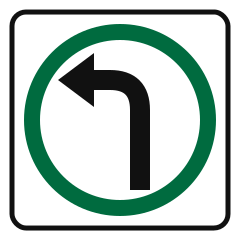
You are in a lane marked with this sign. What must you do?
- Avoid turning left
- Turn left only on red
- Turn left
- Go straight or turn left
What does this sign mean?
- Railway crossing: yield, stop if necessary
- Two roads cross ahead; no special rules apply
- Four-way stop just ahead
- Road closed to all traffic
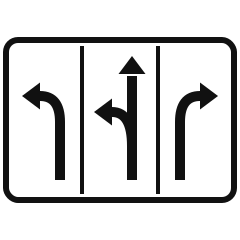
An overhead lane sign hangs over the roadway. Which lane does each sign control?
- Every lane in that direction
- Only the curb lane
- The lane to its right
- The lane it is centred over
What does this sign tell you?
- Traffic moves only in the arrow's direction
- Turn in the arrow's direction at the next corner
- Two-way traffic ahead
- The road ends in one block
A white rectangular sign with black lettering usually tells you what?
- Directions to a nearby town
- A hazard ahead on the road
- A law you must obey
- Services such as food or fuel
A school zone sign has a tab underneath reading a speed in km/h during school days. What does this mean?
- It is the minimum speed in the zone
- You must drive no faster than that speed
- It is only a suggested speed
- It applies only when children are visible
What shape and colour are most warning signs?
- White rectangle with black letters
- Yellow diamond with black symbols
- Red circle with a white bar
- Green rectangle with white letters
You approach a pedestrian crosswalk sign with lights that are flashing. What must you do?
- Stop, then go when it is safe
- Slow down and keep going
- Stop only if a child is crossing
- Sound your horn and continue
What does this five-sided sign mark?
- A school zone
- A school bus stop
- A playground ahead
- A pedestrian corridor
What is the purpose of a speed sign posted before you reach a slower zone?
- Mark the end of all limits
- Show the minimum speed ahead
- Warn of a lower maximum speed ahead
- Give a speed for trucks only
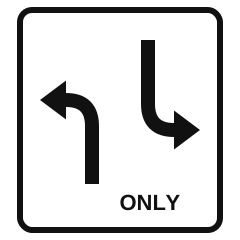
What does this sign tell drivers?
- U-turns allowed in either direction
- The centre lane is for left turns both ways
- Left lane ends ahead
- Two lanes must turn left only
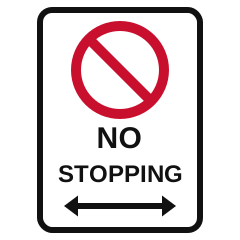
What does this sign mean?
- Parking for up to 15 minutes
- Stopping is prohibited in the area shown
- Stop here for inspection
- No standing on weekends and holidays only
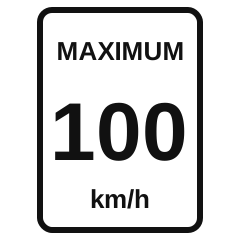
What does this sign mean?
- Suggested speed for bad weather
- Minimum speed allowed on the road
- Fastest speed allowed in ideal conditions
- Speed limit only for trucks
What does this sign mean?
- You must turn left here
- Two-way traffic ahead
- You may not turn around to go back
- The road curves sharply ahead
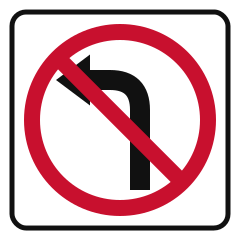
What does this sign mean?
- No U-turn
- No left turn
- Road curves to the left
- Left turn only
What does this sign mean?
- Two-way traffic ahead
- Slow traffic keep right
- Passing is allowed with care
- Passing is not allowed
A sign on a bridge shows a weight limit. In what units is it expressed?
- Kilograms
- Tonnes
- Axles
- Pounds
What does this sign tell you to do?
- Merge into the right lane
- Keep to the right of the island
- Turn right at the next corner
- Pass the vehicle ahead on the right
What does the colour green indicate on traffic signs?
- A construction zone ahead
- A hazard or unusual condition on the road ahead
- A prohibited movement
- Permitted movements or directional guidance
You see a five-sided school zone sign with a blue background and white children. What is it?
- A school bus stop ahead
- A pedestrian-only street
- A hospital zone sign
- An older school zone sign
Which sign colour shows general information or service road information?
- Blue
- White
- Yellow
- Green
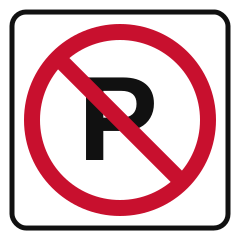
What does this sign mean?
- Parking is prohibited as shown
- Parking is allowed for one hour
- Parking only for permit holders
- Pay parking ahead
Which shape is used only for stop signs?
- Diamond
- Triangle
- Octagon
- Pentagon
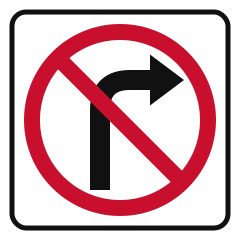
What does this sign mean?
- No right turn
- Right turn only
- Sharp curve to the right
- Keep right
A sign at a signal says no right turn on red. When may you turn right?
- After a full stop on red
- Only when the light is green
- Only when a flashing arrow shows
- Any time no one is coming
The railway crossbuck has the same meaning as which other sign?
- Yield sign
- Slow-moving vehicle sign
- Do not enter sign
- Stop sign
A turn control sign has a small tab below it showing hours. What does the tab mean?
- The rule applies only during those hours
- The sign starts next month
- Those are the hours you must turn
- Parking is allowed during those hours
What does this sign mean?
- Emergency vehicles only
- Do not enter
- Road closed for winter
- No parking at any time
You face a yield sign and a car is closely approaching the intersection on the cross street. What do you do?
- Stop and wave the driver through
- Let it go first, stopping if needed
- Go first, because you are already moving
- Flash your lights and keep going
On a sign, what does the colour orange mean?
- General information about nearby services
- Permitted movement
- Construction or maintenance warning
- School zone ahead
What does this sign require at the intersection?
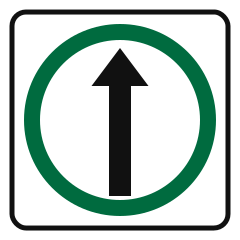
- No through traffic
- Turn right or left only
- One-way street ahead
- Go straight only
Regulatory road signs: key rules to remember
Our summary of what the official handbook says on this topic, in our own words. Read it before or after the practice questions above, then check the original chapter. Read the official chapter ↗
introduction
- Signs are grouped by job: regulatory, warning and information. Shapes and colours are the fastest way to recognise them.
Stop
- Red octagon, white letters. Come to a full stop; go only when the way is clear.
Regulatory
- White rectangle or square, black or other coloured lettering. States the law: speed limits, parking, turning and passing movements.
Yield
- Triangle, red border, white background. Reduce speed approaching the intersection; give right of way and stop if needed when traffic is in or closely approaching the intersection.
Warning
- Diamond, yellow or orange, black letters or symbols. Warns of dangerous or unusual conditions ahead (curve, turn, dip, side road).
Railway crossing
- The crossbuck has the same colours as a yield sign and the same meaning: give right of way, stop if necessary.
School zone
- Pentagon, fluorescent yellow-green background, black silhouette of children (new design).
- With a "Maximum Speed" or "km/h during School Days" tab underneath, the speed shown must be observed.
- Old design: pentagon, blue background, white children. Being replaced.
Standard sign colours
- Red: stop or prohibition. Blue: general information or service road information. Green: permitted movements such as turns, or directional guidance. Yellow: general warning. Fluorescent yellow-green: school zone and school crosswalk ahead. White: regulatory. Orange: construction and maintenance warning.
Regulatory signs
- One-way street; two-way traffic.
- Maximum speed sign = fastest allowed under ideal conditions. Advance warning sign for a lower maximum speed zone ahead. Separate sign for maximum speed in a work zone.
- Keep to the right of a traffic island or obstruction. Do not enter.
- Passing permitted / passing not permitted signs. U-turn permitted / no U-turn (no turning around in the roadway to go the opposite way).
- Heavy trucks should use this road / no heavy trucks; dangerous goods route / dangerous goods carriers prohibited; truck inspection station (arrow shows side of road); over-dimensional route; weight limit expressed in tonnes.
Regulatory parking signs
- Parking allowed as indicated; parking prohibited as indicated; stopping prohibited as indicated; "no stopping any time" = do not stop to wait.
Regulatory pedestrian crossing signs
- Pedestrian crosswalk and school crosswalk signs (new and old designs).
- Crosswalk with lights: traffic must stop when the lights are flashing and go when safe.
Regulatory lane designation signs
- Can be overhead or beside the road; an overhead sign is centred over the lane it controls.
- Bus lane, bicycle lane, must turn left, left or through, must turn right, right or through, two turning lanes, through only, all movements.
Regulatory turn control signs
- May have a tab limiting the sign to certain hours.
- No left turn, no right turn, straight or left only, straight or right only, turn right or left, left only, go straight, right only.
- No right turn on red: wait for the green light before turning right.
- Centre turning lane sign; turning vehicles yield to bikes sign.
Other topics
- Warning signs and railway crossingsYellow diamond warning signs for curves, hills, lane endings, intersections, animals and hazards, school and playground signs, chevrons, the slow-moving vehicle sign, railway crossings and crossroad delineators.
- Construction, guide and information signsOrange construction and maintenance signs, highway route markers, and blue information and service signs.
- Traffic signalsGreen, amber and red lights, right and left turns on red, green and amber arrows, flashing lights and pedestrian signals.
- Pavement markings, bus lanes and bike lanesYellow and white lines, solid and broken lines, lanes that end, bus and bicycle lanes, sharrows and where to stop at stop lines and crosswalks.
- Class 7 and Graduated Driver LicensingClass 7 age and ID rules, the supervising driver, the written tests, Learner, Novice 1 and Novice 2 stages, mandatory driver education, new residents and your driver's licence.
- Speed limits, stunting and racingDefault speed limits, the 60 km/h rule for stopped emergency, tow and highway vehicles, work zone fines, school zones, photo speed enforcement and stunting.
- Distracted driving, fatigue and road rageCellphone rules for GDL and experienced drivers, other distractions, fatigue, stress, aggressive driving, fog and heavy rain, and smoking with children in the vehicle.
- Basic driving skills and getting readySeatbelts, car seats and airbags, seat and mirror adjustment, steering hand positions, the IPDE method, gates, blind spots, following distance and eye use.
- Right of way, pedestrians and parking lotsUncontrolled intersections, T-intersections, two-way and four-way stops, entering highways, pedestrians and wheelchair users, zipper merges and parking lot right of way.
- Turning, signalling and changing lanesSignal distances, hand signals, lane position, lane changes, right and left turns, centre turning lanes, roundabouts, diverging diamond and RCUT interchanges, U-turns and two-point turns.
- Passing, highways and freewaysWhen and where you may pass, passing lanes, safe passing time, being passed, divided highways, medians, entering and leaving a freeway and freeway emergencies.
- Sharing the roadLarge trucks and the no-zone, snow plows, emergency vehicles, farm equipment, school buses, motorcycles, bicycles, e-scooters, tow trucks and funeral processions.
- Stopping, parking and backingStopping on rural roads and highways, marking stopped vehicles, parallel and angle parking, parking on a hill, back-up cameras and safe backing.
- Headlights, night, winter and rural roadsWhen headlights are required, dimming distances, glare, overdriving your headlights, winter driving and survival, black ice, whiteouts, curves, mountains and gravel grid roads.
- Braking, emergencies and collisionsABS, threshold and four-wheel lock braking, skids, soft shoulders and ditches, blow-outs, brake failure, animals on the road, collision facts and what to do after a collision.
- Alcohol, drugs and impaired driving penaltiesHow alcohol and drugs affect driving, zero tolerance for new drivers, roadside suspensions and impoundments, Criminal Code impaired driving, ignition interlock and licence disqualifications.
- Traffic law, points, insurance and registrationPolice stops, impoundments, the Driver Improvement Program, GDL improvement steps, Safe Driver Recognition, vehicle registration, plate insurance and rules related to vehicles.