A Class 7 driver is caught with a small amount of alcohol for the first time. How long is the roadside suspension?
Saskatchewan Class 7 overview
Saskatchewan Class 7 Practice Test 13
30 questions on alcohol, drugs and impaired driving penalties, sharing the road, regulatory road signs, warning signs and railway crossings, braking, emergencies and collisions and more.
- No sign-up
- Every answer explained
- Independent · not a government site
- Set 13 of 14
- 30 questions
- Instant feedback
0/30
All 30 questions in this test
Every question and its answer choices. The correct answers and explanations appear when you take the test above.
A Class 7 driver is caught with a small amount of alcohol for the first time. How long is the roadside suspension?
- 18 months
- 60 days
- 3 days
- 30 days
What following distance should you keep behind a motorcycle in good conditions?
- One second
- At least three seconds
- Two to three car lengths
- Half a second
A school zone sign has a tab underneath reading a speed in km/h during school days. What does this mean?
- It is the minimum speed in the zone
- You must drive no faster than that speed
- It is only a suggested speed
- It applies only when children are visible
A motorcycle is riding near one side of a wide lane. May you drive in the same lane beside it?
- Yes, if the lane is wide
- Yes, at low speed
- Yes, if the rider waves you on
- No, it is illegal and dangerous
You are driving close behind a large truck and can't see its side mirrors. What does this mean?
- The truck is about to turn
- You are at a safe distance
- The truck's mirrors are folded
- The driver can't see you
On a hazard marker, what do the downward-sloping lines show?
- How far away the hazard is
- Where the shoulder ends
- Which way the road curves
- The side you may safely pass on
What does this sign warn you of?

- A divided highway ahead
- A road with two lanes merging
- A narrow bridge ahead
- An underpass with low clearance
You accelerate too hard on ice and the car starts to skid. What should you do?
- Brake hard and steer
- Keep accelerating to regain grip
- Neutral, off the gas, no brake, steer
- Turn the wheel fully to one side
What are the two parts of the Class 7 knowledge test?
- Vehicle parts and first aid
- Rules of the road and a road test
- Signs and a vision test only
- Rules of the road and sign identification
What does this sign mean?
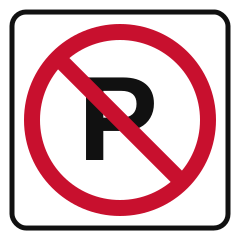
- Parking is prohibited as shown
- Parking is allowed for one hour
- Parking only for permit holders
- Pay parking ahead
What is the most important part of driving a sharp curve?
- Braking hard in the middle
- Slowing down before you reach it
- Accelerating into it
- Moving to the shoulder
You are going into a ditch. What is the main cause of rollovers in this situation?
- Driving down the ditch slope
- Easing off the accelerator as you leave the road
- Trying to get back on the road too early
- Holding the wheel firmly
You are 16, writing your first Class 7 test. Besides proof of age, what form must you bring?
- A medical report from a doctor
- A signature/guarantor form
- A driver education certificate
- A letter from your school
A cyclist ahead extends their right arm straight out. What are they likely signalling?
- A right turn
- A left turn
- Stopping
- Asking you to pass
The forecast warns of black ice on the highway. What is black ice?
- Ice darkened by dirt, oil and road salt
- A thin, clear layer of ice on the road
- Thick ice on the shoulder
- Ice that forms only at night
A person has two drinks and a cold remedy antihistamine. What impairment might that equal?
- About 10 drinks
- About 4 to 5 drinks
- About 2 drinks
- About 3 drinks
What does this sign tell you?

- Traffic moves only in the arrow's direction
- Turn in the arrow's direction at the next corner
- Two-way traffic ahead
- The road ends in one block
On a highway or rural road, where should you keep your vehicle in your lane?
- To the left of the lane
- On the line
- To the right of the lane
- In the centre of the lane
You are in a lane marked with this sign. What must you do?
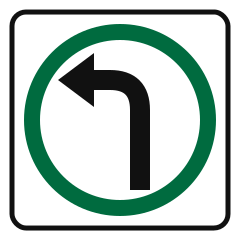
- Avoid turning left
- Turn left only on red
- Turn left
- Go straight or turn left
What does this sign mean?

- Turn lane opens on the left
- Road narrows to one lane
- Divided highway begins; keep right
- Divided highway ends ahead
You turn left from a one-way street onto a two-way street. Which lane do you enter?
- Any lane on the new street
- The lane left of the centre line
- The lane just right of the centre line
- The far right curb lane
A street has a centre turning lane. May you turn left from the lane beside it instead?
- Yes, if the centre lane is busy
- No, use the centre lane to turn left
- Yes, at night only
- Yes, if you signal early
What does this sign tell drivers?
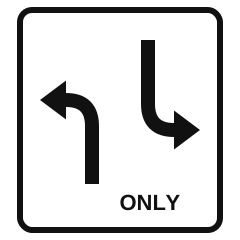
- U-turns allowed in either direction
- The centre lane is for left turns both ways
- Left lane ends ahead
- Two lanes must turn left only
On which surface does four-wheel lock braking not give the shortest stop?
- Wet pavement
- Dry pavement
- Packed gravel
- Glare ice
A child is usually big enough for a regular seatbelt alone at about age seven and over what weight?
- 27 kg (60 lb)
- 18 kg (40 lb)
- 45 kg (100 lb)
- 36 kg (80 lb)
While driving with a Class 7 licence, where must your supervising driver sit?
- Anywhere in the vehicle
- In the back seat on the right
- Directly behind the driver
- In the front passenger seat
Who must wear a seatbelt in Saskatchewan?
- Only passengers under 16
- Only the driver
- Every occupant where belts are provided
- Only front-seat occupants, including the driver
What does this sign tell you to do?

- Stop completely every time
- Speed up to merge ahead of traffic
- Give way only to pedestrians
- Slow down and give the right of way
What does this sign warn you about?

- Divided highway begins
- Passing lane ahead
- Two-way traffic ahead
- One-way street ahead
What does this sign show?
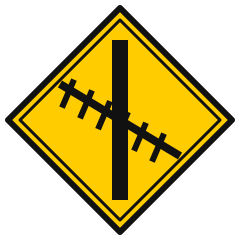
- A rough road with cracks
- A ladder on a work truck
- Tracks cross the road ahead at that angle
- A narrow bridge over a river or creek ahead
All Saskatchewan Class 7 practice tests
- Saskatchewan Class 7 Mock Exam 1 – 40 QuestionsUntimed practice · answers explained
- Saskatchewan Class 7 Mock Exam 2 – 40 QuestionsUntimed practice · answers explained
- Saskatchewan Class 7 Mock Exam 3 – 40 QuestionsUntimed practice · answers explained
- Saskatchewan Class 7 Mock Exam 4 – 40 QuestionsUntimed practice · answers explained
- Saskatchewan Class 7 Mock Exam 5 – 40 QuestionsUntimed practice · answers explained
- Regulatory road signsThe six basic sign shapes, standard sign colours, and regulatory signs: speed, one-way, do not enter, passing, U-turn, parking and stopping, crosswalk, lane designation and turn control signs.
- Warning signs and railway crossingsYellow diamond warning signs for curves, hills, lane endings, intersections, animals and hazards, school and playground signs, chevrons, the slow-moving vehicle sign, railway crossings and crossroad delineators.
- Construction, guide and information signsOrange construction and maintenance signs, highway route markers, and blue information and service signs.
- Traffic signalsGreen, amber and red lights, right and left turns on red, green and amber arrows, flashing lights and pedestrian signals.
- Pavement markings, bus lanes and bike lanesYellow and white lines, solid and broken lines, lanes that end, bus and bicycle lanes, sharrows and where to stop at stop lines and crosswalks.
About this practice test
How many questions are in Saskatchewan Class 7 practice test 13?
30 original multiple-choice practice questions covering alcohol, drugs and impaired driving penalties, sharing the road, regulatory road signs, warning signs and railway crossings, braking, emergencies and collisions, class 7 and graduated driver licensing, headlights, night, winter and rural roads, turning, signalling and changing lanes, basic driving skills and getting ready. Each answer includes an explanation. This mixed practice set does not reproduce the official exam format or predict an official score.
Are the questions the same every time?
Yes. Practice test 13 always has the same 30 questions, so you can repeat it until you get them all right. The other 13 sets use different questions.
Are these real test questions?
No. The official question bank is not published. These are original questions written from the official handbook, which is what the real Saskatchewan Class 7 test is based on.