How should your head restraint be adjusted?
Saskatchewan Class 7 overview
Saskatchewan Class 7 Practice Test 3
30 questions on basic driving skills and getting ready, alcohol, drugs and impaired driving penalties, headlights, night, winter and rural roads, sharing the road, traffic signals and more.
- No sign-up
- Every answer explained
- Independent · not a government site
- Set 3 of 14
- 30 questions
- Instant feedback
0/30
All 30 questions in this test
Every question and its answer choices. The correct answers and explanations appear when you take the test above.
How should your head restraint be adjusted?
- Touching your shoulders for full support
- Level with your neck
- Top level with the top of your head
- As low as it goes
An experienced driver blows over .04 but under .08 for the first time. How long is the roadside suspension?
- 24 hours
- 3 days
- 60 days
- 21 days
Your truck has spotlamps. How far before an oncoming vehicle must you turn them off?
- At least 1,000 m
- At least 200 m
- At least 500 m
- At least 100 m
Where e-scooters are allowed by local bylaw, what must riders have?
- Registration and plates from a licence issuer
- Insurance and a seatbelt
- A Class 7 licence
- Be 16 or older with an approved helmet
May you make a U-turn at an intersection with traffic lights?
- Yes, on any green light
- Only if a sign permits U-turns
- Yes, after a full stop on red
- Only after 10 p.m.
Which hand positions on the steering wheel does the handbook recommend?
- 10 and 2, or 12 and 6
- 9 and 3, or 8 and 4
- 11 and 1, or 7 and 5
- One hand at 12 o'clock
You are driving out of a back alley onto a street. Whom must you yield to?
- Only pedestrians
- No one if you stop first
- Only the cars approaching from your left on the street
- Pedestrians on the sidewalk and street traffic
You hold a Class 7 learner's licence. How much alcohol may be in your system when you drive?
- None at all
- Less than .08
- Less than .05
- Less than .04
What colours are used on construction signs?
- Black on a yellow background
- Black on an orange background
- White on a blue background
- White on a green background
In a city, where may you drive across a street?
- At any driveway
- Only at an intersection, lane or alley
- Only at traffic lights
- Anywhere with a gap in traffic
When does a Saskatchewan driver's licence normally expire?
- On your birthday
- Five years from the date of issue
- Last day of your birth month
- December 31 each year
Which collision must be reported to police right away?
- A scrape in a parking lot
- One where a car must be towed
- Any collision under $1,000
- A dent with no injuries
You are driving at 50 km/h and plan to turn right. How far before the turn should you signal?
- At least 10 m
- At least 150 m
- At least 30 m
- Right as you turn
What does this sign mean?

- You must turn left here
- Two-way traffic ahead
- You may not turn around to go back
- The road curves sharply ahead
What does this sign mean?
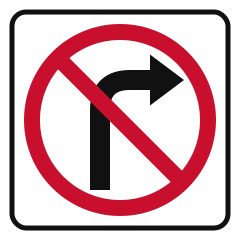
- No right turn
- Right turn only
- Sharp curve to the right
- Keep right
Is it legal to smoke in your vehicle while children are riding in it?
- Yes, if they are over 12
- Yes, with a window open
- No, it is illegal
- Yes, on short trips
What is the starting fine for speeding past workers or occupied equipment in a work zone?
- $500 plus four demerit points
- $240 plus a per-km/h amount
- $60 per km/h over
- $120 flat
In fog you can't see 12 seconds ahead even after slowing down. What should you do?
- Follow the tail lights ahead closely
- Turn on your hazard lights and speed up
- Switch to high beams
- Find a safe place to get off the road
The light turns amber as you approach and you can stop safely. Where must you stop?
- Before entering the crosswalk
- In the middle of the crosswalk
- Wherever traffic behind allows
- Past the crosswalk at the corner
Traffic is heavy and backed up past a railway crossing. Where should you wait?
- Beside the crossing on the shoulder
- On the approach until you can clear it
- Just past the first rail
- On the tracks behind the car ahead
When is it safe to move back into your lane after passing?
- As soon as your front clears its bumper
- When you see the passed car in your inside mirror
- When the other driver flashes their lights
- After counting one second
What should you always do when parking on a slope?
- Leave the car in neutral
- Put on your hazard lights
- Apply the parking brake
- Leave the engine running
A driver is caught driving while suspended for the first time. How long is the vehicle impounded?
- 90 days
- 30 days
- 3 days
- 7 days
When is it fine to use cruise control?
- In fog or blowing snow
- On a long highway trip in dry weather
- On wet or slippery roads
- In stop-and-go city traffic during rush hour
A curb lane has diamond markings and a bus lane sign whose hours are in effect. When may you drive in it?
- Any time traffic is light
- To drop off a passenger
- Only to make a right turn
- To pass slower cars
A flagperson in a work zone signals you to stop. What must you do?
- Stop only if workers are near
- Slow down and keep going
- Honk and drive around
- Stop
A snow plow is stopped on the highway with blue and amber lights flashing. How fast may you pass it?
- No more than 60 km/h
- No more than 80 km/h
- No more than 30 km/h
- At the posted limit
Who sets the speed limits in school zones in Saskatchewan?
- The RCMP detachment
- The school principal
- SGI, the same everywhere
- Each city or town, by bylaw
You are not sure you can make a U-turn safely. What should you do?
- Back up to the last corner
- Make it quickly anyway
- Go around the block
- Use a three-point turn mid-block
What does this sign warn of?

- A lane opens on both sides
- The road ahead becomes narrower
- A divided highway ends
- A bridge is out ahead
All Saskatchewan Class 7 practice tests
- Saskatchewan Class 7 Mock Exam 1 – 40 QuestionsUntimed practice · answers explained
- Saskatchewan Class 7 Mock Exam 2 – 40 QuestionsUntimed practice · answers explained
- Saskatchewan Class 7 Mock Exam 3 – 40 QuestionsUntimed practice · answers explained
- Saskatchewan Class 7 Mock Exam 4 – 40 QuestionsUntimed practice · answers explained
- Saskatchewan Class 7 Mock Exam 5 – 40 QuestionsUntimed practice · answers explained
- Regulatory road signsThe six basic sign shapes, standard sign colours, and regulatory signs: speed, one-way, do not enter, passing, U-turn, parking and stopping, crosswalk, lane designation and turn control signs.
- Warning signs and railway crossingsYellow diamond warning signs for curves, hills, lane endings, intersections, animals and hazards, school and playground signs, chevrons, the slow-moving vehicle sign, railway crossings and crossroad delineators.
- Construction, guide and information signsOrange construction and maintenance signs, highway route markers, and blue information and service signs.
- Traffic signalsGreen, amber and red lights, right and left turns on red, green and amber arrows, flashing lights and pedestrian signals.
- Pavement markings, bus lanes and bike lanesYellow and white lines, solid and broken lines, lanes that end, bus and bicycle lanes, sharrows and where to stop at stop lines and crosswalks.
About this practice test
How many questions are in Saskatchewan Class 7 practice test 3?
30 original multiple-choice practice questions covering basic driving skills and getting ready, alcohol, drugs and impaired driving penalties, headlights, night, winter and rural roads, sharing the road, traffic signals, right of way, pedestrians and parking lots, construction, guide and information signs, class 7 and graduated driver licensing, braking, emergencies and collisions, turning, signalling and changing lanes, regulatory road signs, distracted driving, fatigue and road rage, speed limits, stunting and racing, warning signs and railway crossings, passing, highways and freeways, stopping, parking and backing, traffic law, points, insurance and registration, pavement markings, bus lanes and bike lanes. Each answer includes an explanation. This mixed practice set does not reproduce the official exam format or predict an official score.
Are the questions the same every time?
Yes. Practice test 3 always has the same 30 questions, so you can repeat it until you get them all right. The other 13 sets use different questions.
Are these real test questions?
No. The official question bank is not published. These are original questions written from the official handbook, which is what the real Saskatchewan Class 7 test is based on.