While stopped at a red light, you pick up your phone to read a text. Is this allowed?
Saskatchewan Class 7 overview
Saskatchewan Class 7 Practice Test 1
30 questions on distracted driving, fatigue and road rage, traffic signals, turning, signalling and changing lanes, warning signs and railway crossings, regulatory road signs and more.
- No sign-up
- Every answer explained
- Independent · not a government site
- Set 1 of 14
- 30 questions
- Instant feedback
0/30
All 30 questions in this test
Every question and its answer choices. The correct answers and explanations appear when you take the test above.
While stopped at a red light, you pick up your phone to read a text. Is this allowed?
- Yes, because you are stopped
- Yes, if you only read it
- Yes, if the phone is on speaker
- No, hand-held phone use is banned
When may a pedestrian not start crossing at a signal?
- When facing a red or amber light
- When traffic is light
- When facing a green light
- When a walk symbol is lit
At an RCUT intersection on a divided highway, how do you get across the highway?
- Turn left across the median
- Turn right, then make a U-turn
- Drive straight through the median
- Wait for a gap and cross
This sign is mounted on the back of a vehicle. What does it tell you?

- The vehicle carries dangerous goods
- The vehicle travels under 40 km/h
- The vehicle is wider than its lane
- The vehicle stops at railway crossings
What does this sign mean?
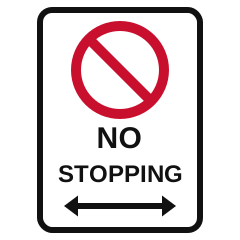
- Parking for up to 15 minutes
- Stopping is prohibited in the area shown
- Stop here for inspection
- No standing on weekends and holidays only
Which training meets the mandatory driver education rule for a 17-year-old outside high school?
- 6 hours in-class and 6 hours in-car
- 2 hours in-class and 2 hours in-car
- 30 hours of supervised practice
- An online video course only
Your car starts acting up on a freeway. When should you pull over?
- When warning lights flash red
- At the next exit, however far
- Only when it stalls
- At the first sign of trouble
You are driving down a parking lane toward a thoroughfare that runs through the lot. Who yields?
- Whoever is closer to the exit
- Thoroughfare traffic yields to you
- Whoever is on the right
- You yield to the thoroughfare traffic
A tired driver drinks strong coffee to keep going. What does the handbook say?
- The effect can wear off suddenly
- Coffee lowers blood alcohol
- Coffee makes driving safe
- Coffee cures fatigue for hours
What should you be prepared to do when you see this sign?

- Pull onto the shoulder
- Stop for a traffic control person
- Merge into the left lane
- Speed up past the work area
Where should the lap part of a seatbelt sit?
- Loose over the thighs
- High across the ribs
- Across the stomach, below the ribs
- Low and snug over the pelvis
How much instruction does the high school driver education program include?
- 12 hours in-class, 12 in-car
- 20 hours in-class, 10 in-car
- 30 hours in-class, 6 in-car
- 6 hours in-class, 6 in-car
Which habit helps you avoid road rage situations?
- Signalling only when others look
- Following closely to keep up
- Using your horn sparingly
- Staying in the passing lane
How should you brake on a long downhill mountain road?
- Hard, in short bursts
- In neutral to save fuel and reduce engine wear
- Lightly and continuously in a lower gear
- Only at the bottom
How fast can experienced cyclists ride going downhill?
- Up to 50 km/h
- Up to 25 km/h
- Up to 15 km/h
- Up to 80 km/h
Your accelerator sticks while driving. What should you do?
- Turn off the key immediately
- Shift to neutral, pull over and stop
- Brake with your left foot only
- Pump the gas pedal hard
A Class 7 driver is caught driving without a supervisor for the second time in 12 months. What happens to the vehicle?
- It is impounded for 7 days
- It is impounded for 30 days
- Nothing happens to the vehicle
- It is impounded for 3 days
You face a yield sign and a car is closely approaching the intersection on the cross street. What do you do?
- Stop and wave the driver through
- Let it go first, stopping if needed
- Go first, because you are already moving
- Flash your lights and keep going
What does this sign tell you?

- The left lane ends ahead
- A bike lane begins
- The right lane ends ahead
- An extra lane is added
You stop on a rural highway. How far must you be from a vehicle stopped on the opposite side?
- At least 100 m
- At least 10 m
- At least 30 m
- At least 5 m
You are in the outside (left) lane of a double right-turn lane at a red light. May you turn right?
- Yes, without stopping
- No, only the curb lane may turn
- Yes, after stopping and yielding
- No, not until the light is green
What does this sign warn you of?

- A survey crew on a farm
- A pedestrian crossing ahead
- A school crossing guard
- Highway workers ahead
You are in the continuing lane during a zipper merge. What is your role?
- Let one vehicle in ahead of you
- Stop until the closing lane is empty
- Close the gap to block merging
- Move into the closing lane
How many points lead to a 30-day licence suspension under the Driver Improvement Program?
- 15 or more
- 12 or more
- 21 or more
- 30 or more
What is the minimum fine for passing a school bus with its red lights flashing?
- $240
- $360
- $1,000
- $120
You are stopping at a stop sign and a stop line is clearly marked. Where do you stop?
- Wherever you can see traffic
- At the edge of the sidewalk
- At the stop line
- Past the stop line
An ambulance is stopped on the highway shoulder with its lights flashing. What is the most you may drive while passing it?
- 50 km/h
- 60 km/h
- 40 km/h
- 80 km/h
You are on a road with no lane lines painted. How should you drive?
- On the shoulder when possible
- As if the lanes were marked
- Anywhere on the road surface
- Down the middle of the road
At night you spot something on the road but can't tell what it is. What should you do?
- Swerve around it at full speed
- Wait until you see it clearly
- Slow down right away while you identify it
- Switch to low beams and keep going
Your car is touching a downed line and catches fire, so you must get out. How do you leave?
- Jump clear, then hop at least 10 m
- Crawl away under the car
- Climb out slowly while holding the door
- Step out and run 3 m
All Saskatchewan Class 7 practice tests
- Saskatchewan Class 7 Mock Exam 1 – 40 QuestionsUntimed practice · answers explained
- Saskatchewan Class 7 Mock Exam 2 – 40 QuestionsUntimed practice · answers explained
- Saskatchewan Class 7 Mock Exam 3 – 40 QuestionsUntimed practice · answers explained
- Saskatchewan Class 7 Mock Exam 4 – 40 QuestionsUntimed practice · answers explained
- Saskatchewan Class 7 Mock Exam 5 – 40 QuestionsUntimed practice · answers explained
- Regulatory road signsThe six basic sign shapes, standard sign colours, and regulatory signs: speed, one-way, do not enter, passing, U-turn, parking and stopping, crosswalk, lane designation and turn control signs.
- Warning signs and railway crossingsYellow diamond warning signs for curves, hills, lane endings, intersections, animals and hazards, school and playground signs, chevrons, the slow-moving vehicle sign, railway crossings and crossroad delineators.
- Construction, guide and information signsOrange construction and maintenance signs, highway route markers, and blue information and service signs.
- Traffic signalsGreen, amber and red lights, right and left turns on red, green and amber arrows, flashing lights and pedestrian signals.
- Pavement markings, bus lanes and bike lanesYellow and white lines, solid and broken lines, lanes that end, bus and bicycle lanes, sharrows and where to stop at stop lines and crosswalks.
About this practice test
How many questions are in Saskatchewan Class 7 practice test 1?
30 original multiple-choice practice questions covering distracted driving, fatigue and road rage, traffic signals, turning, signalling and changing lanes, warning signs and railway crossings, regulatory road signs, class 7 and graduated driver licensing, passing, highways and freeways, right of way, pedestrians and parking lots, alcohol, drugs and impaired driving penalties, construction, guide and information signs, basic driving skills and getting ready, headlights, night, winter and rural roads, sharing the road, braking, emergencies and collisions, traffic law, points, insurance and registration, stopping, parking and backing, pavement markings, bus lanes and bike lanes, speed limits, stunting and racing. Each answer includes an explanation. This mixed practice set does not reproduce the official exam format or predict an official score.
Are the questions the same every time?
Yes. Practice test 1 always has the same 30 questions, so you can repeat it until you get them all right. The other 13 sets use different questions.
Are these real test questions?
No. The official question bank is not published. These are original questions written from the official handbook, which is what the real Saskatchewan Class 7 test is based on.