What does an amber arrow after a flashing green left-turn arrow tell you?
Saskatchewan Class 7 overview
Saskatchewan Class 7 Practice Test 4
30 questions on traffic signals, construction, guide and information signs, headlights, night, winter and rural roads, class 7 and graduated driver licensing, traffic law, points, insurance and registration and more.
- No sign-up
- Every answer explained
- Independent · not a government site
- Set 4 of 14
- 30 questions
- Instant feedback
0/30
All 30 questions in this test
Every question and its answer choices. The correct answers and explanations appear when you take the test above.
What does an amber arrow after a flashing green left-turn arrow tell you?
- Green is coming for both directions
- Pedestrians may start crossing
- The light is about to turn red
- You must turn left immediately
An orange sign warns of a survey crew ahead. What should you do?
- Stop and wait for a flag
- Sound your horn to warn them
- Change lanes without signalling
- Slow down and watch for workers
An icy road looks the same at -2 C and -22 C. When is it more slippery?
- Only when snow is falling
- The same at both
- At -22 C
- At -2 C
What is the minimum age to get a Class 7 learner's licence in Saskatchewan?
- 17, or 16 in high school driver ed
- 16, or 15 in high school driver ed
- 14, or 13 with a parent present
- 18 for everyone
How much liability coverage does basic Saskatchewan plate insurance provide?
- Up to $200,000
- Up to $50,000
- Up to $1 million
- Up to $2 million
You pass this sign. What should you expect?
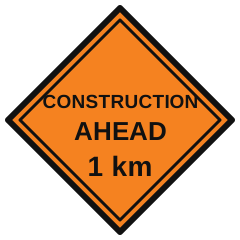
- A road closed to all traffic
- A construction zone with speed changes
- The end of a construction zone
- A detour that avoids all work
A school bus stop ahead sign is posted. What does it tell you to be ready to do?
- Drive in the bus lane
- Use your horn near the stop
- Pass buses quickly on the left
- Stop for a bus with flashing lights
A person in a motorized wheelchair is crossing at an intersection. How do the rules treat them?
- They must yield to all cars
- The same as a motor vehicle
- The same as a pedestrian
- The same as a cyclist
Your 15-year-old passenger refuses to buckle up. Who can be charged?
- The vehicle owner only
- The passenger's parents
- You, the driver
- The passenger
You feel very sleepy on a long, straight highway. What is the best thing to do?
- Open the window and keep going
- Drive faster to arrive sooner
- Turn up the radio
- Stop and rest or change drivers
Why do you turn your front wheels when parking on a hill?
- To save tire wear
- To help other drivers pass you safely
- So a rolling car stops at the curb
- To make leaving easier
A school bus ahead has its red lights flashing and stop arm out. What must you do?
- Pass if no children are visible
- Stop and wait until lights go off
- Slow down and pass carefully
- Stop, then pass on the left
The railway crossbuck has the same meaning as which other sign?
- Yield sign
- Slow-moving vehicle sign
- Do not enter sign
- Stop sign
An incident drops a driver into the Safe Driver Recognition penalty zone. How much is charged per point?
- $250
- $25
- $100
- $50
Another driver slows down on purpose to stop you from passing. What is this considered?
- A stunting offence
- Proper courtesy
- A parking offence
- Legal defensive driving
How many passengers may a GDL driver carry?
- Any number if they are family
- No more than the number of seatbelts
- Four, regardless of seatbelts
- Two, plus the supervisor
A front tire blows out on the highway. What should you do?
- Brake hard immediately
- Speed up to keep control
- Steer sharply to the shoulder to get off the road
- Hold the wheel firmly and brake gently
How does higher speed change the way you steer into a highway curve?
- Turn the wheel less, and sooner
- Turn sharply at the curve's middle
- Brake hard in the curve
- Turn the wheel more, and later
What happens in a whiteout?
- Snow melts into slush
- Ice forms on the inside of your windshield
- Snowbanks block the road
- Sky, horizon and ground blend together
At a four-way stop, which driver should go first?
- The driver on the left
- The driver turning left
- The largest vehicle
- The first to stop
On a sign, what does the colour orange mean?
- General information about nearby services
- Permitted movement
- Construction or maintenance warning
- School zone ahead
Why does the handbook stress watching for motorcycles when turning left?
- Missed motorcycles cause many crashes
- Motorcycles cannot turn left
- Motorcycles must yield to you
- Motorcycles use a separate lane
Your car begins to skid on a slippery road. Where should you look?
- At the edge of the road
- Where you want the car to go
- At the object you might hit
- At the instrument panel
What must you do at a flashing red light?
- Slow down and keep going
- Stop, then go when it is safe
- Stop and wait for a green light
- Yield only to traffic on the right
An experienced driver wants to take calls while driving. Which setup is allowed?
- Phone in a cup holder for texting
- Tablet on the seat for video calls
- Phone held between ear and shoulder
- Voice-activated phone mounted on the dash
For which drivers is there zero tolerance for drugs?
- Commercial truck and bus drivers only
- Both new and experienced drivers
- Learners only
- New drivers only
You see a chevron painted above a bicycle symbol in your lane. What does it mean?
- You may pass cyclists within the lane
- Cyclists and drivers share the lane
- The lane is for bicycles only
- A bike lane starts at the next block
A school bus has stopped with only its four-way hazard lamps on. What should you do?
- Pass slowly, watching for children
- Pass at normal speed
- Honk before passing
- Stop 5 m back and wait until it moves
A sign warns that a bridge surface is subject to icing. When is it most likely to be slippery?
- Only during the night
- Around zero degrees Celsius
- Only after a heavy snowfall
- Only below minus 20 degrees
What do yellow lines on the road separate?
- Bicycles from motor vehicles
- Parking spaces from lanes
- Traffic going in opposite directions
- Traffic going the same direction
All Saskatchewan Class 7 practice tests
- Saskatchewan Class 7 Mock Exam 1 – 40 QuestionsUntimed practice · answers explained
- Saskatchewan Class 7 Mock Exam 2 – 40 QuestionsUntimed practice · answers explained
- Saskatchewan Class 7 Mock Exam 3 – 40 QuestionsUntimed practice · answers explained
- Saskatchewan Class 7 Mock Exam 4 – 40 QuestionsUntimed practice · answers explained
- Saskatchewan Class 7 Mock Exam 5 – 40 QuestionsUntimed practice · answers explained
- Regulatory road signsThe six basic sign shapes, standard sign colours, and regulatory signs: speed, one-way, do not enter, passing, U-turn, parking and stopping, crosswalk, lane designation and turn control signs.
- Warning signs and railway crossingsYellow diamond warning signs for curves, hills, lane endings, intersections, animals and hazards, school and playground signs, chevrons, the slow-moving vehicle sign, railway crossings and crossroad delineators.
- Construction, guide and information signsOrange construction and maintenance signs, highway route markers, and blue information and service signs.
- Traffic signalsGreen, amber and red lights, right and left turns on red, green and amber arrows, flashing lights and pedestrian signals.
- Pavement markings, bus lanes and bike lanesYellow and white lines, solid and broken lines, lanes that end, bus and bicycle lanes, sharrows and where to stop at stop lines and crosswalks.
About this practice test
How many questions are in Saskatchewan Class 7 practice test 4?
30 original multiple-choice practice questions covering traffic signals, construction, guide and information signs, headlights, night, winter and rural roads, class 7 and graduated driver licensing, traffic law, points, insurance and registration, warning signs and railway crossings, right of way, pedestrians and parking lots, basic driving skills and getting ready, distracted driving, fatigue and road rage, stopping, parking and backing, sharing the road, regulatory road signs, speed limits, stunting and racing, braking, emergencies and collisions, passing, highways and freeways, turning, signalling and changing lanes, alcohol, drugs and impaired driving penalties, pavement markings, bus lanes and bike lanes. Each answer includes an explanation. This mixed practice set does not reproduce the official exam format or predict an official score.
Are the questions the same every time?
Yes. Practice test 4 always has the same 30 questions, so you can repeat it until you get them all right. The other 13 sets use different questions.
Are these real test questions?
No. The official question bank is not published. These are original questions written from the official handbook, which is what the real Saskatchewan Class 7 test is based on.