
The tab under this sign shows 50 km/h. What is that number?
Saskatchewan Class 7 Practice Test 7
30 questions on warning signs and railway crossings, pavement markings, bus lanes and bike lanes, stopping, parking and backing, regulatory road signs, traffic signals and more.
- No sign-up
- Every answer explained
- Independent · not a government site
- Set 7 of 14
- 30 questions
- Instant feedback
All 30 questions in this test
Every question and its answer choices. The correct answers and explanations appear when you take the test above.
The tab under this sign shows 50 km/h. What is that number?
- Speed limit for trucks only on the curve
- Minimum speed on the curve
- Recommended safe speed for the curve
- Speed after the curve ends
There is no stop line, but there is an unmarked crosswalk at the corner. Where do you stop?
- At the nearest crosswalk
- Three car lengths back
- In the middle of the crosswalk
- At the edge of the intersection
Your car breaks down on a rural highway at night. How must it be marked?
- With the interior dome light left switched on
- With an open trunk only
- No marking is required
- With flares, hazard lights or reflectors
What does this sign require at the intersection?
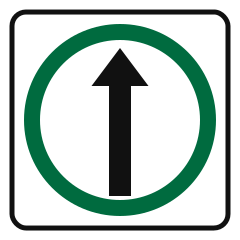
- No through traffic
- Turn right or left only
- One-way street ahead
- Go straight only
You are on a one-way street at a red light and want to turn left onto another one-way street. What applies?
- You may turn without stopping
- You must wait for a left arrow
- Left turns on red are never allowed
- You may turn after stopping and yielding
How long must you hold a Class 7 learner's licence before you can take the Class 5 road test?
- Twelve months
- Six months
- Three months
- Nine months
You pass the sign test but fail the rules part. What must you rewrite?
- Both parts again
- Only the sign part
- Only the rules part
- Both parts plus a vision test
Under the Driver Improvement Program, at how many points does a driver get a warning letter?
- 9 or more
- 6 or more
- 12 or more
- 21 or more
You need to move across two lanes. How should you do it?
- One signal, shoulder check each lane
- Stop between the two lanes
- No signal needed for two lanes
- Signal twice, shoulder check once
In winter, how low should you let your gas tank get?
- It doesn't matter in winter
- Until the warning light comes on
- Not below a quarter
- Not below half full
The centre of the highway has a double line. The line nearest you is broken and the far one is solid. What does this allow?
- Only oncoming traffic may pass
- You may pass only on curves
- You may cross to pass when safe
- Neither side may pass
A driver is caught going 52 km/h over the posted limit. How long is the vehicle impounded?
- 60 days
- 3 days
- 7 days
- 30 days
According to the handbook, what is the main cause of winter collisions?
- Salt on the road
- Not adjusting to changing conditions
- Glare from other drivers' high beams at night
- Worn-out snow tires
Why should you leave a safe following distance behind a cyclist?
- Cyclists must stop at every corner
- Bicycles have no brake lights
- Bicycles are always slow
- Cyclists must ride in the centre
A driver gets a second ticket for using a hand-held phone within 12 months. What happens to the vehicle?
- Nothing; only a fine applies
- It is impounded for 30 days
- It is impounded for seven days
- Its plates are cancelled
When during a rainstorm are roads the most slippery?
- Only when it stops raining
- In the first 10 minutes
- After an hour of rain
- Only at night
A pedestrian signal begins flashing don't walk while someone is halfway across. What should they do?
- Run to beat the traffic
- Stop and wait in the middle
- Finish crossing the street
- Go back to the curb
Two parking lanes in a lot cross with no signs. How do you treat the crossing?
- The larger vehicle goes first
- As a yield sign for you
- As an uncontrolled intersection
- As a four-way stop
On a fuel information sign, what does the letter D mean?
- Drive-through service
- Diesel fuel is available
- Dangerous goods route
- Detour route
During hard braking, your ABS pedal pulsates and the car makes clunking noises. What does this mean?
- The brakes are failing
- You should release the brake
- The ABS is working normally
- A tire has gone flat
A police officer at a check stop asks for a breath sample, though you show no signs of drinking. Must you comply?
- Yes, refusing is an offence
- Only if you are a new driver
- No, they need a reason
- Only if you were speeding
A collision with a deer can't be avoided. Where should you aim?
- Where the animal is going
- Where the animal came from
- Straight at the animal
- Into the ditch
Where may you get on or off a controlled access highway?
- At any farm approach
- Only at the entrances and exits provided
- Anywhere with a gap in the fence
- Wherever the shoulder is wide
Where may a passenger not ride?
- In a seat with a seatbelt
- In or on a trailer
- In the front passenger seat
- In the back seat
On an airport guide sign, what shows you which way to go?
- An arrow under the sign
- The direction the plane points
- The colour of the border
- The number on the tab
Which foot should you use to brake in a car with an automatic transmission?
- Both feet together
- Either foot
- Your left foot
- Your right foot
A highway maintenance truck with its warning lights on is pulling out ahead. What must you do?
- Pass it on the shoulder
- Sound your horn so it waits
- Continue at the same speed
- Yield the right of way to it
What should you watch for when you see this sign?
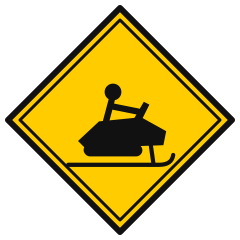
- Snowmobiles allowed on the road
- A snowmobile trail beside the road
- Snowmobiles crossing the road
- A winter road closure
A bus is making a sharp right turn at the corner where you are waiting. What should you expect?
- It will stop and back up
- It will stay fully in its own lane the whole time
- It must yield to you first
- It may swing into your half of the road
What does this five-sided sign mark?
- A school zone
- A school bus stop
- A playground ahead
- A pedestrian corridor
All Saskatchewan Class 7 practice tests
- Saskatchewan Class 7 Mock Exam 1 – 40 QuestionsUntimed practice · answers explained
- Saskatchewan Class 7 Mock Exam 2 – 40 QuestionsUntimed practice · answers explained
- Saskatchewan Class 7 Mock Exam 3 – 40 QuestionsUntimed practice · answers explained
- Saskatchewan Class 7 Mock Exam 4 – 40 QuestionsUntimed practice · answers explained
- Saskatchewan Class 7 Mock Exam 5 – 40 QuestionsUntimed practice · answers explained
- Regulatory road signsThe six basic sign shapes, standard sign colours, and regulatory signs: speed, one-way, do not enter, passing, U-turn, parking and stopping, crosswalk, lane designation and turn control signs.
- Warning signs and railway crossingsYellow diamond warning signs for curves, hills, lane endings, intersections, animals and hazards, school and playground signs, chevrons, the slow-moving vehicle sign, railway crossings and crossroad delineators.
- Construction, guide and information signsOrange construction and maintenance signs, highway route markers, and blue information and service signs.
- Traffic signalsGreen, amber and red lights, right and left turns on red, green and amber arrows, flashing lights and pedestrian signals.
- Pavement markings, bus lanes and bike lanesYellow and white lines, solid and broken lines, lanes that end, bus and bicycle lanes, sharrows and where to stop at stop lines and crosswalks.
About this practice test
How many questions are in Saskatchewan Class 7 practice test 7?
30 original multiple-choice practice questions covering warning signs and railway crossings, pavement markings, bus lanes and bike lanes, stopping, parking and backing, regulatory road signs, traffic signals, class 7 and graduated driver licensing, traffic law, points, insurance and registration, turning, signalling and changing lanes, headlights, night, winter and rural roads, speed limits, stunting and racing, sharing the road, distracted driving, fatigue and road rage, right of way, pedestrians and parking lots, construction, guide and information signs, braking, emergencies and collisions, alcohol, drugs and impaired driving penalties, passing, highways and freeways, basic driving skills and getting ready. Each answer includes an explanation. This mixed practice set does not reproduce the official exam format or predict an official score.
Are the questions the same every time?
Yes. Practice test 7 always has the same 30 questions, so you can repeat it until you get them all right. The other 13 sets use different questions.
Are these real test questions?
No. The official question bank is not published. These are original questions written from the official handbook, which is what the real Saskatchewan Class 7 test is based on.
