What colours are used on construction signs?
Saskatchewan Class 7 overview
Saskatchewan Class 7: Construction, guide and information signs
Orange construction and maintenance signs, highway route markers, and blue information and service signs.
- No sign-up
- Every answer explained
- Independent · not a government site
- 12 questions
- Topic drill
0/12
Study reference: Saskatchewan Driver's Handbook (online edition, Rev. 2026), Ch. 4 Traffic signs and signals — Construction signs, Guide signs, Information signs
All 12 questions in this test
Every question and its answer choices. The correct answers and explanations appear when you take the test above.
What colours are used on construction signs?
- Black on a yellow background
- Black on an orange background
- White on a blue background
- White on a green background
Signs showing symbols for food, fuel and camping tell you what?
- Services that are available nearby
- Routes for trucks only
- Places with special speed limits
- Areas where stopping is banned
What should you be prepared to do when you see this sign?

- Pull onto the shoulder
- Stop for a traffic control person
- Merge into the left lane
- Speed up past the work area
You pass this sign. What should you expect?
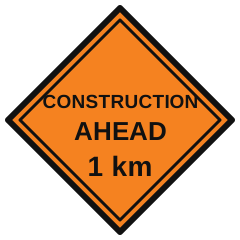
- A road closed to all traffic
- A construction zone with speed changes
- The end of a construction zone
- A detour that avoids all work
On an airport guide sign, what shows you which way to go?
- An arrow under the sign
- The direction the plane points
- The colour of the border
- The number on the tab
What does a pavement drop-off sign warn about?
- The pavement ends and a gravel surface begins ahead
- Rocks may fall onto the road
- A bridge deck is grooved
- The next lane or shoulder is at a different height
What does this sign warn you of?

- A survey crew on a farm
- A pedestrian crossing ahead
- A school crossing guard
- Highway workers ahead
What does a truck entrance construction sign mark?
- Where trucks enter, leave or cross
- A lane reserved for trucks only
- A road closed to trucks
- A truck inspection station
An orange overhead lines sign is posted in a work area. Who most needs to be ready to stop?
- A driver with a high load
- A driver towing a short trailer
- A driver of a small car
- A motorcycle rider
An orange sign warns of a survey crew ahead. What should you do?
- Stop and wait for a flag
- Sound your horn to warn them
- Change lanes without signalling
- Slow down and watch for workers
What kind of sign marks the Trans Canada Highway and provincial highways?
- A regulatory sign
- A temporary construction sign
- A route marker guide sign
- A warning sign
On a fuel information sign, what does the letter D mean?
- Drive-through service
- Diesel fuel is available
- Dangerous goods route
- Detour route
Construction, guide and information signs: key rules to remember
Our summary of what the official handbook says on this topic, in our own words. Read it before or after the practice questions above, then check the original chapter. Read the official chapter ↗
Construction signs
- Black letters or symbols on an orange background.
- Traffic control person ahead: be prepared to stop for instructions. Survey crew ahead. Highway workers.
- Truck entrance left/right: where trucks enter, leave or cross.
- Overhead lines: be prepared to stop if your vehicle has a high load.
- Construction ahead: you are entering a construction zone; extra caution, be ready for speed limit changes.
- Be prepared to stop.
- Pavement drop-off: the next lane or shoulder (or both) is lower or higher than your lane.
- Grooved pavement ahead.
- (Related, Regulatory signs) A separate sign shows the maximum speed in a work zone.
Guide signs
- Route markers for the Trans Canada Highway, provincial highways and numbered rural municipal routes.
- Airport sign: the plane points the direction to the airport.
Information signs
- Advance community sign with service tabs.
- Service symbols: telephone, picnic, accommodation, trailer facilities, food, swimming, camping, hospital, golf, police, museum, gasoline fuel and diesel fuel (D).
- (Standard sign colours) Blue = general information or service information.
Study the Construction, guide and information signs rules as flashcards →
Other topics
- Regulatory road signsThe six basic sign shapes, standard sign colours, and regulatory signs: speed, one-way, do not enter, passing, U-turn, parking and stopping, crosswalk, lane designation and turn control signs.
- Warning signs and railway crossingsYellow diamond warning signs for curves, hills, lane endings, intersections, animals and hazards, school and playground signs, chevrons, the slow-moving vehicle sign, railway crossings and crossroad delineators.
- Traffic signalsGreen, amber and red lights, right and left turns on red, green and amber arrows, flashing lights and pedestrian signals.
- Pavement markings, bus lanes and bike lanesYellow and white lines, solid and broken lines, lanes that end, bus and bicycle lanes, sharrows and where to stop at stop lines and crosswalks.
- Class 7 and Graduated Driver LicensingClass 7 age and ID rules, the supervising driver, the written tests, Learner, Novice 1 and Novice 2 stages, mandatory driver education, new residents and your driver's licence.
- Speed limits, stunting and racingDefault speed limits, the 60 km/h rule for stopped emergency, tow and highway vehicles, work zone fines, school zones, photo speed enforcement and stunting.
- Distracted driving, fatigue and road rageCellphone rules for GDL and experienced drivers, other distractions, fatigue, stress, aggressive driving, fog and heavy rain, and smoking with children in the vehicle.
- Basic driving skills and getting readySeatbelts, car seats and airbags, seat and mirror adjustment, steering hand positions, the IPDE method, gates, blind spots, following distance and eye use.
- Right of way, pedestrians and parking lotsUncontrolled intersections, T-intersections, two-way and four-way stops, entering highways, pedestrians and wheelchair users, zipper merges and parking lot right of way.
- Turning, signalling and changing lanesSignal distances, hand signals, lane position, lane changes, right and left turns, centre turning lanes, roundabouts, diverging diamond and RCUT interchanges, U-turns and two-point turns.
- Passing, highways and freewaysWhen and where you may pass, passing lanes, safe passing time, being passed, divided highways, medians, entering and leaving a freeway and freeway emergencies.
- Sharing the roadLarge trucks and the no-zone, snow plows, emergency vehicles, farm equipment, school buses, motorcycles, bicycles, e-scooters, tow trucks and funeral processions.
- Stopping, parking and backingStopping on rural roads and highways, marking stopped vehicles, parallel and angle parking, parking on a hill, back-up cameras and safe backing.
- Headlights, night, winter and rural roadsWhen headlights are required, dimming distances, glare, overdriving your headlights, winter driving and survival, black ice, whiteouts, curves, mountains and gravel grid roads.
- Braking, emergencies and collisionsABS, threshold and four-wheel lock braking, skids, soft shoulders and ditches, blow-outs, brake failure, animals on the road, collision facts and what to do after a collision.
- Alcohol, drugs and impaired driving penaltiesHow alcohol and drugs affect driving, zero tolerance for new drivers, roadside suspensions and impoundments, Criminal Code impaired driving, ignition interlock and licence disqualifications.
- Traffic law, points, insurance and registrationPolice stops, impoundments, the Driver Improvement Program, GDL improvement steps, Safe Driver Recognition, vehicle registration, plate insurance and rules related to vehicles.