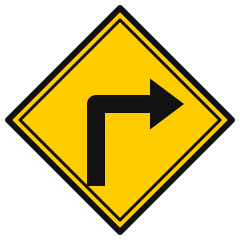
What does this sign warn you about?
New Brunswick Class 7: Warning signs and hazard markers
Yellow diamond warning signs for curves, hills, bumps, narrowing roads, merges, lane endings, intersections, animals and crossings, plus chevrons, hazard markers and the slow moving vehicle sign.
- No sign-up
- Every answer explained
- Independent · not a government site
- 28 questions
- Topic drill
Study reference: New Brunswick Driver's Handbook (2022 PDF edition), Ch. 7 Traffic Signs — 7.4 Warning signs, Hazard markers, pp. 90–92
All 28 questions in this test
Every question and its answer choices. The correct answers and explanations appear when you take the test above.
What does this sign warn you about?
- The road narrows ahead
- An underpass ahead
- A narrow bridge ahead
- A one-lane detour ahead
What does this sign warn you about?
- A sharp curve to the left
- Traffic entering from the right
- Right lane ends ahead
- A road from the right that you must enter
What does a checkerboard warning sign mean?
- The road ends; you may go left or right
- A racing event ahead
- A border crossing ahead
- A railway crossing ahead with no gates or lights
What does this sign warn you about?
- A winding road ahead
- A sharp curve ahead
- Loose gravel on the shoulder
- The road is slippery when wet
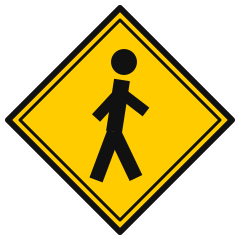
What does this sign warn you about?
- A playground ahead
- A hiking trail ahead
- A pedestrian crosswalk ahead
- No pedestrians allowed
You see a 'school bus stop ahead' sign. What should you be ready to do?
- Turn on your high beams
- Pass the bus quickly before it stops
- Stop for a bus with flashing lights
- Sound your horn to warn children
What does this yellow sign warn you about?

- A passing lane ahead
- Two-way traffic ahead
- A one-way street ahead
- A divided highway ends
What does this sign warn you about?
- The road ahead narrows
- A divided highway begins
- A narrow bridge ahead
- Two lanes merge ahead
What does this sign warn you about?
- A wildlife park entrance just ahead on the right
- Deer regularly cross this section of road
- A hunting area ahead
- A deer farm ahead
What does this sign tell you?
- The road narrows on both sides
- Keep right of the island
- Two lanes merge from the left
- The right lane ends ahead
What does this sign warn you about?
- A stop sign ahead
- A school bus stop ahead
- A railway crossing ahead
- A four-way stop at this corner
What does this sign warn you about?
- A detour ahead
- A winding road ahead
- A single curve to the left
- A slippery road ahead
You see this sign before a long descent. What does the handbook advise?

- Use your four-way flashers
- Speed up to keep momentum
- Pull onto the shoulder and stop
- Shift to a lower gear or slow down
A reverse curve sign warns of two turns in opposite directions. How close together are they?
- Separated by at least 1 km
- Separated by less than 120 metres
- Separated by less than 30 metres
- Separated by less than 300 metres
What does a 'surface subject to icing' warning mean?
- The road is closed in winter
- The surface may be icy near zero degrees
- Snow plows are working on the bridge ahead
- Studded tires are required
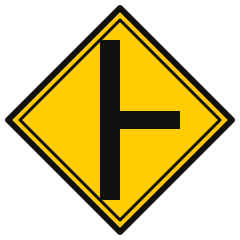
What does this sign warn you about?
- The road curves right
- A right turn only ahead
- A road from the right ahead
- Right lane ends ahead
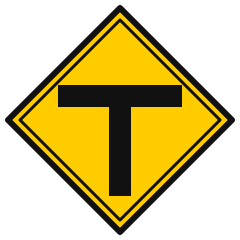
What does this sign warn you about?
- A T intersection ahead
- A dead-end street
- A cross road ahead
- A railway crossing ahead
What does a 'pavement ends' warning sign mean?
- The road continues with a gravel surface
- Pavement markings are missing
- The road is closed ahead for repaving work
- A bridge deck ahead
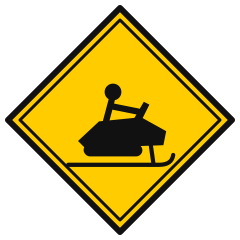
What does this sign warn you about?
- A ski hill entrance ahead
- A snowmobile crossing ahead
- A snow plow route
- Snowmobiles may use this road
What does this sign warn you about?
- A bump or rough road ahead
- Pavement ends ahead
- A hill ahead
- A narrow bridge ahead
What are these signs used for on a sharp curve?
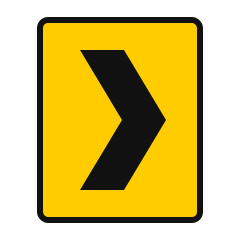
- To mark an exit ramp
- To show a detour route
- To guide drivers around the curve
- To mark a passing zone on the curve
What does this sign tell you?
- A railway crossing ahead
- Traffic signals ahead; be prepared to stop
- The signals ahead are not working
- A construction zone ahead
What does an added lane sign mean?
- The road narrows ahead
- A passing lane ends ahead
- You must merge right away into the left lane
- Two roads join and merging is not required
This marker is placed on an obstacle near the edge of the road. What do its sloping lines tell you?

- How far the obstacle extends
- Which lane is closing
- The direction the road curves
- The side on which you may safely pass
What does this sign warn you about?
- A gentle curve to the right
- Right turn only
- A sharp turn to the right
- A road from the right
What does this sign mean?
- A divided highway begins; keep to the right
- Two roads join ahead
- The road narrows to one lane
- A traffic island is closed for repairs ahead
This sign is on the back of a vehicle ahead. What does it tell you?

- The vehicle carries dangerous goods
- The vehicle is an emergency vehicle
- The vehicle travels slower than 40 km/h
- The vehicle is wider than one lane
A curve warning sign has a small tab underneath showing a speed. What does that speed mean?

- The maximum advised speed for the curve
- The minimum speed on the curve
- The speed limit for trucks only
- The new speed limit for the next 10 km
Warning signs and hazard markers: key rules to remember
Our summary of what the official handbook says on this topic, in our own words. Read it before or after the practice questions above, then check the original chapter. Read the official chapter ↗
7.4 Warning signs (pp. 90–92)
- Yellow, diamond-shaped, mostly symbols instead of words; warn of a road condition ahead that needs special care.
- Two-way traffic ahead; obstruction (pass to either side); stop sign ahead; divided highway begins (keep to the right); divided highway ends.
- Road surface slippery when wet; traffic signals ahead (be prepared to stop); bump or rough road; steep hill (shift to a lower gear or slow down going down a very steep hill).
- Concealed or unusual intersection ahead, road from right and/or left; road narrows (road ahead not as wide as the one you are on).
- Section regularly crossed by the animal shown; underpass with overhead clearance; narrow bridge (pavement narrower than the approach).
- Reverse curve: two turns in opposite directions separated by a tangent of less than 120 m, first turn right. Winding road (first curve right). Sharp curve with maximum advised speed tab.
- Lane ends (right lane ends); curve right ahead; checkerboard — road ends, you may go left or right.
- Added lane: two roads converge and merging is not required. Two lanes merge ahead / traffic entering from right.
- "T" intersection warning; road turns sharply right and left.
- Surface subject to icing: bridge or road may be slippery at zero degrees Celsius — slow down.
- Railway ahead (road crosses tracks at the angle shown); school bus stop ahead (stop for bus with flashing lights); pavement ends (gravel continues); snowmobile crossing; pedestrian crosswalk ahead; cattle crossing; playground ahead; school crosswalk ahead.
Hazard markers (p. 92)
- Chevron alignment signs guide drivers around sharp curves.
- Hazard close to the edge of the road: the downward-sloping lines point to the side on which you may safely pass.
- A warning sign is used on over-dimension loads or their escort vehicles.
- Slow moving vehicle sign: on the rear of vehicles that travel at less than 40 km/h; warns drivers behind to slow down.
Study the Warning signs and hazard markers rules as flashcards →
Other topics
- Sign shapes and coloursThe six basic sign shapes, what each sign colour means, the stop, yield and school zone signs you must get right on the sign test, guide signs and information signs.
- Regulatory signsDo not enter, no U-turn, one-way, keep right, passing and speed signs, green-circle and red-slash signs, parking and stopping signs, lane designation and turn control signs.
- Construction zones and railway crossingsOrange construction signs, construction zone speed limits and doubled fines, railway crossing signs, flashing lights and gates, the 5-metre stopping rule and vehicles that must stop at every crossing.
- Traffic lights and signalsRed, yellow and green lights, right turns on red, flashing red, yellow and green lights, green arrows, pedestrian signals, peace officers and crosswalk guards.
- Pavement markings and lanesYellow and white lines, solid and broken centre lines, lane use, two-way left-turn lanes, stop lines and crosswalks, and railway crossing markings.
- Class 7 graduated licence and testingClass 7 Level 1 and Level 2 conditions, age, consent and vision rules, the road sign and rules tests, passenger limits, night-time restrictions, road test timing and licence admin.
- Demerit points and suspensionsNewly licensed driver points, the 10-point suspension, point values for common offences, suspension lengths for Criminal Code and Motor Vehicle Act convictions, appeals and reinstatement.
- Speed limits, school zones and school busesDefault 50 and 80 km/h limits, school zone speed and hours, doubled fines, stopping for school buses, slow drivers and radar detectors.
- Right of way, intersections and roundaboutsFour-way stops, left turns, entering a highway, driveways and sidewalks, roundabouts, yield and stop signs, turning at intersections and yielding to pedestrians.
- Passing, lane changes and signallingWhen you may pass and pass on the right, no-passing distances near hills, intersections and bridges, the ten passing steps, blind spots, being passed and when and how to signal.
- Parking, backing and other road usersNo-parking distances, parking on hills and rural highways, parallel parking, backing, passengers, walking on the highway, hitchhiking and horseback riders.
- Collisions and emergency vehiclesDuties after a collision, the $1,000 reporting rule, proof of insurance, pulling over for emergency vehicles, slowing to half the limit and moving over, fire trucks and first aid at a crash.
- Seat belts, distraction and safe driving habitsSeat belt and child seat rules, seat belt penalties, hand-held device rules, speed and impact, reaction time, following distance, driving posture, defensive driving and wildlife.
- Impaired drivingZero tolerance for new and young drivers, the 0.05 warning range and 0.08 limit, vehicle impoundment periods, ignition interlock, drug-impaired driving, 24-hour suspensions and refusing a demand.
- Bad weather, night driving and highwaysRain, hydroplaning, skids, ice and ABS, winter stopping distances, blow-outs, curves, night driving, fog, climbing lanes, ramps, continuity lines and zipper merges.
- Sharing the roadLarge trucks and their blind spots and stopping distances, motorcycles, cyclists and the one-metre rule, pedestrians and farm vehicles.
- Vehicle registration, inspection and equipmentRegistration, plates, visitors and new residents, transit markers, disability placards, safety inspections, required lights and distances, horn, mirror, studded tire dates and safety chains.