A driver has a second criminal negligence conviction within three years. How long is the suspension?
New Brunswick Class 7 overview
New Brunswick Class 7 Practice Test 3
40 questions on demerit points and suspensions, bad weather, night driving and highways, sign shapes and colours, passing, lane changes and signalling, speed limits, school zones and school buses and more.
- No sign-up
- Every answer explained
- Independent · not a government site
- Set 3 of 11
- 40 questions
- Instant feedback
0/40
All 40 questions in this test
Every question and its answer choices. The correct answers and explanations appear when you take the test above.
A driver has a second criminal negligence conviction within three years. How long is the suspension?
- 24 months
- 12 months
- 18 months
- 36 months
You are on a highway and traffic is entering from a ramp. What should you do?
- Sound your horn
- Stop to let every car in
- Move left if safe, or slow to let it in
- Speed up to close the gap so it merges behind
What does this sign require you to do?

- Stop only if there is cross traffic
- Slow down and proceed if no one is coming
- Come to a full stop and make sure the way is clear
- Give way to traffic on your left only
Your view is blocked as you approach a narrow bridge. Within what distance may you not drive on the left side of the road?
- 100 metres
- 150 metres
- 30 metres
- 15 metres
What happens to the fine if you are caught speeding in a school zone?
- It is tripled
- It is replaced by a warning
- It is doubled
- It is the same as anywhere else
You believed you had the right of way, but a collision happened anyway. What does the handbook say?
- You are never at fault
- Only the other driver is responsible
- You may still be held responsible
- Insurance will always cover you
What does a single solid yellow centre line mean?
- Passing is permitted with care
- The road is one-way
- A bike lane is ahead
- Passing is not permitted
What are these signs used for on a sharp curve?
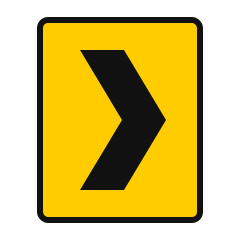
- To mark an exit ramp
- To show a detour route
- To guide drivers around the curve
- To mark a passing zone on the curve
How fast should you be moving when backing up?
- As fast as needed to clear traffic
- At least 20 km/h
- No faster than a person walking quickly
- The same speed as driving forward
What does this sign mean?
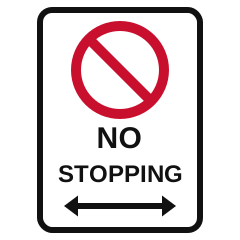
- Stop sign ahead
- Stop only for emergencies in the area shown
- Stopping is prohibited in the area shown
- Parking for loading only
Which statement about cyclists in New Brunswick is true?
- Cyclists may ride on sidewalks in towns
- Helmets are required only for children
- Cyclists should ride against traffic to see cars
- Riding a bicycle without a helmet is against the law
A newly licensed driver has had no convictions. How many points do they gain each year after the first?
- 3 points a year, up to 12
- 4 points a year, up to 10
- 2 points a year, up to 10
- 1 point a year, up to 8
Part of a rural construction zone has no speed limit sign. What is the limit there?
- 100 km/h
- 80 km/h
- 50 km/h
- 60 km/h
While passing, may you go over the speed limit to complete the pass faster?
- Yes, by up to 10 km/h
- Yes, if the road ahead is completely clear
- Yes, for up to 15 seconds
- No, never above the posted limit
What does a flashing yellow (amber) light mean?
- Pedestrians must stop
- Slow down and proceed with extra care
- Stop and wait for green
- The light is about to turn green
What does this sign warn you about?

- The road narrows ahead
- An underpass ahead
- A narrow bridge ahead
- A one-lane detour ahead
How many correct answers do you need on the 20-question rules test?
- 14
- 18
- 16
- 15
You are in a construction zone in an urban district and no other speed is posted. What is the limit?
- 30 km/h
- 60 km/h
- 50 km/h
- 40 km/h
When does a New Brunswick driver's licence expire?
- On your birthday in the year of expiry
- On March 31 of the expiry year
- On December 31 of the expiry year
- On the anniversary of your road test
You are driving out of a driveway in a residential area across a sidewalk. What must you do?
- Slow down and honk
- Stop before driving onto the sidewalk
- Stop only if you see someone
- Stop after crossing the sidewalk
A lane is ending because of road work. How does a zipper merge work?
- Stop at the end of the lane and wait
- Drive on the shoulder past the closure
- Merge as early as possible and leave the lane empty
- Use the ending lane to the merge point, then take turns
To whom must a reportable collision be reported?
- Your insurance company only
- The vehicle's manufacturer
- Service New Brunswick within 30 days
- The nearest RCMP office or local police
What does this sign mean?

- Stop, then proceed
- No parking at any time
- Do not enter
- Road closed ahead, detour right
You correctly identify the stop, yield and school zone signs on the sign test. How many of the other signs may you get wrong and still pass?
- No more than five
- No more than four
- No more than six
- No more than two
What do alternating flashing amber lights on a school bus mean?
- The bus is stopped and loading
- You may pass with care
- The bus is out of service
- The bus is about to stop for children
What is New Brunswick's 'warning range' for blood alcohol?
- Between 0.08 and 0.10
- Anything above zero for all drivers
- Between 0.02 and 0.05
- Between 0.05 and 0.08
Above what amount of total property damage must a collision be reported to police?
- $5,000
- $2,000
- $500
- $1,000
Before you back up, what must you check?
- Only your backup camera, if the car has one
- Only your rear-view mirror
- Only your side mirrors
- Over your shoulder and your blind spot
Who must enroll in New Brunswick's Ignition Interlock Program?
- Only drivers under 21
- Only drivers with three convictions in ten years
- Only commercial drivers
- Anyone convicted of alcohol-impaired driving
At 50 km/h, about how far does your car travel during an average reaction time before you brake?
- About 50 metres
- About 3 metres
- About 25 metres
- About 10 metres
What does 'overdriving your headlights' mean?
- Going too fast to stop within the distance you see
- Using high beams in the city
- Driving with one headlight out
- Leaving your headlights on long after you park the car
What pavement marking may be painted on the approach to a railway crossing?
- A green bike symbol
- A yellow diamond
- An X and/or a stop line
- Double white arrows
May you use a two-way left-turn lane to pass a slow vehicle?
- Yes, if no one is turning
- Only at night
- No, it is not a passing lane
- Yes, for short distances
How far behind a truck can its rear blind spot extend?
- Up to 25 metres
- Up to 10 metres
- Up to 100 metres
- Up to 60 metres
Who is responsible for making sure a 14-year-old passenger wears a seat belt?
- The passenger
- The vehicle owner, even if not in the car
- The driver
- The passenger's parent, even if not in the car
During which period may approved studded tires be used in New Brunswick?
- December 1 to March 31
- November 1 to April 15
- October 15 to April 30
- October 1 to May 31
Which three functions are traffic signs grouped by in the handbook?
- Urban, rural and highway
- Regulatory, warning and information
- Federal, provincial and municipal
- Permanent, temporary and seasonal
A visitor drives their own car in New Brunswick for personal use. How long can they do so without registering it in the province?
- 30 days
- Six months
- 90 days
- One year
Where are crosswalk guards allowed to stop traffic?
- Anywhere in a school zone
- Only for pedestrians at crosswalks
- At any intersection, for any reason
- Only at railway crossings
Before starting your vehicle, how can you check for children or pedestrians hidden in blind spots?
- Look only in the rear-view mirror
- Turn on the four-way flashers
- Sound the horn twice
- Walk around the vehicle in a circle check
All New Brunswick Class 7 practice tests
- New Brunswick Class 7 Mock Exam 1 – 40 QuestionsUntimed practice · answers explained
- New Brunswick Class 7 Mock Exam 2 – 40 QuestionsUntimed practice · answers explained
- New Brunswick Class 7 Mock Exam 3 – 40 QuestionsUntimed practice · answers explained
- New Brunswick Class 7 Mock Exam 4 – 40 QuestionsUntimed practice · answers explained
- New Brunswick Class 7 Mock Exam 5 – 40 QuestionsUntimed practice · answers explained
- Sign shapes and coloursThe six basic sign shapes, what each sign colour means, the stop, yield and school zone signs you must get right on the sign test, guide signs and information signs.
- Regulatory signsDo not enter, no U-turn, one-way, keep right, passing and speed signs, green-circle and red-slash signs, parking and stopping signs, lane designation and turn control signs.
- Warning signs and hazard markersYellow diamond warning signs for curves, hills, bumps, narrowing roads, merges, lane endings, intersections, animals and crossings, plus chevrons, hazard markers and the slow moving vehicle sign.
- Construction zones and railway crossingsOrange construction signs, construction zone speed limits and doubled fines, railway crossing signs, flashing lights and gates, the 5-metre stopping rule and vehicles that must stop at every crossing.
- Traffic lights and signalsRed, yellow and green lights, right turns on red, flashing red, yellow and green lights, green arrows, pedestrian signals, peace officers and crosswalk guards.
About this practice test
How many questions are in New Brunswick Class 7 practice test 3?
40 original multiple-choice practice questions covering demerit points and suspensions, bad weather, night driving and highways, sign shapes and colours, passing, lane changes and signalling, speed limits, school zones and school buses, right of way, intersections and roundabouts, pavement markings and lanes, warning signs and hazard markers, parking, backing and other road users, regulatory signs, sharing the road, construction zones and railway crossings, traffic lights and signals, class 7 graduated licence and testing, collisions and emergency vehicles, impaired driving, seat belts, distraction and safe driving habits, vehicle registration, inspection and equipment. Each answer includes an explanation. This mixed practice set does not reproduce the official exam format or predict an official score.
Are the questions the same every time?
Yes. Practice test 3 always has the same 40 questions, so you can repeat it until you get them all right. The other 10 sets use different questions.
Are these real test questions?
No. The official question bank is not published. These are original questions written from the official handbook, which is what the real New Brunswick Class 7 test is based on.