New Brunswick Class 7 overview

New Brunswick Class 7: Construction zones and railway crossings

Orange construction signs, construction zone speed limits and doubled fines, railway crossing signs, flashing lights and gates, the 5-metre stopping rule and vehicles that must stop at every crossing.

  • 21 questions
  • Topic drill
0/21
Construction zones and railway crossings · Question 1Score 0/0
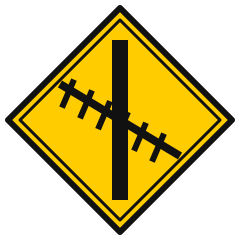
A yellow diamond with a black road line crossed at an angle by a line with short ties

What does this yellow sign warn you about?

Study reference: New Brunswick Driver's Handbook (2022 PDF edition), Ch. 4 & 7 Rules of the Road; Traffic Signs — 7.4 Construction signs, 7.5 Railway crossings, 4.5 Construction zones, 4.12 Railway crossings, pp. 36, 41–42, 93–94

All 21 questions in this test

Every question and its answer choices. The correct answers and explanations appear when you take the test above.

  1. What does this yellow sign warn you about?

    A yellow diamond with a black road line crossed at an angle by a line with short ties
    1. A narrow bridge ahead
    2. Railway tracks cross the road ahead at that angle
    3. A side road from the right joins the highway at that angle
    4. The road ends at a fence
  2. What does a 'survey crew ahead' sign tell you to do?

    1. Use the shoulder to pass
    2. Stop and wait for a flag person to wave you on
    3. Slow down; a crew is working near the road
    4. Expect a detour ahead
  3. You are following a vehicle carrying flammable liquids toward a railway crossing. What should you expect?

    1. It will cross only on a green light
    2. It will use its four-way flashers and keep going
    3. It will speed up to cross quickly
    4. It will stop, look and listen before crossing
  4. Part of a rural construction zone has no speed limit sign. What is the limit there?

    1. 100 km/h
    2. 80 km/h
    3. 50 km/h
    4. 60 km/h
  5. A small sign under a railway crossing sign shows the number 2. What does it mean?

    1. Stop two metres from the rail
    2. Trains pass every two minutes
    3. There are two sets of tracks
    4. Only two vehicles may cross at once
  6. The gates are down at a railway crossing but you see no train. What should you do?

    1. Honk and cross if the lights stop
    2. Drive around the gate carefully
    3. Back up and cross at an angle
    4. Stay stopped; never drive around the gate
  7. The lights and bell are active at a crossing with no painted stop line. Where must you stop?

    1. No closer than 5 metres from the nearest rail
    2. Wherever you can see the train
    3. Beside the crossbuck post
    4. Right at the edge of the first rail, behind the gate
  8. What does a 'pavement drop-off' sign warn you about?

    1. Loose stones on the road
    2. The shoulder or next lane is at a different level
    3. A steep hill ahead
    4. The pavement ends and a gravel surface begins ahead
  9. What does a railway advance warning sign tell you to do?

    1. Stop only if you hear a horn
    2. Look, listen and slow down
    3. Change lanes before the tracks
    4. Speed up to clear the tracks
  10. A train has just passed a crossing with two tracks. Why should you wait before crossing?

    1. You must wait 30 seconds by law after any train
    2. The rails are too hot to drive on
    3. The gates must be lifted by hand
    4. A second train may be on the other track
  11. How close to the nearest rail of a railway crossing may you park?

    1. No closer than 30 metres
    2. No closer than 10 metres
    3. No closer than 5 metres
    4. No closer than 15 metres
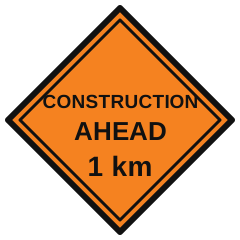
  12. What does this sign mean?

    An orange diamond with black text reading CONSTRUCTION AHEAD and a distance
    1. The road is closed ahead to all traffic
    2. You are entering a construction zone
    3. Construction has ended
    4. A detour begins here
  13. What colour are construction signs?

    1. Black on a yellow background
    2. Red on a white background
    3. White on a green background
    4. Black on an orange background
  14. What does a Railway Crossing sign require you to do?

    A white X-shaped sign with black lettering on both arms
    1. Sound your horn before crossing
    2. Stop every time, even with no train
    3. Yield to all trains
    4. Yield only when the lights flash
  15. What should you be ready to do when you see this sign?

    An orange diamond with a black figure holding a flag
    1. Stop if a traffic control person signals you
    2. Speed up to clear the zone
    3. Pass the line of stopped cars
    4. Turn around and find another route around the work
  16. You are in a construction zone in an urban district and no other speed is posted. What is the limit?

    1. 30 km/h
    2. 60 km/h
    3. 50 km/h
    4. 40 km/h
  17. What does this sign mean?

    An orange rectangle with the black word DETOUR
    1. The road ends ahead
    2. Turn left only
    3. A one-way street
    4. A detour is ahead
  18. What does this orange sign warn you about?

    An orange diamond with a black figure using a shovel
    1. A school zone ahead
    2. A park entrance ahead
    3. Road workers are present ahead
    4. A pedestrian crossing ahead
  19. A stop sign is posted at a railway crossing. How close to the nearest rail may you stop?

    1. No closer than 15 metres
    2. No closer than 5 metres
    3. No closer than 3 metres
    4. No closer than 1 metre
  20. What happens to speeding fines in a construction zone?

    1. They are doubled
    2. They apply only to trucks
    3. They stay the same
    4. They are tripled
  21. Traffic is heavy and slow ahead of a railway crossing. When may you start across the tracks?

    1. Only after honking your horn
    2. As soon as the car ahead moves
    3. When your whole vehicle fits on the far side
    4. Whenever the crossing lights and bells are off

Construction zones and railway crossings: key rules to remember

Our summary of what the official handbook says on this topic, in our own words. Read it before or after the practice questions above, then check the original chapter. Read the official chapter ↗

Construction signs (p. 93)

  • Construction signs: black letters or symbols on an orange background.
  • Construction ahead: you are entering a construction zone; extra caution, be ready for speed limit changes.
  • Traffic control person ahead: be prepared to stop for instructions.
  • Road work ahead: workers and maintenance activity present; obey posted speed limits.
  • Detour ahead; survey crew ahead (slow down); truck entrance left/right (where trucks enter, leave or cross).
  • Pavement drop-off: the adjacent lane and/or shoulder is lower or higher than your lane.

4.5 Construction zones (p. 36)

  • Obey the speed limit on construction zone signs; it is 50 km/h in an urban district unless otherwise posted; where no limit is posted in the zone, the limit is 80 km/h. Signs mark the start and end of the zone.
  • Speeding fines in school and construction zones are doubled.

7.5 Railway crossings (p. 94)

  • Train–vehicle collisions are the deadliest highway collisions.
  • Advance warning signs: look, listen, slow down, you may have to stop; an advisory speed tab may show a safe speed lower than posted.
  • Pavement markings: an "X" and/or stop line may be painted on the approach.
  • Railway Crossing sign (crossbuck) at all public crossings: yield to all trains; a sign below shows the number of tracks if more than one.
  • With a stop sign: stop no closer than 5 m from the nearest rail; go only when safe.
  • With flashing lights and bell: stop when activated (train approaching) at the stop line or, if none, no closer than 5 m from the nearest rail; wait until lights and bells stop, the train has passed, or it is safe. With more than one track, make sure all tracks are clear — a second train may come from the other direction.

4.12 Railway crossings (pp. 41–42)

  • If lights are flashing, a flagman signals, or a train is dangerously close: stop not less than 5 m (16 ft) from the nearest rail.
  • Never drive around a gate or barrier.
  • In slow, heavy traffic, do not start across unless there is room for your whole vehicle on the other side.
  • Buses, vehicles carrying passengers for hire, and vehicles carrying explosives or flammable liquids must stop, listen and look both ways before crossing; be ready to stop if following one. School buses must also stop at crossings unless otherwise indicated (Part 6).
  • Parking: not within 15 m of the nearest rail of a railway crossing (Part 4.20).

Study the Construction zones and railway crossings rules as flashcards →

Other topics

Full practice tests