New Brunswick Class 7 Practice Test – Printable PDF
100 original New Brunswick Class 7 practice questions, signs and rules mixed, with the answer key on separate pages. Print it or save it as a PDF for free.
- No sign-up
- Every answer explained
- Independent · not a government site
- 100 questions
- Answer key included
- Free, no sign-up
This page sets out 100 New Brunswick Class 7 practice questions on one printable sheet, for anyone who would rather study with paper and a pencil. They are drawn evenly from all 18 topics in our bank, so both parts of the knowledge test are there: road sign recognition and the rules of the road, from graduated licence conditions and demerit points to school buses, roundabouts and impaired driving. The answer key begins on a fresh page after the last question.
Every question is our own, written from the New Brunswick Driver's Handbook, and each answer in the key comes with a short explanation and the handbook page it is based on. Service New Brunswick does not publish its test questions, so no PDF online is the real test. When you mark your sheet, score the sign questions and the rules questions separately, the way the real tests are scored: 16 of 20 is the bar on the rules test, and the sign test lets you miss no more than four signs. Then return to the topic tests for the part that needs work and try the 40-question mock exam.
New Brunswick Class 7 Practice Test – Printable PDF
1.What is New Brunswick's 'warning range' for blood alcohol?
- Between 0.08 and 0.10
- Anything above zero for all drivers
- Between 0.02 and 0.05
- Between 0.05 and 0.08
2.Before you park on a highway, how much clear roadway must be left for other traffic?
- At least 2 metres
- At least 5 metres
- At least 10 metres
- At least 3 metres
3.How close to the nearest rail of a railway crossing may you park?
- No closer than 30 metres
- No closer than 10 metres
- No closer than 5 metres
- No closer than 15 metres
4.What does this sign tell you?

- The road narrows on both sides
- Keep right of the island
- Two lanes merge from the left
- The right lane ends ahead
5.A driver gets a second alcohol-related conviction within 10 years. How long is the suspension?
- Two years
- Five years
- 18 months
- Three years
6.An emergency vehicle with its siren on is approaching an intersection you are about to enter on a green light. What must you do?
- Stop in the middle of the intersection
- Proceed, because your light is green
- Speed up to clear the intersection
- Yield to the emergency vehicle
7.You are towing a trailer. Where should the safety chain be attached?
- To the frame or bumper, not the hitch
- To the towing vehicle's tow hook
- To the trailer tongue only
- To the hitch ball
8.What does a posted speed limit tell you?
- The speed police allow before ticketing
- The speed you must drive at all times
- The maximum safe speed under ideal conditions
- The minimum speed in good weather
9.When is passing on the right allowed in New Brunswick?
- When the vehicle ahead is turning left
- When the driver ahead is going below the limit
- Whenever the right shoulder is paved
- Never, under any circumstances
10.In which direction does traffic travel in a roundabout?
- Either direction
- The direction of the first exit
- Clockwise
- Counter-clockwise
11.Which colour is used for construction and maintenance warning signs?
- Blue
- Orange
- Yellow
- Red
12.What do alternating flashing amber lights on a school bus mean?
- The bus is stopped and loading
- You may pass with care
- The bus is out of service
- The bus is about to stop for children
13.What does 'overdriving your headlights' mean?
- Going too fast to stop within the distance you see
- Using high beams in the city
- Driving with one headlight out
- Leaving your headlights on long after you park the car
14.What must a farm tractor display on its rear when driving on a highway?

- Four-way flashers only
- A flashing red light
- A wide load banner
- A slow-moving vehicle sign
15.What does this sign mean?

- Stop, then proceed
- No parking at any time
- Do not enter
- Road closed ahead, detour right
16.Which of these is an offence under New Brunswick law?
- Turning right on red after a full stop
- Driving with your headlights on in daylight hours
- Disobeying a signal unless an officer directs you
- Stopping for a yellow light
17.A parent who signed a 16-year-old's consent form changes their mind. What can they do?
- Withdraw consent in writing to the Registrar
- Phone the driving school to cancel it
- Ask the police to take the licence away
- Nothing until the driver turns 18
18.What pavement marking may be painted on the approach to a railway crossing?
- A green bike symbol
- A yellow diamond
- An X and/or a stop line
- Double white arrows
19.A driver is on a three-month Administrative Licence Suspension for alcohol. What interlock option exists?
- A mandatory interlock for life
- No interlock option at all
- An interlock only after one year
- A voluntary ignition interlock program
20.How fast should you be moving when backing up?
- As fast as needed to clear traffic
- At least 20 km/h
- No faster than a person walking quickly
- The same speed as driving forward
21.Traffic is heavy and slow ahead of a railway crossing. When may you start across the tracks?
- Only after honking your horn
- As soon as the car ahead moves
- When your whole vehicle fits on the far side
- Whenever the crossing lights and bells are off
22.What does this sign warn you about?

- A bump or rough road ahead
- Pavement ends ahead
- A hill ahead
- A narrow bridge ahead
23.How many points is a newly licensed driver credited with when the licence is first issued?
- 2 points
- 10 points
- 4 points
- 6 points
24.A driver is pinned by the steering wheel after a crash. How can you ease the pressure?
- Pull the driver out by the arms
- Deflate the tires
- Push the steering wheel forward with your hands
- Release the seat catch and slide the seat back
25.What must be true of your rear licence plate at night?
- It must be removed for washing
- It must be lit
- It must be covered
- It must be reflective only
26.If you double your speed, how much greater is the force of impact in a collision?
- Eight times as great
- Twice as great
- Four times as great
- Three times as great
27.What must you check before changing lanes on a multi-lane road?
- Only the car directly ahead
- Only the lane you are leaving and its mirror
- Only your inside mirror
- Clearance beside, ahead and behind you
28.You and another driver reach a four-way stop at about the same time. The other car is on your right. Who goes first?
- Whoever is going straight
- The car on your right
- The larger vehicle
- You, because you are on the left
29.What does the colour green mean on a traffic sign?
- A permitted turn or direction
- A prohibited turn or movement
- A construction zone ahead
- A school crossing ahead
30.Is it ever legal to pass a school bus showing alternating flashing red lights on an undivided road?
- Yes, if no children are visible
- No, it is illegal
- Yes, if you are going the other way
- Yes, on the left at low speed
31.What do continuity lines on a highway show?
- The edge of the shoulder
- Where passing is not allowed on the highway
- Where a ramp lane borders the through lane
- A lane reserved for buses
32.How much road directly in front of a long-hood tractor may the driver be unable to see?
- About the first 1 metre
- About the first 30 metres
- About the first 15 metres
- About the first 6 metres
33.What does this sign mean?

- Traffic moves in one direction only
- Two-way traffic ahead
- Detour in the direction shown
- Turn right only
34.A police officer directs you to drive through a red light. What should you do?
- Turn right instead
- Wait for the light to turn green
- Follow the officer's direction with caution
- Ignore the officer and obey the light
35.What is the minimum age to apply for a Class 7 graduated licence in New Brunswick?
- 15 years old
- 16 years old
- 18 years old
- 14 years old
36.What does a single solid yellow centre line mean?
- Passing is permitted with care
- The road is one-way
- A bike lane is ahead
- Passing is not permitted
37.Who is covered by New Brunswick's zero tolerance program for drug-impaired driving?
- Only drivers with past convictions
- Only commercial drivers
- Only drivers over 65
- Novice drivers and drivers under 21
38.You park across the street from a fire station entrance. How far away must you be?
- At least 10 metres
- At least 50 metres
- At least 25 metres
- At least 5 metres
39.You are in a construction zone in an urban district and no other speed is posted. What is the limit?
- 30 km/h
- 60 km/h
- 50 km/h
- 40 km/h
40.What does this sign warn you about?

- A wildlife park entrance just ahead on the right
- Deer regularly cross this section of road
- A hunting area ahead
- A deer farm ahead
41.A newly licensed driver loses every point they have been credited. What happens?
- Their points reset to four
- They receive a warning letter
- The Registrar suspends their licence
- They must retake the sign test only
42.Which of these counts as a 'service vehicle' under the slow-down and move-over rule?
- A provincial road maintenance vehicle
- A school bus on its route
- A courier delivery van
- A taxi waiting for a fare on the shoulder
43.You just moved to New Brunswick to live. When must you register your vehicle here?
- When your old registration expires
- Within six months
- Within 60 days
- Immediately
44.Which of these is prohibited while you are driving?
- Using a GPS mounted and set before you leave
- Holding a phone to call or text
- Adjusting the heater
- Listening to the radio
45.On a multi-lane street, when should you leave the right lane?
- When driving under the limit
- Whenever you want to go faster than 50 km/h
- Only to pass or to turn left
- Whenever traffic is light
46.You are in the inner lane of a multi-lane roundabout and realize you need the outer lane. What should you do?
- Signal and cut across the lane
- Stop and wait for a gap
- Stay in your lane and do not change
- Change lanes quickly inside
47.What does this five-sided sign mark?

- A pedestrian crosswalk
- A playground ahead
- A hospital zone
- A school zone
48.What is the speed limit in an urban district when no other limit is posted?
- 60 km/h
- 50 km/h
- 40 km/h
- 70 km/h
49.In a severe rainstorm, at about what speed can tires lose all contact with the road?
- About 85 km/h
- About 55 km/h
- About 110 km/h
- About 70 km/h
50.A motorcycle is ahead of you in your lane. How much of the lane is the motorcycle entitled to?
- Only the space it needs
- Half the lane
- The full lane
- The right third of the lane
51.What does this sign tell you to do?

- Turn right at the next corner or driveway
- Right lane ends ahead
- Keep right of the island or obstruction
- Merge into the right lane
52.A pedestrian signal shows Walk. What must vehicles do?
- Yield the right of way to pedestrians in the crosswalk
- Proceed, because cars have a green too
- Yield only to pedestrians already halfway across
- Honk to warn pedestrians
53.You passed your written tests but did not finish the road test. How long do your test results stay valid?
- Three months
- Six months
- One year
- Two years
54.May you use a two-way left-turn lane to pass a slow vehicle?
- Yes, if no one is turning
- Only at night
- No, it is not a passing lane
- Yes, for short distances
55.A driver who already had a 0.08-or-over suspension within 10 years is caught again. How long is the mandatory impoundment?
- 30 days
- 60 days
- One year
- 90 days
56.Is it legal to coast downhill with your transmission in neutral?
- Yes, on hills only
- No, coasting in neutral is prohibited
- Yes, below 50 km/h
- Yes, to save fuel on long downhill grades
57.What does a 'survey crew ahead' sign tell you to do?
- Use the shoulder to pass
- Stop and wait for a flag person to wave you on
- Slow down; a crew is working near the road
- Expect a detour ahead
58.This sign is on the back of a vehicle ahead. What does it tell you?
- The vehicle carries dangerous goods
- The vehicle is an emergency vehicle
- The vehicle travels slower than 40 km/h
- The vehicle is wider than one lane
59.A radar check shows you were going 15 km/h above the posted limit. What is the point penalty?
- 1 point
- 5 points
- 2 points
- 3 points
60.What is accepted as proof of financial responsibility after a collision?
- A bank statement
- A signed letter from your employer or your bank
- A New Brunswick Liability Insurance Card
- The vehicle's bill of sale
61.Within what distance of an oncoming vehicle must you dim your high beams?
- 100 metres
- 300 metres
- 150 metres
- 60 metres
62.Who is responsible for making sure a 14-year-old passenger wears a seat belt?
- The passenger
- The vehicle owner, even if not in the car
- The driver
- The passenger's parent, even if not in the car
63.Why should you stay back from the vehicle ahead before passing?
- It is required for trucks only
- It lets the other driver know you want to pass
- Following closely blocks your view and forces a sharp move
- It saves fuel
64.What must you do at a yield sign?
- Yield to traffic in or near the intersection
- Speed up to merge
- Proceed; the other road's traffic must yield to you
- Always come to a full stop
65.Which three functions are traffic signs grouped by in the handbook?
- Urban, rural and highway
- Regulatory, warning and information
- Federal, provincial and municipal
- Permanent, temporary and seasonal
66.A school bus stopped ahead of you has its red lights flashing. How far back must you stop?
- At least 5 metres
- At least 10 metres
- At least 20 metres
- At least 2 metres
67.Your car has anti-lock brakes (ABS) and you must stop quickly on ice. What should you do?
- Pull the parking brake
- Apply steady pressure and do not pump
- Brake, release, then brake again
- Pump the brake rapidly
68.Which statement about cyclists in New Brunswick is true?
- Cyclists may ride on sidewalks in towns
- Helmets are required only for children
- Cyclists should ride against traffic to see cars
- Riding a bicycle without a helmet is against the law
69.What does this sign mean?
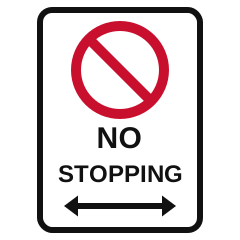
- Stop sign ahead
- Stop only for emergencies in the area shown
- Stopping is prohibited in the area shown
- Parking for loading only
70.Where are crosswalk guards allowed to stop traffic?
- Anywhere in a school zone
- Only for pedestrians at crosswalks
- At any intersection, for any reason
- Only at railway crossings
71.Your vision test shows you need glasses to drive safely. What happens?
- Testing stops until you get the correction you need
- You pass, with a warning
- You get a licence for daylight driving only
- You must retake the vision test in one year
72.You are waiting in a two-way left-turn lane. What hazard should you watch for?
- Trains crossing the lane
- Oncoming vehicles using the same lane
- Pedestrians walking along the centre lane
- Bicycles riding in the lane
73.A police officer believes you are unfit to drive safely because of a medical problem. What can the officer do?
- Cancel your licence permanently
- Give you two demerit points
- Nothing unless you have been drinking
- Suspend your licence for 24 hours
74.May a passenger ride in the open back of a pickup truck on a highway?
- Yes, if they are seated
- Only in limited cases, like a parade
- Yes, if they are over 16
- Yes, if the truck stays under 50 km/h
75.Part of a rural construction zone has no speed limit sign. What is the limit there?
- 100 km/h
- 80 km/h
- 50 km/h
- 60 km/h
76.What does this sign warn you about?

- The road ahead narrows
- A divided highway begins
- A narrow bridge ahead
- Two lanes merge ahead
77.You are convicted of driving while suspended for the first time. How long is the new suspension?
- 12 months
- 6 months
- 3 months
- 24 months
78.A tow truck is stopped on the shoulder with flashing lights, and you are on a two-lane highway in your direction. What must you do?
- Sound your horn and keep going at your speed
- Slow to half the limit and change lanes
- Keep your speed and your lane
- Stop in your lane behind it
79.For how long can a disability parking placard be valid?
- Up to five years
- Up to three years
- For life
- Up to one year
80.How much brake pedal travel should remain at all times when you press the brake?
- At least half
- At least one-third
- At least three-quarters
- At least one-tenth
81.Another driver sounds their horn to pass you. What must you do?
- Move right and do not speed up
- Move left to block them
- Brake hard to let them by
- Speed up to stay ahead
82.A large truck is travelling in a roundabout beside your lane. What should you do?
- Pass it quickly on the inside
- Stay right beside it so the driver can see you
- Honk so it moves over
- Give it room; do not drive beside or pass it
83.Which shape is used only for the stop sign?
- Pentagon
- Diamond
- Octagon
- Triangle
84.What does New Brunswick law say about radar detectors?
- They are legal in cars but not trucks
- They are legal if turned off in school zones
- They are legal everywhere
- Possessing and using them is illegal
85.Where must you never stop, park or make a U-turn?
- On a curve
- In a parking lot
- On a straight residential street
- On a wide road with good visibility
86.Which is one of the three main types of crash involving farm equipment?
- Overtaking a farm vehicle that is turning left
- Farm vehicles backing into parked cars
- Farm vehicles running red lights in towns
- Head-on crashes on divided highways
87.What does this sign mean?
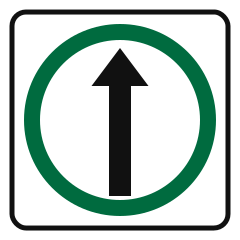
- One-way street ahead
- Passing permitted
- Go straight through only
- No straight-through traffic
88.You face a red light with a painted stop line. Where must you stop?
- Wherever you can see cross traffic
- In the crosswalk
- Past the crosswalk, at the edge of the intersection
- At the stop line
89.You move to a new address. How long do you have to tell the Motor Vehicle Branch?
- 5 days
- 10 days
- 60 days
- 30 days
90.When should you move into a two-way left-turn lane?
- As soon as the lane begins
- As near as possible to where you will turn
- At least one block before the turn
- Only after the oncoming lane is clear
91.What are the most important factors in how impaired you become from alcohol?
- Whether you drink alone or with a group of friends
- The colour of the drink
- How much is absorbed and the time to eliminate it
- Whether you drink indoors or outdoors
92.Your car faces up a steep street with a curb on your right. How should the front wheels be turned when you leave it?
- To the right, toward the curb
- To the left, away from the curb
- Straight ahead
- Left only if the road is icy
93.What does a Railway Crossing sign require you to do?

- Sound your horn before crossing
- Stop every time, even with no train
- Yield to all trains
- Yield only when the lights flash
94.What does this sign warn you about?
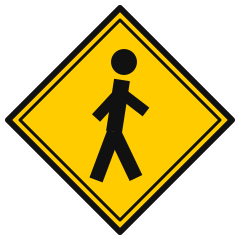
- A playground ahead
- A hiking trail ahead
- A pedestrian crosswalk ahead
- No pedestrians allowed
95.Your suspension period has ended. What might you need before your licence is reinstated?
- A reinstatement fee and any listed conditions
- A letter from your employer
- A new birth certificate
- Nothing; it restarts automatically on that date
96.Which information must you give the other party after a collision?
- Only your insurance company name
- Name, address, plate, licence and insurance card
- Only your phone number
- Your employer's name, home phone and date of birth
97.How far behind the vehicle must your rear-view mirror let you see?
- At least 100 metres
- At least 60 metres
- At least 30 metres
- At least 150 metres
98.Your car has air bags. Do you still need to wear a seat belt?
- Only on highways over 80 km/h
- Only in the back seat
- No, air bags replace seat belts in newer cars
- Yes, seat belts must be used with air bags
99.The car ahead of you starts to pass a truck. What should you do?
- Sound your horn to hurry it
- Wait until it finishes before you pass
- Pass both on the right
- Follow it closely and pass too
100.Traffic ahead is backed up past the far side of an intersection. Your light is green. What should you do?
- Go around the traffic using the right shoulder
- Wait until you can clear the intersection
- Sound your horn until traffic moves
- Enter and wait in the intersection
Answer key with explanations
1. D — Between 0.05 and 0.08
A BAC between 0.05 and 0.08 percent is the warning range and brings penalties under New Brunswick's Motor Vehicle Act.
Impaired driving · Based on: New Brunswick Driver's Handbook (2022 PDF edition), Ch. 5 Safe Driving, p. 65
2. B — At least 5 metres
A vehicle cannot be parked on a highway unless 5 metres (16 feet) of unobstructed roadway is left for traffic and it can be seen 60 metres each way.
Parking, backing and other road users · Based on: New Brunswick Driver's Handbook (2022 PDF edition), Ch. 4 Rules of the Road, p. 47
3. D — No closer than 15 metres
It is not permitted to stop, stand or park within 15 metres (50 feet) of the nearest rail of a railway crossing.
Construction zones and railway crossings · Based on: New Brunswick Driver's Handbook (2022 PDF edition), Ch. 4 & 7 Rules of the Road; Traffic Signs, p. 48
4. D — The right lane ends ahead
The right lane ends sign means traffic in the right lane must merge left before the lane ends.
Warning signs and hazard markers · Based on: New Brunswick Driver's Handbook (2022 PDF edition), Ch. 7 Traffic Signs, p. 91
5. D — Three years
A second alcohol or drug conviction within ten years means a three-year suspension; a third within ten years means five years.
Demerit points and suspensions · Based on: New Brunswick Driver's Handbook (2022 PDF edition), Ch. 1 Licensing of Drivers, p. 21
6. D — Yield to the emergency vehicle
Drivers must yield the right of way to emergency vehicles at intersections.
Collisions and emergency vehicles · Based on: New Brunswick Driver's Handbook (2022 PDF edition), Ch. 4–6 Rules of the Road, Safe Driving, Sharing the Road, p. 81
7. A — To the frame or bumper, not the hitch
Trailers need a safety chain as a second attachment, fastened to the frame or bumper of the towing vehicle rather than to the hitch.
Vehicle registration, inspection and equipment · Based on: New Brunswick Driver's Handbook (2022 PDF edition), Ch. 2–3 Registration of Vehicles; Equipment, p. 32
8. C — The maximum safe speed under ideal conditions
Speed limits show the maximum speed for ideal conditions. Poor visibility, wet roads, pedestrians or heavy traffic call for a lower speed.
Seat belts, distraction and safe driving habits · Based on: New Brunswick Driver's Handbook (2022 PDF edition), Ch. 5 Safe Driving, p. 59
9. A — When the vehicle ahead is turning left
Passing on the right is allowed only when overtaking a vehicle turning or signalling left, on a one-way street, or on roads with multiple lanes in your direction.
Passing, lane changes and signalling · Based on: New Brunswick Driver's Handbook (2022 PDF edition), Ch. 4 Rules of the Road, p. 35
10. D — Counter-clockwise
In a roundabout, also called a rotary or traffic circle, you must drive in a counter-clockwise direction.
Right of way, intersections and roundabouts · Based on: New Brunswick Driver's Handbook (2022 PDF edition), Ch. 4 Rules of the Road, p. 41
11. B — Orange
Orange is reserved for construction and maintenance warnings; yellow is used for general warnings.
Sign shapes and colours · Based on: New Brunswick Driver's Handbook (2022 PDF edition), Ch. 7 Traffic Signs, p. 87
12. D — The bus is about to stop for children
Alternating flashing amber lights are used 150 metres before the bus stops to pick up children. Be alert and prepare to stop.
Speed limits, school zones and school buses · Based on: New Brunswick Driver's Handbook (2022 PDF edition), Ch. 4 Rules of the Road, p. 81
13. A — Going too fast to stop within the distance you see
Overdriving your headlights means going so fast you cannot stop within the distance your headlights reveal objects on the road.
Bad weather, night driving and highways · Based on: New Brunswick Driver's Handbook (2022 PDF edition), Ch. 5 Safe Driving, p. 74
14. D — A slow-moving vehicle sign
Except when directly crossing a highway, farm tractors and self-propelled farm implements must have a slow-moving vehicle sign attached to the rear.
Sharing the road · Based on: New Brunswick Driver's Handbook (2022 PDF edition), Ch. 6 Sharing the Road, p. 83
15. C — Do not enter
The red circle with a white horizontal bar means do not enter; traffic is not allowed in this direction.
Regulatory signs · Based on: New Brunswick Driver's Handbook (2022 PDF edition), Ch. 7 Traffic Signs, p. 88
16. C — Disobeying a signal unless an officer directs you
It is an offence to disobey a peace officer's direction or an official traffic sign or signal, except when a peace officer directs otherwise.
Traffic lights and signals · Based on: New Brunswick Driver's Handbook (2022 PDF edition), Ch. 4 Rules of the Road, p. 33
17. A — Withdraw consent in writing to the Registrar
Before the driver turns 18, a parent or guardian can withdraw consent by writing to the Registrar of Motor Vehicles, who may then cancel the licence.
Class 7 graduated licence and testing · Based on: New Brunswick Driver's Handbook (2022 PDF edition), Ch. 1 Licensing of Drivers, p. 15
18. C — An X and/or a stop line
Pavement markings at some railway crossings consist of an X and/or a stop line painted on the approach.
Pavement markings and lanes · Based on: New Brunswick Driver's Handbook (2022 PDF edition), Ch. 4 Rules of the Road, p. 94
19. D — A voluntary ignition interlock program
A voluntary interlock program is available for drivers on a 30-day short-term suspension or a three-month Administrative Licence Suspension for alcohol.
Impaired driving · Based on: New Brunswick Driver's Handbook (2022 PDF edition), Ch. 5 Safe Driving, p. 66
20. C — No faster than a person walking quickly
Backing should be done at a speed no faster than a person walking quickly, while you keep scanning in all directions.
Parking, backing and other road users · Based on: New Brunswick Driver's Handbook (2022 PDF edition), Ch. 4 Rules of the Road, p. 50
21. C — When your whole vehicle fits on the far side
In heavy, slow traffic, never start across unless there is enough room past the tracks for your whole vehicle, so you never stop on them.
Construction zones and railway crossings · Based on: New Brunswick Driver's Handbook (2022 PDF edition), Ch. 4 & 7 Rules of the Road; Traffic Signs, p. 42
22. A — A bump or rough road ahead
Two black humps on a yellow diamond warn of a bump or rough section of road ahead.
Warning signs and hazard markers · Based on: New Brunswick Driver's Handbook (2022 PDF edition), Ch. 7 Traffic Signs, p. 91
23. C — 4 points
Newly licensed drivers start with four points, then earn two more each following year up to a maximum of ten.
Demerit points and suspensions · Based on: New Brunswick Driver's Handbook (2022 PDF edition), Ch. 1 Licensing of Drivers, p. 20
24. D — Release the seat catch and slide the seat back
If a driver is trapped by the steering wheel, ease the pressure by releasing the seat catch and pulling the seat back.
Collisions and emergency vehicles · Based on: New Brunswick Driver's Handbook (2022 PDF edition), Ch. 4–6 Rules of the Road, Safe Driving, Sharing the Road, p. 62
25. B — It must be lit
Plates must be securely fastened and clearly legible, and the rear plate must be lighted at night.
Vehicle registration, inspection and equipment · Based on: New Brunswick Driver's Handbook (2022 PDF edition), Ch. 2–3 Registration of Vehicles; Equipment, p. 24
26. C — Four times as great
When speed is doubled, the impact on striking an object is four times as great, like a car falling four storeys instead of one.
Seat belts, distraction and safe driving habits · Based on: New Brunswick Driver's Handbook (2022 PDF edition), Ch. 5 Safe Driving, p. 59
27. D — Clearance beside, ahead and behind you
Before changing lanes, check for safe clearance to the side of, ahead of and behind your vehicle, and give the proper signal.
Passing, lane changes and signalling · Based on: New Brunswick Driver's Handbook (2022 PDF edition), Ch. 4 Rules of the Road, p. 39
28. B — The car on your right
When two vehicles enter a three- or four-way stop at about the same time, yield to the driver on your right.
Right of way, intersections and roundabouts · Based on: New Brunswick Driver's Handbook (2022 PDF edition), Ch. 4 Rules of the Road, p. 40
29. A — A permitted turn or direction
Green shows traffic movements that are permitted, such as turns, or gives directional guidance.
Sign shapes and colours · Based on: New Brunswick Driver's Handbook (2022 PDF edition), Ch. 7 Traffic Signs, p. 87
30. B — No, it is illegal
It is illegal to pass a school bus displaying alternating flashing red lights; meeting and following drivers must stop.
Speed limits, school zones and school buses · Based on: New Brunswick Driver's Handbook (2022 PDF edition), Ch. 4 Rules of the Road, p. 81
31. C — Where a ramp lane borders the through lane
Continuity lines are wider than normal lane lines and mark the separation between the through lane and entry or exit ramps.
Bad weather, night driving and highways · Based on: New Brunswick Driver's Handbook (2022 PDF edition), Ch. 5 Safe Driving, p. 76
32. D — About the first 6 metres
With a long hood, a truck driver may not see the first six metres in front of the bumper, enough space for a car to disappear.
Sharing the road · Based on: New Brunswick Driver's Handbook (2022 PDF edition), Ch. 6 Sharing the Road, p. 85
33. A — Traffic moves in one direction only
A one-way sign means the street or highway carries traffic in the direction of the arrow only.
Regulatory signs · Based on: New Brunswick Driver's Handbook (2022 PDF edition), Ch. 7 Traffic Signs, p. 88
34. C — Follow the officer's direction with caution
When a peace officer is directing traffic and clearly directs you, follow that direction with caution regardless of signs or signals.
Traffic lights and signals · Based on: New Brunswick Driver's Handbook (2022 PDF edition), Ch. 4 Rules of the Road, p. 44
35. B — 16 years old
A Class 7 applicant must be at least 16. Applicants under 18 also need a parental consent form.
Class 7 graduated licence and testing · Based on: New Brunswick Driver's Handbook (2022 PDF edition), Ch. 1 Licensing of Drivers, p. 9
36. D — Passing is not permitted
A solid single yellow line indicates that passing is not permitted.
Pavement markings and lanes · Based on: New Brunswick Driver's Handbook (2022 PDF edition), Ch. 4 Rules of the Road, p. 37
37. D — Novice drivers and drivers under 21
There is a zero tolerance program for drug-impaired driving for novice drivers and those under 21.
Impaired driving · Based on: New Brunswick Driver's Handbook (2022 PDF edition), Ch. 5 Safe Driving, p. 64
38. C — At least 25 metres
On the side of the street opposite a fire station, you may not park within 25 metres (82 feet) of its entrance.
Parking, backing and other road users · Based on: New Brunswick Driver's Handbook (2022 PDF edition), Ch. 4 Rules of the Road, p. 48
39. C — 50 km/h
The construction zone limit is 50 km/h in an urban district unless a different speed is posted.
Construction zones and railway crossings · Based on: New Brunswick Driver's Handbook (2022 PDF edition), Ch. 4 & 7 Rules of the Road; Traffic Signs, p. 36
40. B — Deer regularly cross this section of road
An animal symbol on a warning sign marks a section of road regularly crossed by the animal shown. Slow down and watch the roadsides.
Warning signs and hazard markers · Based on: New Brunswick Driver's Handbook (2022 PDF edition), Ch. 7 Traffic Signs, p. 91
41. C — The Registrar suspends their licence
When a newly licensed driver loses all of their points, the Registrar suspends their driving privileges.
Demerit points and suspensions · Based on: New Brunswick Driver's Handbook (2022 PDF edition), Ch. 1 Licensing of Drivers, p. 20
42. A — A provincial road maintenance vehicle
Service vehicles include tow trucks, public or private utility vehicles, and road safety or maintenance vehicles under contract with the Province.
Collisions and emergency vehicles · Based on: New Brunswick Driver's Handbook (2022 PDF edition), Ch. 4–6 Rules of the Road, Safe Driving, Sharing the Road, p. 34
43. D — Immediately
A person who becomes a resident of New Brunswick must register their vehicle with Service New Brunswick immediately.
Vehicle registration, inspection and equipment · Based on: New Brunswick Driver's Handbook (2022 PDF edition), Ch. 2–3 Registration of Vehicles; Equipment, p. 25
44. B — Holding a phone to call or text
Using hand-held electronic devices while driving is prohibited, including phones for calls or texts, portable GPS units and mp3 players.
Seat belts, distraction and safe driving habits · Based on: New Brunswick Driver's Handbook (2022 PDF edition), Ch. 5 Safe Driving, p. 58
45. C — Only to pass or to turn left
Keep well to the right except when you intend to pass another vehicle or to make a left turn.
Passing, lane changes and signalling · Based on: New Brunswick Driver's Handbook (2022 PDF edition), Ch. 4 Rules of the Road, p. 47
46. C — Stay in your lane and do not change
Do not change lanes while in a multi-lane roundabout, and do not stop inside it. Choose your lane before you enter.
Right of way, intersections and roundabouts · Based on: New Brunswick Driver's Handbook (2022 PDF edition), Ch. 4 Rules of the Road, p. 41
47. D — A school zone
The fluorescent yellow pentagon marks a school zone. When children are present, slow down and use extreme caution.
Sign shapes and colours · Based on: New Brunswick Driver's Handbook (2022 PDF edition), Ch. 7 Traffic Signs, p. 87
48. B — 50 km/h
Unless otherwise indicated, the speed limit in any urban district in New Brunswick is 50 km/h.
Speed limits, school zones and school buses · Based on: New Brunswick Driver's Handbook (2022 PDF edition), Ch. 4 Rules of the Road, p. 35
49. A — About 85 km/h
In a severe rainstorm, tires can lose all contact with the road at about 85 km/h, leaving no friction to brake or steer.
Bad weather, night driving and highways · Based on: New Brunswick Driver's Handbook (2022 PDF edition), Ch. 5 Safe Driving, p. 70
50. C — The full lane
A motorcycle is entitled to a full highway lane, so never crowd into the same lane beside it.
Sharing the road · Based on: New Brunswick Driver's Handbook (2022 PDF edition), Ch. 6 Sharing the Road, p. 79
51. C — Keep right of the island or obstruction
This sign means keep to the right of a traffic island or obstruction.
Regulatory signs · Based on: New Brunswick Driver's Handbook (2022 PDF edition), Ch. 7 Traffic Signs, p. 88
52. A — Yield the right of way to pedestrians in the crosswalk
With a Walk signal, pedestrians may proceed in the crosswalk and all other traffic must yield the right of way to them.
Traffic lights and signals · Based on: New Brunswick Driver's Handbook (2022 PDF edition), Ch. 4 Rules of the Road, p. 52
53. B — Six months
All test results are valid for only six months. Any test that expires must be taken again.
Class 7 graduated licence and testing · Based on: New Brunswick Driver's Handbook (2022 PDF edition), Ch. 1 Licensing of Drivers, p. 18
54. C — No, it is not a passing lane
The handbook cautions that the two-way left-turn lane is NOT intended as a passing lane.
Pavement markings and lanes · Based on: New Brunswick Driver's Handbook (2022 PDF edition), Ch. 4 Rules of the Road, p. 46
55. B — 60 days
With a previous 0.08-or-over or refusal suspension within 10 years, the mandatory vehicle impoundment rises to 60 days.
Impaired driving · Based on: New Brunswick Driver's Handbook (2022 PDF edition), Ch. 5 Safe Driving, p. 66
56. B — No, coasting in neutral is prohibited
Coasting a vehicle with the transmission in neutral is prohibited.
Parking, backing and other road users · Based on: New Brunswick Driver's Handbook (2022 PDF edition), Ch. 4 Rules of the Road, p. 50
57. C — Slow down; a crew is working near the road
A survey crew sign means a crew is working on or near the travelled road. Slow down and use caution.
Construction zones and railway crossings · Based on: New Brunswick Driver's Handbook (2022 PDF edition), Ch. 4 & 7 Rules of the Road; Traffic Signs, p. 93
58. C — The vehicle travels slower than 40 km/h
The slow moving vehicle sign is mounted on vehicles that travel at less than 40 km/h and warns drivers coming up behind to slow down.
Warning signs and hazard markers · Based on: New Brunswick Driver's Handbook (2022 PDF edition), Ch. 7 Traffic Signs, p. 92
59. D — 3 points
Speeding by 25 km/h or less over the limit costs three demerit points.
Demerit points and suspensions · Based on: New Brunswick Driver's Handbook (2022 PDF edition), Ch. 1 Licensing of Drivers, p. 22
60. C — A New Brunswick Liability Insurance Card
The accepted proof is a New Brunswick Liability Insurance Card from an authorized insurer showing liability and property damage coverage.
Collisions and emergency vehicles · Based on: New Brunswick Driver's Handbook (2022 PDF edition), Ch. 4–6 Rules of the Road, Safe Driving, Sharing the Road, p. 33
61. C — 150 metres
High beams must be dimmed within 150 metres (500 feet) of an approaching vehicle.
Vehicle registration, inspection and equipment · Based on: New Brunswick Driver's Handbook (2022 PDF edition), Ch. 2–3 Registration of Vehicles; Equipment, p. 29
62. C — The driver
Drivers must make sure passengers under 16 use seat belts. Passengers 16 and older are responsible for buckling themselves.
Seat belts, distraction and safe driving habits · Based on: New Brunswick Driver's Handbook (2022 PDF edition), Ch. 5 Safe Driving, p. 55
63. C — Following closely blocks your view and forces a sharp move
Moving up close behind a vehicle obscures your view and forces you to cut out sharply, leaving no time to pull back if a car is coming.
Passing, lane changes and signalling · Based on: New Brunswick Driver's Handbook (2022 PDF edition), Ch. 4 Rules of the Road, p. 38
64. A — Yield to traffic in or near the intersection
At a yield sign, yield to traffic in the intersection or approaching so closely as to be an immediate hazard; stop only if needed.
Right of way, intersections and roundabouts · Based on: New Brunswick Driver's Handbook (2022 PDF edition), Ch. 4 Rules of the Road, p. 42
65. B — Regulatory, warning and information
Signs are classified by function as regulatory, warning or information, and learning shapes and colours is the fastest way to tell them apart.
Sign shapes and colours · Based on: New Brunswick Driver's Handbook (2022 PDF edition), Ch. 7 Traffic Signs, p. 86
66. A — At least 5 metres
You must stop not less than 5 metres (16 feet) from a school bus showing flashing red lights, whether you approach from the front or rear.
Speed limits, school zones and school buses · Based on: New Brunswick Driver's Handbook (2022 PDF edition), Ch. 4 Rules of the Road, p. 36
67. B — Apply steady pressure and do not pump
With ABS, apply steady pressure to the brakes and do not pump the pedal; the system prevents wheel lock.
Bad weather, night driving and highways · Based on: New Brunswick Driver's Handbook (2022 PDF edition), Ch. 5 Safe Driving, p. 69
68. D — Riding a bicycle without a helmet is against the law
The handbook states that it is against the law to ride a bicycle without a helmet, and cyclists must ride with traffic, not on sidewalks.
Sharing the road · Based on: New Brunswick Driver's Handbook (2022 PDF edition), Ch. 6 Sharing the Road, p. 80
69. C — Stopping is prohibited in the area shown
A no-stopping sign prohibits stopping in the area indicated by the arrows, which is stricter than a no-parking sign.
Regulatory signs · Based on: New Brunswick Driver's Handbook (2022 PDF edition), Ch. 7 Traffic Signs, p. 89
70. B — Only for pedestrians at crosswalks
Crosswalk guards are authorized to stop traffic for pedestrians crossing at crosswalks only.
Traffic lights and signals · Based on: New Brunswick Driver's Handbook (2022 PDF edition), Ch. 4 Rules of the Road, p. 44
71. A — Testing stops until you get the correction you need
If you need visual correction, no further testing can happen until you obtain it, and your licence will require you to wear it.
Class 7 graduated licence and testing · Based on: New Brunswick Driver's Handbook (2022 PDF edition), Ch. 1 Licensing of Drivers, p. 16
72. B — Oncoming vehicles using the same lane
Extreme caution is needed: vehicles from the opposite direction may also use the lane, and some may block your view.
Pavement markings and lanes · Based on: New Brunswick Driver's Handbook (2022 PDF edition), Ch. 4 Rules of the Road, p. 46
73. D — Suspend your licence for 24 hours
Under the Motor Vehicle Act, police can suspend a licence for 24 hours if they believe a driver is unfit to drive safely for a medical or other reason.
Impaired driving · Based on: New Brunswick Driver's Handbook (2022 PDF edition), Ch. 5 Safe Driving, p. 66
74. B — Only in limited cases, like a parade
No one may ride in a part of a vehicle not designed for passengers, except in an approved parade, while working, or when being taken to or from a worksite.
Parking, backing and other road users · Based on: New Brunswick Driver's Handbook (2022 PDF edition), Ch. 4 Rules of the Road, p. 51
75. B — 80 km/h
In sections of a construction zone where no speed limit has been posted, the limit is 80 km/h.
Construction zones and railway crossings · Based on: New Brunswick Driver's Handbook (2022 PDF edition), Ch. 4 & 7 Rules of the Road; Traffic Signs, p. 36
76. A — The road ahead narrows
Two lines that move closer together show the road ahead is not as wide as the road you are on.
Warning signs and hazard markers · Based on: New Brunswick Driver's Handbook (2022 PDF edition), Ch. 7 Traffic Signs, p. 91
77. A — 12 months
Driving while suspended under the Motor Vehicle Act brings 12 months for a first conviction and 24 months for a second within three years.
Demerit points and suspensions · Based on: New Brunswick Driver's Handbook (2022 PDF edition), Ch. 1 Licensing of Drivers, p. 22
78. B — Slow to half the limit and change lanes
The slow-down and move-over rule applies to service vehicles such as tow trucks too. With two or more lanes, move into another lane if it is safe.
Collisions and emergency vehicles · Based on: New Brunswick Driver's Handbook (2022 PDF edition), Ch. 4–6 Rules of the Road, Safe Driving, Sharing the Road, p. 34
79. A — Up to five years
A placard is valid for up to five years and must be surrendered when it is no longer needed.
Vehicle registration, inspection and equipment · Based on: New Brunswick Driver's Handbook (2022 PDF edition), Ch. 2–3 Registration of Vehicles; Equipment, p. 26
80. B — At least one-third
The vehicle check diagram says brakes should keep one-third of the pedal remaining at all times, with a working hand brake and no leaks.
Seat belts, distraction and safe driving habits · Based on: New Brunswick Driver's Handbook (2022 PDF edition), Ch. 5 Safe Driving, p. 54
81. A — Move right and do not speed up
When being overtaken, move to the right on hearing the signal and do not increase your speed until you have been completely passed.
Passing, lane changes and signalling · Based on: New Brunswick Driver's Handbook (2022 PDF edition), Ch. 4 Rules of the Road, p. 35
82. D — Give it room; do not drive beside or pass it
Large trucks need more space in a roundabout. Give them plenty of room and do not pass or drive side by side with them.
Right of way, intersections and roundabouts · Based on: New Brunswick Driver's Handbook (2022 PDF edition), Ch. 4 Rules of the Road, p. 41
83. C — Octagon
The stop sign is the only red eight-sided (octagonal) sign, so you can recognize it even when the lettering is hidden.
Sign shapes and colours · Based on: New Brunswick Driver's Handbook (2022 PDF edition), Ch. 7 Traffic Signs, p. 86
84. D — Possessing and using them is illegal
Possession and use of radar detectors is illegal in New Brunswick.
Speed limits, school zones and school buses · Based on: New Brunswick Driver's Handbook (2022 PDF edition), Ch. 4 Rules of the Road, p. 33
85. A — On a curve
Never stop, park or make a U-turn in a curve, and do not pass or back up on curves or hills, where your view is blocked.
Bad weather, night driving and highways · Based on: New Brunswick Driver's Handbook (2022 PDF edition), Ch. 5 Safe Driving, p. 73
86. A — Overtaking a farm vehicle that is turning left
The handbook lists rear-end collisions, intersection collisions and overtaking a farm vehicle that is turning left as the three major types.
Sharing the road · Based on: New Brunswick Driver's Handbook (2022 PDF edition), Ch. 6 Sharing the Road, p. 82
87. C — Go straight through only
A straight arrow inside a green circle means traffic must go straight through; no turns.
Regulatory signs · Based on: New Brunswick Driver's Handbook (2022 PDF edition), Ch. 7 Traffic Signs, p. 90
88. D — At the stop line
At a red light, stop at the clearly marked stop line; if none, before the nearest crosswalk; if none, before entering the intersection.
Traffic lights and signals · Based on: New Brunswick Driver's Handbook (2022 PDF edition), Ch. 4 Rules of the Road, p. 43
89. B — 10 days
Drivers must report a change of address, and also a change of name, to the Motor Vehicle Branch within ten days.
Class 7 graduated licence and testing · Based on: New Brunswick Driver's Handbook (2022 PDF edition), Ch. 1 Licensing of Drivers, p. 19
90. B — As near as possible to where you will turn
Signal, slow down, check your blind spot and move into the lane as near as possible to the point of your turn, then wait for a gap.
Pavement markings and lanes · Based on: New Brunswick Driver's Handbook (2022 PDF edition), Ch. 4 Rules of the Road, p. 46
91. C — How much is absorbed and the time to eliminate it
The amount of alcohol absorbed into the blood and the time allowed to eliminate it matter most; body weight and food also play a part.
Impaired driving · Based on: New Brunswick Driver's Handbook (2022 PDF edition), Ch. 5 Safe Driving, p. 64
92. B — To the left, away from the curb
Uphill with a curb, turn the wheel left so the tire rests against the curb if the car rolls back. Set the parking brake.
Parking, backing and other road users · Based on: New Brunswick Driver's Handbook (2022 PDF edition), Ch. 4 Rules of the Road, p. 47
93. C — Yield to all trains
Railway Crossing signs are at all public crossings and mean drivers must yield to all trains.
Construction zones and railway crossings · Based on: New Brunswick Driver's Handbook (2022 PDF edition), Ch. 4 & 7 Rules of the Road; Traffic Signs, p. 94
94. C — A pedestrian crosswalk ahead
A walking person on a yellow diamond warns of a pedestrian crosswalk ahead.
Warning signs and hazard markers · Based on: New Brunswick Driver's Handbook (2022 PDF edition), Ch. 7 Traffic Signs, p. 92
95. A — A reinstatement fee and any listed conditions
Reinstatement depends on meeting the conditions, which can include a reinstatement fee, an impaired driver education course or the Ignition Interlock Program.
Demerit points and suspensions · Based on: New Brunswick Driver's Handbook (2022 PDF edition), Ch. 1 Licensing of Drivers, p. 22
96. B — Name, address, plate, licence and insurance card
You must provide your name, address, vehicle plate number, driver's licence and liability insurance card to the other parties involved.
Collisions and emergency vehicles · Based on: New Brunswick Driver's Handbook (2022 PDF edition), Ch. 4–6 Rules of the Road, Safe Driving, Sharing the Road, p. 33
97. B — At least 60 metres
The mirror must reflect a view of the highway at least 60 metres (200 feet) to the rear.
Vehicle registration, inspection and equipment · Based on: New Brunswick Driver's Handbook (2022 PDF edition), Ch. 2–3 Registration of Vehicles; Equipment, p. 30
98. D — Yes, seat belts must be used with air bags
Air bags add protection in head-on collisions, but seat belts must still be worn together with them.
Seat belts, distraction and safe driving habits · Based on: New Brunswick Driver's Handbook (2022 PDF edition), Ch. 5 Safe Driving, p. 56
99. B — Wait until it finishes before you pass
Do not follow another car that is passing; let that driver complete the pass before you attempt yours.
Passing, lane changes and signalling · Based on: New Brunswick Driver's Handbook (2022 PDF edition), Ch. 4 Rules of the Road, p. 68
100. B — Wait until you can clear the intersection
Except when preparing to turn, do not enter an intersection or marked crosswalk unless there is room on the other side to clear it completely.
Right of way, intersections and roundabouts · Based on: New Brunswick Driver's Handbook (2022 PDF edition), Ch. 4 Rules of the Road, p. 51
Original practice questions by Canada Exam Prep, written from the official handbook. Not official test questions. Free to print for personal study.
FAQ
NB Class 7 practice test (PDF): common questions
Does Service New Brunswick publish the test questions as a PDF?
No. The real questions are not released. The free official material is the New Brunswick Driver's Handbook, published as PDF parts on gnb.ca, with a French edition called the Manuel du conducteur pour le Nouveau-Brunswick. Practice PDFs like this one are made by third parties.
How do I turn this page into a PDF?
Use the Print or save as PDF button and pick Save as PDF as the printer. Phones offer the same choice in the print or share menu. Navigation, buttons and ads are left out of the printed copy.
Where is the answer key?
Right after question 100, starting on a new page. For each question it gives the correct letter and answer, a short explanation and the page of the handbook the question comes from.
Keep practising
- NB sign test practicePrepare for the 20-sign road sign recognition test in New Brunswick: 60 questions on sign shapes, colours, regulatory, warning, construction and railway signs.
- New Brunswick road signs chartEvery sign drawing in our New Brunswick Class 7 question bank on one page with its meaning: basic shapes, regulatory, warning, construction and railway signs.
- New Brunswick Class 7 study guide
- New Brunswick Class 7 Mock Exam 1 – 40 QuestionsUntimed practice · answers explained
- New Brunswick Class 7 Mock Exam 2 – 40 QuestionsUntimed practice · answers explained
- New Brunswick Class 7 Practice Test 140 questions with explanations
- New Brunswick Class 7 Practice Test 240 questions with explanations
- New Brunswick Class 7 Practice Test 340 questions with explanations
Practice by topic
- Sign shapes and coloursThe six basic sign shapes, what each sign colour means, the stop, yield and school zone signs you must get right on the sign test, guide signs and information signs.
- Regulatory signsDo not enter, no U-turn, one-way, keep right, passing and speed signs, green-circle and red-slash signs, parking and stopping signs, lane designation and turn control signs.
- Warning signs and hazard markersYellow diamond warning signs for curves, hills, bumps, narrowing roads, merges, lane endings, intersections, animals and crossings, plus chevrons, hazard markers and the slow moving vehicle sign.
- Construction zones and railway crossingsOrange construction signs, construction zone speed limits and doubled fines, railway crossing signs, flashing lights and gates, the 5-metre stopping rule and vehicles that must stop at every crossing.
- Traffic lights and signalsRed, yellow and green lights, right turns on red, flashing red, yellow and green lights, green arrows, pedestrian signals, peace officers and crosswalk guards.
- Pavement markings and lanesYellow and white lines, solid and broken centre lines, lane use, two-way left-turn lanes, stop lines and crosswalks, and railway crossing markings.
- Class 7 graduated licence and testingClass 7 Level 1 and Level 2 conditions, age, consent and vision rules, the road sign and rules tests, passenger limits, night-time restrictions, road test timing and licence admin.
- Demerit points and suspensionsNewly licensed driver points, the 10-point suspension, point values for common offences, suspension lengths for Criminal Code and Motor Vehicle Act convictions, appeals and reinstatement.
- Speed limits, school zones and school busesDefault 50 and 80 km/h limits, school zone speed and hours, doubled fines, stopping for school buses, slow drivers and radar detectors.
- Right of way, intersections and roundaboutsFour-way stops, left turns, entering a highway, driveways and sidewalks, roundabouts, yield and stop signs, turning at intersections and yielding to pedestrians.
- Passing, lane changes and signallingWhen you may pass and pass on the right, no-passing distances near hills, intersections and bridges, the ten passing steps, blind spots, being passed and when and how to signal.
- Parking, backing and other road usersNo-parking distances, parking on hills and rural highways, parallel parking, backing, passengers, walking on the highway, hitchhiking and horseback riders.
- Collisions and emergency vehiclesDuties after a collision, the $1,000 reporting rule, proof of insurance, pulling over for emergency vehicles, slowing to half the limit and moving over, fire trucks and first aid at a crash.
- Seat belts, distraction and safe driving habitsSeat belt and child seat rules, seat belt penalties, hand-held device rules, speed and impact, reaction time, following distance, driving posture, defensive driving and wildlife.
- Impaired drivingZero tolerance for new and young drivers, the 0.05 warning range and 0.08 limit, vehicle impoundment periods, ignition interlock, drug-impaired driving, 24-hour suspensions and refusing a demand.
- Bad weather, night driving and highwaysRain, hydroplaning, skids, ice and ABS, winter stopping distances, blow-outs, curves, night driving, fog, climbing lanes, ramps, continuity lines and zipper merges.
- Sharing the roadLarge trucks and their blind spots and stopping distances, motorcycles, cyclists and the one-metre rule, pedestrians and farm vehicles.
- Vehicle registration, inspection and equipmentRegistration, plates, visitors and new residents, transit markers, disability placards, safety inspections, required lights and distances, horn, mirror, studded tire dates and safety chains.