A red or amber pedestrian light is showing at a mid-block crossing. What must drivers do?
New Brunswick Class 7 overview
New Brunswick Class 7 Practice Test 6
40 questions on traffic lights and signals, parking, backing and other road users, speed limits, school zones and school buses, right of way, intersections and roundabouts, vehicle registration, inspection and equipment and more.
- No sign-up
- Every answer explained
- Independent · not a government site
- Set 6 of 11
- 40 questions
- Instant feedback
0/40
All 40 questions in this test
Every question and its answer choices. The correct answers and explanations appear when you take the test above.
A red or amber pedestrian light is showing at a mid-block crossing. What must drivers do?
- Slow down, and go if no one is in the crossing
- Go, because the light is for pedestrians
- Stop only if a guard is present
- Stop, and go on green once pedestrians clear
How far back from a stop sign at the side of the road must you park?
- At least 5 metres
- At least 3 metres
- At least 30 metres
- At least 10 metres
Outside urban districts, what is the speed limit when none is posted?
- 80 km/h
- 70 km/h
- 100 km/h
- 90 km/h
You are in the inner lane of a multi-lane roundabout and realize you need the outer lane. What should you do?
- Signal and cut across the lane
- Stop and wait for a gap
- Stay in your lane and do not change
- Change lanes quickly inside
How far ahead must low-beam headlights clearly show?
- 30 metres
- 60 metres
- 100 metres
- 15 metres
How many points is a newly licensed driver credited with when the licence is first issued?
- 2 points
- 10 points
- 4 points
- 6 points
Traffic is heavy and slow ahead of a railway crossing. When may you start across the tracks?
- Only after honking your horn
- As soon as the car ahead moves
- When your whole vehicle fits on the far side
- Whenever the crossing lights and bells are off
For how long can a disability parking placard be valid?
- Up to five years
- Up to three years
- For life
- Up to one year
A novice driver breaks the zero tolerance rule. What happens to the vehicle?
- A three-day discretionary impoundment
- A 60-day impoundment
- No impoundment, only a warning
- A mandatory seven-day impoundment
What do yellow lines on the road separate?
- Traffic moving in opposite directions
- Lanes moving in the same direction
- Parking spaces from the road
- Bike lanes from car lanes
How far before a turn must you signal?
- At least 150 metres
- At least 30 metres
- At least 10 metres
- At least 60 metres
You are first to arrive at a serious crash. What should you do first?
- Run to the cars and pull people out
- Drive on and call later
- Park well off the road and turn on your flashers
- Stop in your lane right beside the crash to help
You have stopped for a school bus with flashing red lights. When may you go again?
- After waiting 30 seconds
- When the bus starts moving or the driver signals you
- As soon as the children are on the sidewalk
- When the amber lights come on
A turn control sign has a small tab underneath it showing times. What does the tab mean?
- The sign applies only during those hours
- The sign applies only outside those hours
- The road closes during those hours
- Turns are allowed only for buses then
You are 17 and applying for your Class 7 licence. What extra document do you need?
- A letter from your high school principal
- A parental consent form signed by any relative
- Proof that you have finished a driving course
- A parental consent form witnessed by a non-relative
A driver is caught in the warning range for the third time in five years. What happens to the vehicle?
- A mandatory 30-day impoundment
- A mandatory seven-day impoundment
- The vehicle is seized permanently
- A discretionary three-day impoundment
You are driving on a four-lane road with two lanes in your direction and are not turning or passing. Which lane should you use?
- The left lane, for a smoother ride
- The lane with the fewest cars
- Either lane, as you like
- The lane nearest the right edge
Transport Canada recommends that children up to what age ride in the back seat?
- 12 and under
- 9 and under
- 6 and under
- 16 and under
What does a flashing red traffic light mean?
- Stop only if traffic is coming
- Stop fully, then go when the way is clear
- The signal is broken; drive through with care
- Slow down and proceed with caution
The fog becomes so dense you can barely see. What is the safest thing to do?
- Follow the tail lights ahead closely
- Switch to high beams and continue
- Stop in your lane with flashers on
- Get well off the road and wait for it to lift
Which colour is used for construction and maintenance warning signs?
- Blue
- Orange
- Yellow
- Red
Your vehicle fails its safety inspection. How long do you have to fix it and get it re-inspected?
- 14 days from the rejection
- Until the next registration renewal
- 30 days from the rejection
- 7 days from the rejection
What does this orange sign warn you about?

- A school zone ahead
- A park entrance ahead
- Road workers are present ahead
- A pedestrian crossing ahead
You want to pass a heavy truck while going down a long hill. What does the handbook advise?
- Wait until you are on level ground
- Pass quickly before it speeds up
- Pass on the right shoulder
- Flash your lights so it slows down
What does a railway advance warning sign tell you to do?
- Stop only if you hear a horn
- Look, listen and slow down
- Change lanes before the tracks
- Speed up to clear the tracks
You are turning left at an intersection. Who must you yield to?
- Nobody once your signal is on
- Only pedestrians on your left
- Only vehicles turning left from the other side
- Oncoming vehicles in or near the intersection
What must you do before changing lanes, besides checking your mirrors?
- Sound your horn
- Slow down by 10 km/h
- Look over your shoulder
- Turn on your high beams
How many points does a driver lose for not wearing a seat belt properly?
- 5 points
- 6 points
- 2 points
- 3 points
What is the purpose of this type of green sign?
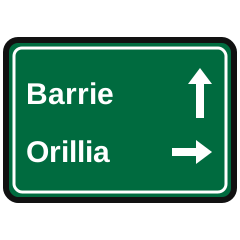
- To tell you the speed limit
- To warn of a hazard ahead
- To show where parking is allowed nearby
- To guide you to places along the route
What does this sign warn you about?

- A sharp curve to the left
- Traffic entering from the right
- Right lane ends ahead
- A road from the right that you must enter
Your rear wheels start to skid. What should you do?
- Brake firmly; steer the other way
- Accelerate hard; steer straight
- Feet off the pedals; steer into the skid
- Pull the parking brake; hold the wheel
What does this white sign mean?
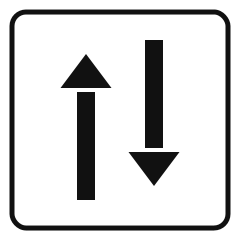
- Two-way traffic on this road
- Passing lane ahead
- Divided highway begins
- Keep right except to pass
What must you do at a pedestrian crossing sign marking a mid-block crosswalk?
- Stop only if a crossing guard is present
- Yield only to children
- Yield to pedestrians within the crosswalk
- Sound your horn before crossing
Which of these is prohibited while you are driving?
- Using a GPS mounted and set before you leave
- Holding a phone to call or text
- Adjusting the heater
- Listening to the radio
A car in the next lane has stopped to let a pedestrian cross at a crosswalk. What must you do?
- Pass carefully at low speed
- Sound your horn and continue
- Stop behind it; do not pass
- Change lanes and pass on the other side
You must park on a rural highway at night. What lights must show on the roadway side?
- Only the four-way flashers, front and back
- High beams pointed ahead
- Only the interior dome light
- A white or amber light ahead, red behind
What is the minimum time a new driver spends in the Class 7 graduated licence program before becoming fully licensed?
- 18 months
- 24 months
- 36 months
- 12 months
What does this sign warn you about?

- A bump or rough road ahead
- Pavement ends ahead
- A hill ahead
- A narrow bridge ahead
An emergency vehicle with its siren on is approaching an intersection you are about to enter on a green light. What must you do?
- Stop in the middle of the intersection
- Proceed, because your light is green
- Speed up to clear the intersection
- Yield to the emergency vehicle
Your licence is suspended for losing all your points. When can you appeal to the Registrar?
- Only after half the suspension is served
- Only if you have never had a ticket
- If it is your first such suspension in three years
- Any time, as often as you like
All New Brunswick Class 7 practice tests
- New Brunswick Class 7 Mock Exam 1 – 40 QuestionsUntimed practice · answers explained
- New Brunswick Class 7 Mock Exam 2 – 40 QuestionsUntimed practice · answers explained
- New Brunswick Class 7 Mock Exam 3 – 40 QuestionsUntimed practice · answers explained
- New Brunswick Class 7 Mock Exam 4 – 40 QuestionsUntimed practice · answers explained
- New Brunswick Class 7 Mock Exam 5 – 40 QuestionsUntimed practice · answers explained
- Sign shapes and coloursThe six basic sign shapes, what each sign colour means, the stop, yield and school zone signs you must get right on the sign test, guide signs and information signs.
- Regulatory signsDo not enter, no U-turn, one-way, keep right, passing and speed signs, green-circle and red-slash signs, parking and stopping signs, lane designation and turn control signs.
- Warning signs and hazard markersYellow diamond warning signs for curves, hills, bumps, narrowing roads, merges, lane endings, intersections, animals and crossings, plus chevrons, hazard markers and the slow moving vehicle sign.
- Construction zones and railway crossingsOrange construction signs, construction zone speed limits and doubled fines, railway crossing signs, flashing lights and gates, the 5-metre stopping rule and vehicles that must stop at every crossing.
- Traffic lights and signalsRed, yellow and green lights, right turns on red, flashing red, yellow and green lights, green arrows, pedestrian signals, peace officers and crosswalk guards.
About this practice test
How many questions are in New Brunswick Class 7 practice test 6?
40 original multiple-choice practice questions covering traffic lights and signals, parking, backing and other road users, speed limits, school zones and school buses, right of way, intersections and roundabouts, vehicle registration, inspection and equipment, demerit points and suspensions, construction zones and railway crossings, impaired driving, pavement markings and lanes, passing, lane changes and signalling, collisions and emergency vehicles, regulatory signs, class 7 graduated licence and testing, seat belts, distraction and safe driving habits, bad weather, night driving and highways, sign shapes and colours, sharing the road, warning signs and hazard markers. Each answer includes an explanation. This mixed practice set does not reproduce the official exam format or predict an official score.
Are the questions the same every time?
Yes. Practice test 6 always has the same 40 questions, so you can repeat it until you get them all right. The other 10 sets use different questions.
Are these real test questions?
No. The official question bank is not published. These are original questions written from the official handbook, which is what the real New Brunswick Class 7 test is based on.