You are taking a cold medicine that warns of drowsiness. What should you do?
New Brunswick Class 7 overview
New Brunswick Class 7 Practice Test 7
40 questions on impaired driving, bad weather, night driving and highways, demerit points and suspensions, sharing the road, traffic lights and signals and more.
- No sign-up
- Every answer explained
- Independent · not a government site
- Set 7 of 11
- 40 questions
- Instant feedback
0/40
All 40 questions in this test
Every question and its answer choices. The correct answers and explanations appear when you take the test above.
You are taking a cold medicine that warns of drowsiness. What should you do?
- Drink coffee to stay alert and drive carefully
- Drive only short distances
- Avoid driving and never mix it with alcohol
- Drive only during the day
What helps most to prevent hydroplaning?
- Higher tire pressure than recommended
- Good tires with deep treads
- Using cruise control
- Driving in the left lane
Who counts as a newly licensed driver for the point system?
- Anyone under 21
- Anyone licensed for less than four years
- Anyone licensed for less than two years
- Anyone still on Level 1
Which is one of the three main types of crash involving farm equipment?
- Overtaking a farm vehicle that is turning left
- Farm vehicles backing into parked cars
- Farm vehicles running red lights in towns
- Head-on crashes on divided highways
A pedestrian signal shows Walk. What must vehicles do?
- Yield the right of way to pedestrians in the crosswalk
- Proceed, because cars have a green too
- Yield only to pedestrians already halfway across
- Honk to warn pedestrians
You approach an intersection with this sign. What must you do?

- Speed up to merge ahead of traffic
- Proceed, because you have the right of way
- Slow down, give the right of way and stop if needed
- Stop completely every time
What happens to speeding fines in a construction zone?
- They are doubled
- They apply only to trucks
- They stay the same
- They are tripled
What does a flashing green traffic light mean in New Brunswick?
- Pedestrians have the right of way to cross now
- The light is about to turn red
- Proceed straight only
- An advance green; you may turn left if safe
Where should you avoid installing a child car seat?
- In any seat with a lap and shoulder belt
- Behind the driver's seat
- In a front seat with a passenger air bag
- In the middle of the back seat
How much road directly in front of a long-hood tractor may the driver be unable to see?
- About the first 1 metre
- About the first 30 metres
- About the first 15 metres
- About the first 6 metres
A graduated driver loses all of their points. What is the result?
- Automatic upgrade to Level 1 with a new curfew
- A one-month suspension, then they continue where they left off
- A fine only, because graduated drivers have no points
- At least three months' suspension, then a restart of the program
When should you move into a two-way left-turn lane?
- As soon as the lane begins
- As near as possible to where you will turn
- At least one block before the turn
- Only after the oncoming lane is clear
What does this sign warn you about?
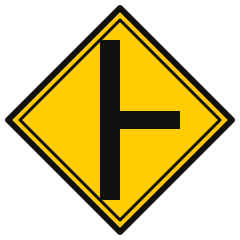
- The road curves right
- A right turn only ahead
- A road from the right ahead
- Right lane ends ahead
Within what distance of an oncoming vehicle must you dim your high beams?
- 100 metres
- 300 metres
- 150 metres
- 60 metres
You are passing a cyclist on a two-lane road with a solid yellow line and no oncoming traffic. What does the handbook allow?
- Stay in your lane and squeeze past
- Cross the yellow line if it is safe
- Sound your horn so the cyclist moves onto the shoulder
- Never pass a cyclist on a two-lane road
You are approaching a roundabout. Who has the right of way?
- Traffic entering the roundabout
- Traffic already in the roundabout
- Whoever is going to the first exit
- The vehicle on your right
You buy a used car privately. When may you drive it?
- As soon as you pay the seller
- After the seller signs the bill of sale
- Right away, using the seller's plates for 30 days
- After the registration is recorded in your name
A Level 2 driver under 21 needs to drive after midnight for a reason other than work or school. What can they do?
- Drive with any passenger who is 18 or older
- Get a note from a parent and carry it in the car
- Apply to the Registrar of Motor Vehicles for an exemption
- Ask a police officer for a one-night permit
You are pressing a pad on a bleeding wound and the pad becomes soaked with blood. What should you do?
- Pour water on the wound
- Stop pressing and let it drain
- Remove it and use a fresh one
- Leave it on and put another pad on top
When starting to parallel park, how far beside the car ahead of the space should you stop?
- Touching its mirror
- About 2 metres
- About half a metre
- About one lane width
What should you be ready to do when you see this sign?

- Stop if a traffic control person signals you
- Speed up to clear the zone
- Pass the line of stopped cars
- Turn around and find another route around the work
A regulatory sign shows a symbol inside a red circle with a diagonal slash. What does it mean?
- The action shown is not allowed
- A warning to use caution
- The action is allowed only at night
- The action shown is allowed
Under the Criminal Code, what blood alcohol concentration is illegal for any driver?
- 50 mg per 100 mL (0.05) or more
- 80 mg per 100 mL of blood (0.08) or more
- 100 mg per 100 mL (0.10) or more
- 30 mg per 100 mL (0.03) or more
What is accepted as proof of financial responsibility after a collision?
- A bank statement
- A signed letter from your employer or your bank
- A New Brunswick Liability Insurance Card
- The vehicle's bill of sale
Is it legal to coast downhill with your transmission in neutral?
- Yes, on hills only
- No, coasting in neutral is prohibited
- Yes, below 50 km/h
- Yes, to save fuel on long downhill grades
A driver with no record in the past 10 years blows over 0.08. How long is the mandatory vehicle impoundment?
- 30 days
- 60 days
- 7 days
- 90 days
You have finished Level 2. What happens next?
- The Class 5 licence is mailed to you automatically
- You must apply for your Class 5 licence yourself
- You keep driving on Level 2 until renewal
- You must repeat the written tests first
Within what distance of a hill crest or curve, where your view is blocked, is it illegal to pass?
- 60 metres
- 300 metres
- 150 metres
- 30 metres
Who must you yield to as you enter a roundabout, besides vehicles?
- No one else; they must wait
- Only buses
- Pedestrians and cyclists
- Only children
You see a blue sign beside the highway. What is it most likely telling you about?
- Motorist services or tourist information
- A school zone ahead
- A change in the speed limit for the next zone
- A road closure
What is the speed limit in an urban district when no other limit is posted?
- 60 km/h
- 50 km/h
- 40 km/h
- 70 km/h
It is 3:30 p.m. on a school day in an urban school zone with no other speed posted. What is the limit?
- 40 km/h
- 50 km/h
- 60 km/h
- 30 km/h
Lane signs are mounted above the road. How do you know which lane each sign controls?
- The signs are numbered from the right
- Each sign is centred over its lane
- Only the left lane has a sign
- The lane colour matches the sign
How many points does a distracted driving conviction cost?
- 10 points
- 3 points
- 2 points
- 5 points
What do white rectangular or square signs with black lettering usually tell you?
- The location of tourist attractions
- Hazards such as curves or dips ahead
- The law, such as speed limits or parking rules
- Directions to the nearest town
On a multi-lane street, when should you leave the right lane?
- When driving under the limit
- Whenever you want to go faster than 50 km/h
- Only to pass or to turn left
- Whenever traffic is light
What does a 'pavement ends' warning sign mean?
- The road continues with a gravel surface
- Pavement markings are missing
- The road is closed ahead for repaving work
- A bridge deck ahead
The centre line is double yellow, with the broken line on your side. What does that mean?
- You may pass if traffic and conditions allow
- You may pass only at night
- You must not pass under any conditions
- Only the other direction may pass
Your car has air bags. Do you still need to wear a seat belt?
- Only on highways over 80 km/h
- Only in the back seat
- No, air bags replace seat belts in newer cars
- Yes, seat belts must be used with air bags
Where must you never stop, park or make a U-turn?
- On a curve
- In a parking lot
- On a straight residential street
- On a wide road with good visibility
All New Brunswick Class 7 practice tests
- New Brunswick Class 7 Mock Exam 1 – 40 QuestionsUntimed practice · answers explained
- New Brunswick Class 7 Mock Exam 2 – 40 QuestionsUntimed practice · answers explained
- New Brunswick Class 7 Mock Exam 3 – 40 QuestionsUntimed practice · answers explained
- New Brunswick Class 7 Mock Exam 4 – 40 QuestionsUntimed practice · answers explained
- New Brunswick Class 7 Mock Exam 5 – 40 QuestionsUntimed practice · answers explained
- Sign shapes and coloursThe six basic sign shapes, what each sign colour means, the stop, yield and school zone signs you must get right on the sign test, guide signs and information signs.
- Regulatory signsDo not enter, no U-turn, one-way, keep right, passing and speed signs, green-circle and red-slash signs, parking and stopping signs, lane designation and turn control signs.
- Warning signs and hazard markersYellow diamond warning signs for curves, hills, bumps, narrowing roads, merges, lane endings, intersections, animals and crossings, plus chevrons, hazard markers and the slow moving vehicle sign.
- Construction zones and railway crossingsOrange construction signs, construction zone speed limits and doubled fines, railway crossing signs, flashing lights and gates, the 5-metre stopping rule and vehicles that must stop at every crossing.
- Traffic lights and signalsRed, yellow and green lights, right turns on red, flashing red, yellow and green lights, green arrows, pedestrian signals, peace officers and crosswalk guards.
About this practice test
How many questions are in New Brunswick Class 7 practice test 7?
40 original multiple-choice practice questions covering impaired driving, bad weather, night driving and highways, demerit points and suspensions, sharing the road, traffic lights and signals, sign shapes and colours, construction zones and railway crossings, seat belts, distraction and safe driving habits, class 7 graduated licence and testing, pavement markings and lanes, warning signs and hazard markers, vehicle registration, inspection and equipment, right of way, intersections and roundabouts, collisions and emergency vehicles, parking, backing and other road users, regulatory signs, passing, lane changes and signalling, speed limits, school zones and school buses. Each answer includes an explanation. This mixed practice set does not reproduce the official exam format or predict an official score.
Are the questions the same every time?
Yes. Practice test 7 always has the same 40 questions, so you can repeat it until you get them all right. The other 10 sets use different questions.
Are these real test questions?
No. The official question bank is not published. These are original questions written from the official handbook, which is what the real New Brunswick Class 7 test is based on.