The signal shows a red light with a green arrow pointing right. What may you do?
New Brunswick Class 7 overview
New Brunswick Class 7 Practice Test 11
40 questions on traffic lights and signals, speed limits, school zones and school buses, seat belts, distraction and safe driving habits, sharing the road, passing, lane changes and signalling and more.
- No sign-up
- Every answer explained
- Independent · not a government site
- Set 11 of 11
- 40 questions
- Instant feedback
0/40
All 40 questions in this test
Every question and its answer choices. The correct answers and explanations appear when you take the test above.
The signal shows a red light with a green arrow pointing right. What may you do?
- Wait for the full green light
- Turn right with caution after yielding
- Turn right without checking for pedestrians
- Go straight through
You must drive slowly on the open highway because of a load. What does the law require?
- Drive on the shoulder the whole way with flashers on
- Keep right and pull off at times to let traffic pass
- Use the left lane to stay visible
- Keep going; others must wait
While driving in winter you start yawning and feel dizzy and nauseated. What could be the cause?
- Studded tires
- Carbon monoxide from a leaking exhaust
- Low tire pressure from the cold weather
- Cold engine oil
Where should a cyclist ride on a road without a bike lane?
- On the sidewalk when traffic is heavy
- With traffic, close to the right edge
- Facing traffic, close to the left edge
- In the centre of the lane at all times
The car ahead of you starts to pass a truck. What should you do?
- Sound your horn to hurry it
- Wait until it finishes before you pass
- Pass both on the right
- Follow it closely and pass too
What do continuity lines on a highway show?
- The edge of the shoulder
- Where passing is not allowed on the highway
- Where a ramp lane borders the through lane
- A lane reserved for buses
What does this yellow sign warn you about?

- A passing lane ahead
- Two-way traffic ahead
- A one-way street ahead
- A divided highway ends
A fully loaded tractor-trailer is travelling at 90 km/h in ideal conditions. About how far will it travel before it stops?
- About 150 metres
- About 102 metres
- About 56 metres
- About 60 metres
You are in a collision that damages another car. What must you do?
- Leave if no one is hurt
- Stop only if the police arrive
- Move on and phone your insurer later in the day
- Stop and exchange details with the other driver
When must your vehicle's lights be on?
- When you cannot see 30 metres ahead in daylight
- Only when it is raining
- At night or when you can't see 150 m ahead
- Only between sunset and midnight
How can you reduce the fire hazard at a crash scene?
- Open the hood of every car
- Turn off the ignitions and keep smokers away
- Pour water into the fuel tank
- Start the engines to blow away the fuel fumes
A car ahead is turning left and the paved shoulder on the right is wide. May you use the shoulder to pass?
- No, never drive onto the shoulder to pass
- Yes, if the shoulder is paved and wide enough
- Yes, at low speed
- Yes, if you signal
A stop sign is posted at a railway crossing. How close to the nearest rail may you stop?
- No closer than 15 metres
- No closer than 5 metres
- No closer than 3 metres
- No closer than 1 metre
Which documents prove your name and date of birth when you apply for a learner's licence?
- A photocopy of a parent's driver's licence and health card
- One original passport, birth certificate or court order
- Two utility bills with your name on them
- A school report card and a bank card
A pedestrian crosses in the middle of a block, away from any crosswalk. Who must yield?
- The pedestrian must yield to vehicles
- Drivers must always yield to pedestrians
- Whoever arrived first
- Neither; both must stop
What colour are construction signs?
- Black on a yellow background
- Red on a white background
- White on a green background
- Black on an orange background
You see this sign and children are present. What should you do?

- Speed up to clear the zone quickly
- Stop and wait for a crossing guard
- Keep your speed and sound your horn
- Slow down and watch for children
What are the most important factors in how impaired you become from alcohol?
- Whether you drink alone or with a group of friends
- The colour of the drink
- How much is absorbed and the time to eliminate it
- Whether you drink indoors or outdoors
A regulatory sign shows a symbol inside a green circle. What does it mean?
- The action shown is prohibited
- A hazard is ahead
- The action shown is permitted
- The action shown is recommended in winter
Where is a suspension from a Criminal Code conviction appealed?
- To a Judge of the Court of Queen's Bench
- To the Registrar of Motor Vehicles
- To Service New Brunswick
- To the local police chief
Which is one of the most common causes of crashes in New Brunswick?
- Using winter tires
- Inattention or driver distraction
- Flat tires
- Driving with headlights on
A Level 2 driver is caught driving with alcohol in their blood. What happens?
- A three-month suspension, keeping credit for past tests
- A one-year suspension, then restart the program with no credit
- A warning letter and two demerit points
- A 24-hour roadside suspension only
On the road sign test, which three signs must you identify correctly no matter what?
- Stop, school bus and pedestrian crossing
- Yield, speed limit and one way
- Stop, railway crossing and do not enter
- Stop, yield and school zone
What does this sign tell you?

- A railway crossing ahead
- Traffic signals ahead; be prepared to stop
- The signals ahead are not working
- A construction zone ahead
You are stopped at a red light with no sign prohibiting a right turn. What may you do?
- Turn right only when a green arrow appears
- Turn left or right after stopping
- Turn right without stopping if the way is clear
- Turn right after a full stop, yielding to all
Both centre lines are solid yellow. Who may pass?
- Only the direction with the wider lane
- Only traffic going uphill
- Neither direction
- Both directions, with care
Is it legal to double park beside a car parked at the curb?
- Yes, for up to five minutes
- No, it is not permitted
- Yes, if you stay in the car
- Yes, with four-way flashers on
Where should a disability parking placard be hung?
- On the rear-view mirror while parked
- On the rear window at all times
- On the driver's sun visor
- On the dashboard while driving
What do the newer railway crossing signs look like?
- A white X with a red reflective border
- A green circle with a train
- A red octagon with an X
- A yellow diamond with black letters
A two-lane highway has a single broken yellow centre line. When may you pass?
- Never, because the line is yellow
- Any time traffic is light, even on curves
- When it is safe and conditions are ideal
- Only when following a truck
Why is it important to obey regulatory signs?
- They apply only in cities
- They apply only to commercial vehicles
- Ignoring them is an offence
- They are advice only
What does this sign warn you about?
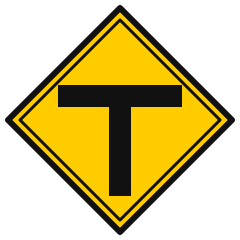
- A T intersection ahead
- A dead-end street
- A cross road ahead
- A railway crossing ahead
A driver gets a second alcohol-related conviction within 10 years. How long is the suspension?
- Two years
- Five years
- 18 months
- Three years
Who pays the cost of the ignition interlock program?
- The province
- The driver's insurance company
- The participant
- The police service
A front tire blows out at highway speed. What should you do?
- Steer quickly onto the shoulder
- Brake hard right away
- Ease off the gas and slow gradually
- Shift into neutral and brake
You are not sure where to turn and the street signs are hard to read. What does the handbook advise?
- Make a quick turn when you see the street
- Stop in your lane to read the signs
- Follow the car ahead
- Drive slowly until you can read them
Without chains, how much farther can it take to stop on snow and ice than on dry concrete?
- Up to 20 times as far
- Up to 5 times as far
- Up to 12 times as far
- Up to 2 times as far
If you double your speed, how much greater is the force of impact in a collision?
- Eight times as great
- Twice as great
- Four times as great
- Three times as great
How close to a fire hydrant may you park?
- No closer than 15 metres
- No closer than 10 metres
- No closer than 5 metres
- No closer than 2 metres
What shape are information signs that show the location of facilities like campgrounds and gas?
- Pentagon
- Round
- Triangle
- Square
All New Brunswick Class 7 practice tests
- New Brunswick Class 7 Mock Exam 1 – 40 QuestionsUntimed practice · answers explained
- New Brunswick Class 7 Mock Exam 2 – 40 QuestionsUntimed practice · answers explained
- New Brunswick Class 7 Mock Exam 3 – 40 QuestionsUntimed practice · answers explained
- New Brunswick Class 7 Mock Exam 4 – 40 QuestionsUntimed practice · answers explained
- New Brunswick Class 7 Mock Exam 5 – 40 QuestionsUntimed practice · answers explained
- Sign shapes and coloursThe six basic sign shapes, what each sign colour means, the stop, yield and school zone signs you must get right on the sign test, guide signs and information signs.
- Regulatory signsDo not enter, no U-turn, one-way, keep right, passing and speed signs, green-circle and red-slash signs, parking and stopping signs, lane designation and turn control signs.
- Warning signs and hazard markersYellow diamond warning signs for curves, hills, bumps, narrowing roads, merges, lane endings, intersections, animals and crossings, plus chevrons, hazard markers and the slow moving vehicle sign.
- Construction zones and railway crossingsOrange construction signs, construction zone speed limits and doubled fines, railway crossing signs, flashing lights and gates, the 5-metre stopping rule and vehicles that must stop at every crossing.
- Traffic lights and signalsRed, yellow and green lights, right turns on red, flashing red, yellow and green lights, green arrows, pedestrian signals, peace officers and crosswalk guards.
About this practice test
How many questions are in New Brunswick Class 7 practice test 11?
40 original multiple-choice practice questions covering traffic lights and signals, speed limits, school zones and school buses, seat belts, distraction and safe driving habits, sharing the road, passing, lane changes and signalling, bad weather, night driving and highways, warning signs and hazard markers, collisions and emergency vehicles, vehicle registration, inspection and equipment, construction zones and railway crossings, class 7 graduated licence and testing, right of way, intersections and roundabouts, impaired driving, regulatory signs, demerit points and suspensions, pavement markings and lanes, parking, backing and other road users, sign shapes and colours. Each answer includes an explanation. This mixed practice set does not reproduce the official exam format or predict an official score.
Are the questions the same every time?
Yes. Practice test 11 always has the same 40 questions, so you can repeat it until you get them all right. The other 10 sets use different questions.
Are these real test questions?
No. The official question bank is not published. These are original questions written from the official handbook, which is what the real New Brunswick Class 7 test is based on.