Which of these is a place where you may never park?
New Brunswick Class 7 overview
New Brunswick Class 7 Mock Exam 4
Same format as the real test. Answers stay hidden until you submit. The official time limit is not published; the timer is a practice setting.
- No sign-up
- Every answer explained
- Independent · not a government site
- 40 questions
- untimed
- Pass mark 16/20 per section
0/40
All 40 questions in this test
Every question and its answer choices. The correct answers and explanations appear when you take the test above.
Which of these is a place where you may never park?
- On a residential street with no signs
- On a bridge
- In a marked parking space
- In a parking lot
When are moose and deer most likely to be a danger on New Brunswick roads?
- At midday
- Only in winter
- At dawn and dusk
- Only on gravel roads
What does this yellow sign warn you about?

- A passing lane ahead
- Two-way traffic ahead
- A one-way street ahead
- A divided highway ends
When parked at a curb, what is the farthest your wheels may be from it?
- 2 metres
- 50 centimetres
- 1 metre
- 20 centimetres
Up to what age must every New Brunswick driver keep a blood alcohol level of zero, even with a full licence?
- Under 25
- Under 21
- Under 19
- Under 18
What must you do at a pedestrian crossing sign marking a mid-block crosswalk?
- Stop only if a crossing guard is present
- Yield only to children
- Yield to pedestrians within the crosswalk
- Sound your horn before crossing
You face a red light with a painted stop line. Where must you stop?
- Wherever you can see cross traffic
- In the crosswalk
- Past the crosswalk, at the edge of the intersection
- At the stop line
You are in a collision that damages another car. What must you do?
- Leave if no one is hurt
- Stop only if the police arrive
- Move on and phone your insurer later in the day
- Stop and exchange details with the other driver
Which is one of the most common causes of crashes in New Brunswick?
- Using winter tires
- Inattention or driver distraction
- Flat tires
- Driving with headlights on
Who is responsible for making sure a 14-year-old passenger wears a seat belt?
- The passenger
- The vehicle owner, even if not in the car
- The driver
- The passenger's parent, even if not in the car
There is no sidewalk along the road. Where should a pedestrian walk?
- On the left side, facing oncoming traffic
- On whichever side is flatter
- On the right side, with traffic behind you
- In the middle of the lane
You graduated from a licensed driver training school. How soon can you take the road test for Level 2?
- After 4 months at Level 1
- After 12 months at Level 1
- After 6 months at Level 1
- After 8 months at Level 1
Your view is blocked as you approach a narrow bridge. Within what distance may you not drive on the left side of the road?
- 100 metres
- 150 metres
- 30 metres
- 15 metres
What is Ellen's Law in New Brunswick?
- The rule to give cyclists one metre when passing
- The rule banning hand-held phones while you drive
- The rule requiring winter tires
- The rule for stopping at school buses
What does this sign mean?

- Traffic moves in one direction only
- Two-way traffic ahead
- Detour in the direction shown
- Turn right only
Lane signs are mounted above the road. How do you know which lane each sign controls?
- The signs are numbered from the right
- Each sign is centred over its lane
- Only the left lane has a sign
- The lane colour matches the sign
What does the handbook say about your position relative to the centre line?
- Keep well over on your side; do not hug it
- Stay close to it so you can see ahead
- Straddle it on empty roads
- Drive on the centre line in curves
Which of these is an offence under New Brunswick law?
- Turning right on red after a full stop
- Driving with your headlights on in daylight hours
- Disobeying a signal unless an officer directs you
- Stopping for a yellow light
A curve warning sign has a small tab underneath showing a speed. What does that speed mean?

- The maximum advised speed for the curve
- The minimum speed on the curve
- The speed limit for trucks only
- The new speed limit for the next 10 km
The light is green but a pedestrian signal is showing for people crossing in front of you. What applies?
- Sound your horn and continue
- Go immediately; green always means go
- Stop until all lights are green
- Proceed only as the pedestrian light allows
What pavement marking may be painted on the approach to a railway crossing?
- A green bike symbol
- A yellow diamond
- An X and/or a stop line
- Double white arrows
Before turning right on a red light, what must you do besides stopping?
- Signal, and check pedestrians and traffic
- Sound your horn twice first
- Flash your headlights first
- Wait at least 10 seconds, then turn quickly
A turn control sign has a small tab underneath it showing times. What does the tab mean?
- The sign applies only during those hours
- The sign applies only outside those hours
- The road closes during those hours
- Turns are allowed only for buses then
What does this sign tell you?

- The road narrows on both sides
- Keep right of the island
- Two lanes merge from the left
- The right lane ends ahead
What does the colour white mean on a traffic sign?
- Warning
- Regulatory
- Guidance
- Tourism
Where must the accompanying driver sit when you drive with a Level 1 licence?
- Anywhere in the vehicle
- In the front passenger seat
- In the back seat on the right side
- Directly behind the driver
What does this sign warn you about?

- A sharp curve to the left
- Traffic entering from the right
- Right lane ends ahead
- A road from the right that you must enter
Who must you yield to as you enter a roundabout, besides vehicles?
- No one else; they must wait
- Only buses
- Pedestrians and cyclists
- Only children
You are driving on a four-lane road with two lanes in your direction and are not turning or passing. Which lane should you use?
- The left lane, for a smoother ride
- The lane with the fewest cars
- Either lane, as you like
- The lane nearest the right edge
At a stop sign with no painted stop line, but with an unmarked crosswalk at the corner, where must you stop?
- Anywhere within 10 metres
- Before entering the crosswalk
- Past the crosswalk at the road edge
- In the crosswalk
When must your vehicle's lights be on?
- When you cannot see 30 metres ahead in daylight
- Only when it is raining
- At night or when you can't see 150 m ahead
- Only between sunset and midnight
You miss your exit on a highway. What should you do?
- Stop and wait for a gap
- Back up on the shoulder
- Drive on to the next exit
- Make a U-turn through the median
What is the purpose of this type of green sign?
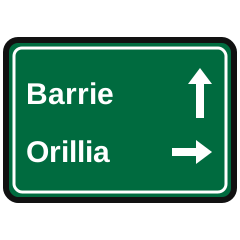
- To tell you the speed limit
- To warn of a hazard ahead
- To show where parking is allowed nearby
- To guide you to places along the route
Your right wheels drop off the pavement onto the shoulder. What should you do first?
- Brake hard and turn left quickly
- Jerk the wheel back onto the road
- Speed up to climb back on
- Ease off the gas and steer straight ahead
Both centre lines are solid yellow. Who may pass?
- Only the direction with the wider lane
- Only traffic going uphill
- Neither direction
- Both directions, with care
Why does a tractor-trailer take longer to stop than its weight alone would suggest?
- Trucks have fewer brakes than cars
- Air brakes have a delay called brake lag
- Truck tires grip less on dry roads
- Truck drivers react more slowly
Into which lane should you complete a turn?
- The lane with the least traffic
- Any open lane
- The far lane, to give room
- The proper lane nearest you
What is the suspension for a first conviction for a Criminal Code offence involving a vehicle that is not listed separately?
- Twelve months
- Two years
- Six months
- Three months
What happens to speeding fines in a construction zone?
- They are doubled
- They apply only to trucks
- They stay the same
- They are tripled
You are on a highway and traffic is entering from a ramp. What should you do?
- Sound your horn
- Stop to let every car in
- Move left if safe, or slow to let it in
- Speed up to close the gap so it merges behind
Keep practising
- New Brunswick Class 7 Mock Exam 1 – 40 QuestionsUntimed practice · answers explained
- New Brunswick Class 7 Mock Exam 2 – 40 QuestionsUntimed practice · answers explained
- New Brunswick Class 7 Mock Exam 3 – 40 QuestionsUntimed practice · answers explained
- New Brunswick Class 7 Mock Exam 5 – 40 QuestionsUntimed practice · answers explained
- New Brunswick Class 7 Practice Test 140 questions with explanations
- New Brunswick Class 7 Practice Test 240 questions with explanations
- New Brunswick Class 7 Practice Test 340 questions with explanations
- New Brunswick Class 7 Practice Test 440 questions with explanations