A police officer believes you are unfit to drive safely because of a medical problem. What can the officer do?
New Brunswick Class 7 overview
New Brunswick Class 7 Practice Test 8
40 questions on impaired driving, bad weather, night driving and highways, demerit points and suspensions, passing, lane changes and signalling, warning signs and hazard markers and more.
- No sign-up
- Every answer explained
- Independent · not a government site
- Set 8 of 11
- 40 questions
- Instant feedback
0/40
All 40 questions in this test
Every question and its answer choices. The correct answers and explanations appear when you take the test above.
A police officer believes you are unfit to drive safely because of a medical problem. What can the officer do?
- Cancel your licence permanently
- Give you two demerit points
- Nothing unless you have been drinking
- Suspend your licence for 24 hours
About how much of each tire is in contact with the road?
- About the length of the palm of your hand
- About the width of the whole car
- About the length of a ruler, 30 centimetres
- About the size of a fingernail
How many points is a Criminal Code offence involving a motor vehicle worth?
- 6 points
- 5 points
- 8 points
- 10 points
You plan to pass another car at night. Which headlights should you use as you come up behind it?
- Fog lights only
- Low beams until you start to pass
- High beams to warn the driver
- Parking lights only
You see this sign before a long descent. What does the handbook advise?

- Use your four-way flashers
- Speed up to keep momentum
- Pull onto the shoulder and stop
- Shift to a lower gear or slow down
Your turn signals stop working. How must you signal a turn?
- With hand and arm signals
- With your four-way flashers
- By flashing your headlights
- You do not need to signal
You come up behind a slow farm tractor. Before you pass, what should you make sure of?
- Your high beams are on
- You keep honking until it pulls onto the shoulder for you
- You are within 10 metres of it
- The operator knows you'll pass and the way is clear
How should snow tires be installed for the best traction and steering control?
- On the rear wheels only
- On the front wheels only
- On all four wheels
- On the drive wheels only, mixed with radials
Which lights should you use when driving in fog?
- Low-beam headlights
- High-beam headlights
- Four-way flashers only
- Parking lights only
In which direction does traffic travel in a roundabout?
- Either direction
- The direction of the first exit
- Clockwise
- Counter-clockwise
What does a checkerboard warning sign mean?
- The road ends; you may go left or right
- A racing event ahead
- A border crossing ahead
- A railway crossing ahead with no gates or lights
How close may you follow a fire truck responding to an emergency?
- No closer than 60 metres
- No closer than 30 metres
- No closer than 150 metres
- No closer than 300 metres
Where should your hands usually be on the steering wheel?
- At about 10 and 2 o'clock
- At 6 o'clock with both hands
- At 12 o'clock with one hand
- Anywhere that feels comfortable
Why should you leave extra following distance behind a motorcycle?
- It cannot use its brakes on wet roads
- It can stop more quickly than a car
- It always slows down on curves
- Its tail light is hard to see in daylight
While passing, when may you move back into the right lane?
- When its headlights show in your rear-view mirror
- When the other driver flashes their lights
- As soon as your rear bumper clears its front bumper
- After counting to two
Several people are hurt at a crash scene. Who should you attend to first?
- The drivers before the passengers
- Anyone who can walk
- Anyone not breathing or bleeding severely
- The person who is shouting loudest
You come up behind a person riding a horse on the road. What should you do?
- Flash your high beams
- Sound your horn to warn them
- Pass close and fast
- Slow down and give plenty of room
You are about to drive onto a highway from a side road with no signs. Who has the right of way?
- Whoever is going faster
- Only trucks on the highway
- You, because you were there first
- All vehicles approaching on the highway
When may you use your four-way flashers?
- When driving slowly in heavy rain
- When parked on the road because of an emergency
- When towing another vehicle on a highway
- When parking briefly in a no-parking zone
A parent who signed a 16-year-old's consent form changes their mind. What can they do?
- Withdraw consent in writing to the Registrar
- Phone the driving school to cancel it
- Ask the police to take the licence away
- Nothing until the driver turns 18
What does the handbook say about your position relative to the centre line?
- Keep well over on your side; do not hug it
- Stay close to it so you can see ahead
- Straddle it on empty roads
- Drive on the centre line in curves
What does this sign mean?

- Turn around ahead
- No U-turn
- Sharp curve ahead
- No left turn
Your suspension period has ended. What might you need before your licence is reinstated?
- A reinstatement fee and any listed conditions
- A letter from your employer
- A new birth certificate
- Nothing; it restarts automatically on that date
You refuse a police demand for a breath sample. What penalty can you face if convicted?
- A 24-hour suspension only
- Nothing, because the test is optional
- A small fine only
- The same penalties as impaired driving
What does this lane sign mean?
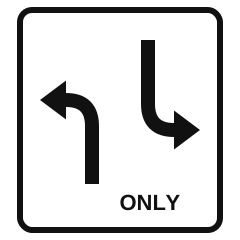
- Passing is allowed in both directions
- Turning is not permitted from this centre lane
- The lane is for buses only
- The centre lane is for left turns both ways
How close to the nearest rail of a railway crossing may you park?
- No closer than 30 metres
- No closer than 10 metres
- No closer than 5 metres
- No closer than 15 metres
How many passengers may a Level 2 driver carry?
- No more than four, with two in front
- No more than two, both in the back
- No more than three, with only one in front
- Any number, if everyone wears a seat belt
When should you avoid using cruise control?
- During daylight
- On roads with a 100 km/h limit
- On long, dry highways
- On wet or slippery roads
You and another driver reach a four-way stop at about the same time. The other car is on your right. Who goes first?
- Whoever is going straight
- The car on your right
- The larger vehicle
- You, because you are on the left
How close to a crosswalk at an intersection may you park?
- No closer than 1 metre
- Right up to the painted lines
- No closer than 15 metres
- No closer than 5 metres
When giving artificial respiration to an adult, how often should you give a breath?
- Every five seconds
- Every thirty seconds
- Every second
- Every ten seconds
You just moved to New Brunswick to live. When must you register your vehicle here?
- When your old registration expires
- Within six months
- Within 60 days
- Immediately
Which of these is a place where you may never park?
- On a residential street with no signs
- On a bridge
- In a marked parking space
- In a parking lot
You are following a vehicle carrying flammable liquids toward a railway crossing. What should you expect?
- It will cross only on a green light
- It will use its four-way flashers and keep going
- It will speed up to cross quickly
- It will stop, look and listen before crossing
What is the average driver's reaction time under normal conditions?
- About two seconds
- About three-quarters of a second
- About three seconds
- About one-tenth of a second
What does the colour white mean on a traffic sign?
- Warning
- Regulatory
- Guidance
- Tourism
You are waiting in a two-way left-turn lane. What hazard should you watch for?
- Trains crossing the lane
- Oncoming vehicles using the same lane
- Pedestrians walking along the centre lane
- Bicycles riding in the lane
Which shape is used only for the stop sign?
- Pentagon
- Diamond
- Octagon
- Triangle
What does this sign tell you to do?

- Turn right at the next corner or driveway
- Right lane ends ahead
- Keep right of the island or obstruction
- Merge into the right lane
A reverse curve sign warns of two turns in opposite directions. How close together are they?
- Separated by at least 1 km
- Separated by less than 120 metres
- Separated by less than 30 metres
- Separated by less than 300 metres
All New Brunswick Class 7 practice tests
- New Brunswick Class 7 Mock Exam 1 – 40 QuestionsUntimed practice · answers explained
- New Brunswick Class 7 Mock Exam 2 – 40 QuestionsUntimed practice · answers explained
- New Brunswick Class 7 Mock Exam 3 – 40 QuestionsUntimed practice · answers explained
- New Brunswick Class 7 Mock Exam 4 – 40 QuestionsUntimed practice · answers explained
- New Brunswick Class 7 Mock Exam 5 – 40 QuestionsUntimed practice · answers explained
- Sign shapes and coloursThe six basic sign shapes, what each sign colour means, the stop, yield and school zone signs you must get right on the sign test, guide signs and information signs.
- Regulatory signsDo not enter, no U-turn, one-way, keep right, passing and speed signs, green-circle and red-slash signs, parking and stopping signs, lane designation and turn control signs.
- Warning signs and hazard markersYellow diamond warning signs for curves, hills, bumps, narrowing roads, merges, lane endings, intersections, animals and crossings, plus chevrons, hazard markers and the slow moving vehicle sign.
- Construction zones and railway crossingsOrange construction signs, construction zone speed limits and doubled fines, railway crossing signs, flashing lights and gates, the 5-metre stopping rule and vehicles that must stop at every crossing.
- Traffic lights and signalsRed, yellow and green lights, right turns on red, flashing red, yellow and green lights, green arrows, pedestrian signals, peace officers and crosswalk guards.
About this practice test
How many questions are in New Brunswick Class 7 practice test 8?
40 original multiple-choice practice questions covering impaired driving, bad weather, night driving and highways, demerit points and suspensions, passing, lane changes and signalling, warning signs and hazard markers, sharing the road, seat belts, distraction and safe driving habits, right of way, intersections and roundabouts, collisions and emergency vehicles, parking, backing and other road users, vehicle registration, inspection and equipment, class 7 graduated licence and testing, pavement markings and lanes, regulatory signs, construction zones and railway crossings, sign shapes and colours. Each answer includes an explanation. This mixed practice set does not reproduce the official exam format or predict an official score.
Are the questions the same every time?
Yes. Practice test 8 always has the same 40 questions, so you can repeat it until you get them all right. The other 10 sets use different questions.
Are these real test questions?
No. The official question bank is not published. These are original questions written from the official handbook, which is what the real New Brunswick Class 7 test is based on.