A warning sign shows the reserved lane is the curb lane of the cross-street. You are turning right onto that street. Which lane do you enter?
Manitoba Class 5 overview
Manitoba Class 5: Warning, construction and guide signs
Yellow diamond warning signs for curves, lanes, hills, crossings and hazards, orange construction and maintenance signs, doubled speeding fines, and green guide and information signs.
- No sign-up
- Every answer explained
- Independent · not a government site
- 38 questions
- Topic drill
0/38
Study reference: MPI Driver's Handbook (online edition, 2026), Ch. 4 Signs and Signals — Warning Signs, Construction and Maintenance Signs, Guide and Information Signs
All 38 questions in this test
Every question and its answer choices. The correct answers and explanations appear when you take the test above.
A warning sign shows the reserved lane is the curb lane of the cross-street. You are turning right onto that street. Which lane do you enter?
- The curb lane
- The lane next to the median
- The second lane from the curb
- Whichever lane is empty
On a route sign, what does the letter 'A' indicate?
- An alternative route that returns to your route
- A route to the airport from the next interchange
- An arterial truck route
- Access for disabled persons at the next exit
On this sign, what does the angle of the track symbol tell you?
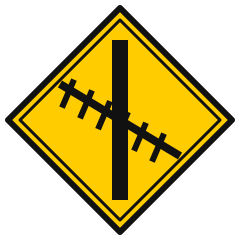
- How many tracks there are
- The angle at which the tracks cross the road
- Which way the next train will come
- How fast trains travel there
What does this sign warn you of?
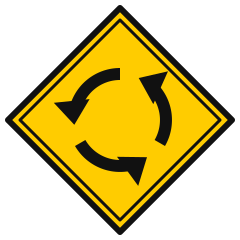
- A detour ahead
- No turns allowed
- A roundabout ahead
- A U-turn route ahead
What does this sign warn you of?

- A narrow bridge ahead
- The road narrows on the left
- A divided highway ends
- A railway crossing ahead
What does this sign warn you of?

- A passing lane ahead
- Keep right except to pass
- Two-way traffic ahead
- A divided highway begins
What does this striped marker show?

- An obstruction near the road
- A designated snow route
- The edge of a railway crossing
- A school bus stop
In a work area, a sign reads 'Maximum 40 km/h when meeting traffic'. What does it require?
- Drive 40 km/h only when workers are present
- Drive at least 40 km/h at all times
- No more than 40 km/h while passing oncoming vehicles
- Keep 40 m behind oncoming traffic
In the zone this sign marks, what happens to fines for speeding?
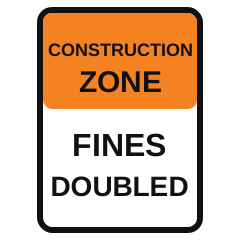
- They are replaced by a warning
- They are tripled
- They apply only when workers are present
- They are doubled
What does a diamond-shaped sign warn you about?
- A rule you must obey
- The start of a school area
- Services such as gas, food or lodging nearby
- Possible danger on or near the road ahead
What does this sign warn you of?
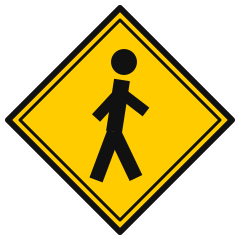
- A hiking trail crossing
- A playground ahead
- Pedestrians are prohibited
- A pedestrian crosswalk ahead
What does this sign warn you of?

- A construction zone ahead
- A pedestrian corridor ahead
- A railway crossing ahead
- Traffic signals ahead
What does this sign warn you of?

- A steep hill ahead
- A bump ahead
- The pavement ends
- Trucks entering ahead
What does this sign warn you of?

- The road narrows ahead
- A divided highway begins
- The right lane ends ahead
- Merging roadways ahead
What does this sign warn you of?

- A traffic island ahead
- A divided highway begins ahead
- A divided highway ends ahead
- Two-way traffic ahead
What does this sign warn you of?

- The pavement ends
- A hill ahead
- A narrow bridge ahead
- A bump in the road ahead
A guide sign shows a cul-de-sac. What kind of street is it?
- A road closed for winter
- A private driveway
- A one-way loop
- A dead end with a turnaround
You see this sign. What should you prepare to do?

- Stop for a school bus
- Yield at a sign ahead
- Stop at a railway crossing
- Stop at a stop sign ahead
A warning sign shows 'Low structure clearance 4.1 m'. What is it telling you?
- Keep 4.1 m behind the vehicle ahead
- Overhead clearance ahead is 4.1 m
- The road narrows to 4.1 m wide
- Trucks over 4.1 m long are banned
What does a 'Bridge ices' sign warn you about?
- Ice can form on the bridge surface
- Trucks may not use the bridge
- The bridge closes in winter
- The bridge has a weight limit
What does this sign warn you of?

- Road work ahead
- A playground ahead
- A pedestrian crosswalk ahead
- A flagperson ahead
What does this sign warn you of?

- A wildlife park ahead
- A farm ahead
- Hunting allowed near the road
- A deer crossing area ahead
A 'Prepare to stop' sign has flashing amber lights. What does it tell you?
- The signal ahead is red or about to turn red
- A flagperson is directing traffic around a crash
- A school bus is stopped ahead
- A train is approaching
What is the purpose of construction and maintenance signs?
- To show official truck routes
- To warn of road work areas ahead
- To show detour distances only
- To mark the end of a speed zone
You pass a diamond-shaped sign. What should you do?
- Sound your horn as a warning
- Move into the left lane
- Slow down so you keep full control
- Stop and check for cross traffic
What does this sign warn you of?

- A school crossing guard ahead
- Road work ahead
- A detour ahead
- A flagperson ahead
What does this sign warn you of?
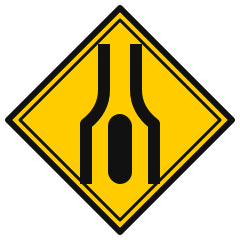
- The lanes cross over ahead
- A divided highway begins ahead
- The road is closed ahead
- A divided highway ends ahead
What does this sign warn you of?

- The right lane ends ahead
- Merging roadways ahead
- A right curve ahead
- The road narrows on both sides
What does the number on the small tab under this sign tell you?

- The distance to the curve in kilometres
- The number of curves ahead
- The maximum recommended speed for the curve
- The minimum speed on the curve
What does this sign warn you of?
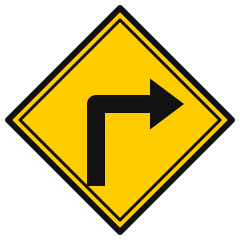
- A side road joins from the right
- A detour to the right
- A very sharp right turn ahead
- A gentle right curve ahead
What does this sign tell you?

- The road is closed for good
- The construction zone ends
- The lane is for exiting only
- A detour is ahead
A flagperson in a work zone signals you to stop. What must you do?
- Go on if the lane looks clear
- Stop only if workers are visible
- Obey the flagperson
- Follow the posted signs instead
What do guide and information signs tell you?
- Where you are and how to get places
- What the speed limit is on that road
- Where hazards are ahead
- When you must yield
What does this sign warn you of?

- A winding road ahead
- Loose gravel ahead
- The road is slippery when wet
- No passing zone ahead
What does this sign warn you of?

- A slippery road ahead
- A single curve to the right
- A winding road ahead
- A road that narrows ahead
What does this sign warn you of?
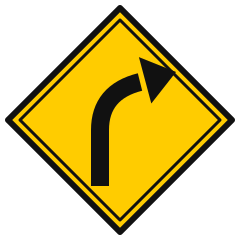
- A side road on the right
- A curve to the right ahead
- The right lane ends ahead
- A right turn is required
What should you do when you see construction and maintenance signs?
- Change lanes right away
- Slow down to a safe speed
- Switch on your high beams
- Keep your speed to clear the area fast
A small square sign with the number 2 is mounted under a railway crossing sign. What does it tell you?
- Only two vehicles may cross at once
- The next train comes in two minutes
- Stop two metres from the rail
- There are two sets of tracks
Warning, construction and guide signs: key rules to remember
Our summary of what the official handbook says on this topic, in our own words. Read it before or after the practice questions above, then check the original chapter. Read the official chapter ↗
Warning Signs (Ch. 4 Signs and Signals)
- Warn of possible dangerous conditions immediately ahead (diamond shape: slow down to keep full control).
- Listed: very sharp right turn; divided highway begins / ends; sharp right curve with 40 km/h recommended speed tab; pedestrian crosswalk ahead; two-way traffic ahead; winding road; right lane ends; left lane ends; road ends (exit right or left); bump; merging roadways; steep hill; hidden intersection; bridge ices; school area (yellow-green pentagon); narrow bridge; hazard marker (obstruction); stop ahead; low structure clearance 4.1 m; traffic signals ahead; right curve; playground ahead; school crosswalk ahead; deer crossing; railway crossing advance (track position shows the angle the tracks cross); road slippery when wet; traffic island; roundabout ahead; pavement ends; recommended exit speed 40 km/h; speed limit change ahead; reserved bus lane ahead.
- Reserved lane in the curb lane of the cross-street: turning right, enter the second lane from the curb. Reserved lane in the median lane: turning right, enter the curb lane.
- Prepare to stop sign: when its amber lights flash, the signal ahead is red or about to turn red.
- Railway crossing sign with lights and bells: when flashing/ringing, be ready to stop for a train. A number on a square sign below it = number of tracks.
Construction and Maintenance Signs
- Warn of construction and maintenance areas; slow down; some locations post maximum speeds.
- Drivers must watch for and obey flag persons.
- Listed: designated construction zone (speed fines double); construction zone ends; maximum 40 km/h when meeting traffic; detour ahead; overhead wires; barricade ahead; flying stones; part of roadway removed; construction area; trucks entering on right; flagperson ahead; road work; bump; pavement edge drop-off.
Guide and Information Signs
- Tell you where you are, what road you're on and how to get places: service, location, route marker and distance signs; vary in size and colour.
- Examples: eastbound TransCanada, westbound Provincial Trunk Highway, southbound Provincial Road, northbound City Route; hospital; camping; picnic; travel information; access for disabled persons; airport with scheduled service.
- "A" route: alternative route that returns to the route you're on.
- Cul-de-sac: dead end with a turnaround.
- Stop for school bus when signals flashing.
Study the Warning, construction and guide signs rules as flashcards →
Other topics
- Sign shapes and regulatory signsWhat each sign shape and colour means, stop, yield and four-way stop rules, the 24-hour clock on signs, turn and lane-use signs, speed and school-zone signs, parking and snow-route signs.
- Traffic signals and pedestrian signalsRed, amber and green lights, where to stop on red, turns on red, flashing lights, green and amber arrows, the green left-arrow shown with a red light, and the transit priority signal.
- Pavement markings and reserved lanesYellow and white lines, solid and broken lines, stop lines, painted left-turn islands, diamond reserved lanes, contra-flow lanes, bicycle lanes and sharrows.
- Graduated licensing and getting your licenceLearner, Intermediate and Full stages, supervising driver rules, passenger limits, zero alcohol and drugs, knowledge and road test rules, new residents and keeping your licence valid.
- Starting, lane changes, turns and roundaboutsHand position, starting from the curb, lane changes and blind spots, hand signals, curves, signalling distances, right and left turns, U-turns and roundabouts.
- Speed, following distance, passing and expresswaysDefault speed limits, the four-second following rule, safe passing and when passing is banned, the No-Zone around trucks, and entering and leaving an expressway.
- Right-of-way, emergency vehicles and work zonesUncontrolled intersections, private driveways, funeral processions, yielding to emergency vehicles, the slow-down-and-move-over speeds, construction zones and the zipper merge.
- School buses, transit buses, railways and school zonesStopping for school buses, sharing the road with transit buses, railway crossing distances and rules, and reduced-speed school and playground zones.
- Pedestrians and cyclistsMarked and unmarked crosswalks, pedestrian signals and push buttons, pedestrian corridors, people who are blind, sharing the road with cyclists and the one-metre passing rule.
- Backing up and parkingBacking safely, three-point turns, parallel and angle parking, the backing skill test, parking on hills, leaving a vehicle running and where parking is illegal.
- Vehicle equipment, seatbelts and child seatsRequired brakes, lights, tires, mirrors, horn and windows, dashboard gauges, seatbelt rules, rear-facing, forward-facing and booster seats, and fuel-efficient driving.
- Night, winter and poor driving conditionsIce and snow, headlight laws, fog and reduced visibility, night driving distances, gravel and winter roads, hills, farm equipment, animals on the road and pilot vehicles.
- Driving emergencies and collisionsRunning off the pavement, blowouts, skids, emergency braking, wet brakes, breakdowns, a car in water or touching power lines, and what to do and report after a collision.
- Alcohol, drugs and impaired driving penaltiesHow alcohol and drugs affect driving, cannabis rules, the novice zero-tolerance restriction, tiered roadside suspensions for .05 to .079, and the three-month suspension at .08 or refusal.
- Distraction, fatigue, suspensions and your driving recordHand-held device penalties, drowsy driving, driving while suspended, Criminal Code suspensions, the Driver Improvement and Control Program and the Driver Safety Rating scale.