On a highway normally posted at 90 km/h, how low can a school zone limit be set?
Manitoba Class 5 overview
Manitoba Class 5 Practice Test 8
30 questions on school buses, transit buses, railways and school zones, driving emergencies and collisions, right-of-way, emergency vehicles and work zones, sign shapes and regulatory signs, speed, following distance, passing and expressways and more.
- No sign-up
- Every answer explained
- Independent · not a government site
- Set 8 of 13
- 30 questions
- Instant feedback
0/30
All 30 questions in this test
Every question and its answer choices. The correct answers and explanations appear when you take the test above.
On a highway normally posted at 90 km/h, how low can a school zone limit be set?
- 30 km/h
- 60 km/h
- 40 km/h
- 50 km/h
After slowing on the shoulder, what must you be careful of as you ease back onto the pavement?
- Not looking in your mirror
- Not using your signal
- Not slowing down too much
- Not overshooting the centre line
A funeral procession with headlights on is going through a red light at your intersection. What must you do?
- Honk to warn them
- Yield to the procession
- Go ahead if your light is green
- Join the end of the procession
What do square or rectangular signs generally do?
- Warn of hazards ahead
- Show construction zones and detours ahead
- Mark school areas
- Regulate traffic and direct drivers
Under ideal driving conditions, what following distance does the handbook recommend?
- Three seconds
- Six seconds
- Two seconds
- Four seconds
What does this sign warn you of?

- Road work ahead
- A playground ahead
- A pedestrian crosswalk ahead
- A flagperson ahead
What kind of drug is alcohol?
- A hallucinogen
- A stimulant
- A depressant
- A painkiller
What does this sign warn you of?
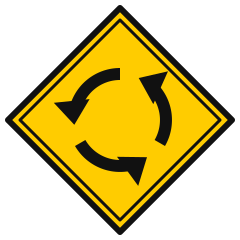
- A detour ahead
- No turns allowed
- A roundabout ahead
- A U-turn route ahead
When starting to parallel park, about how far beside the parked vehicle should you stop?
- About 1 metre
- About 30 centimetres
- About 2 metres
- About 3 metres
May you drive inside a painted left-turn island?
- No, no traffic is permitted in them
- Yes, to pass slow traffic
- Yes, to wait for a gap to turn
- Only emergency vehicles may
It is a driver's first warn-range (.05 to .079) suspension, but a child under 16 is in the vehicle. How long is the suspension?
- 30 days
- 7 days
- 72 hours
- 15 days
Who is allowed to use a school crosswalk?
- All pedestrians
- Only children with a patrol
- Only schoolchildren
- Anyone, but only during school hours
Why might a cyclist ride closer to the middle of the lane?
- Because they want a rest
- Because the road is dry
- To slow down cars behind them on purpose
- To avoid the doors of parked cars
On a sign that uses the 24-hour clock, what does 0:00 mean?
- Midnight
- Any time of day
- 1 a.m.
- Noon
Who is responsible for making sure every minor in the vehicle is properly secured?
- Only the vehicle owner
- The driver
- The minor
- The front passenger
When entering a left-hand curve, where should you steer?
- Toward, but not over, the centre of the road
- Toward the right shoulder
- Over the centre line to straighten it
- Toward the left shoulder
A vehicle ahead on a two-lane road is stopped to turn left. May you pass it on the right?
- Yes, by driving on the shoulder
- No, never pass on the right
- Only if it waves you on
- Yes, if you can do so safely on the road
You become stranded in winter conditions. What does the handbook advise?
- Walk to find help
- Stay with your vehicle
- Leave the car to find shelter
- Stand in the lane to flag cars
Your vehicle has anti-lock brakes and you must stop quickly on snow. What should you do?
- Brake lightly, then release and repeat
- Pump the brakes rapidly
- Apply full brake pressure and hold it
- Shift into neutral
By law, when may you leave your vehicle unattended with the engine running?
- To warm it up or defrost the windshield
- When you run into a store briefly
- Never, under any circumstances
- Only at night with the doors locked
How far in advance can you book a knowledge or road test appointment?
- Up to 30 days
- Up to 14 days
- Up to 90 days
- Up to 60 days
Your temperature gauge shows the engine is running hot. What should you do?
- Turn on the air conditioning
- Drive faster to cool it down
- Stop operating the vehicle
- Ignore it unless you see smoke
If you must rest at the side of the road, what should you do?
- Pull well over and turn on your four-way flashers
- Stop in the right lane of the road with your lights on
- Park close to the centre line
- Turn off all your lights to sleep
What does a double solid yellow line mean?
- No passing for traffic going either way
- Passing allowed during daylight only
- A reserved lane is beside you
- No passing for traffic on the right only
There are no crosswalk lines at an intersection where your light is red. Where should your vehicle stop?
- Right beside the signal pole
- Just before the sidewalk
- In the centre of the intersection
- Past the sidewalk, at the curb line
The light turns amber as you approach and you can stop safely. What should you do?
- Honk and go through
- Keep going at the same speed
- Slow down and stop
- Speed up to make the light
What kind of light may the lead car of a funeral procession display?
- A flashing blue light
- A flashing green light
- A flashing amber light
- A flashing purple light
You need to change direction in a city. What does the handbook advise instead of a U-turn?
- Turn quickly in mid-block
- Go around the block
- Use the oncoming lane
- Reverse to the last corner
A newcomer with an out-of-country licence is issued a Manitoba 5L licence. What changes?
- They may keep using the home licence
- They must drive with a supervising driver
- They may drive alone at night
- They can skip the road test
Your right wheels drift off the edge of a rural road at highway speed. How should you return?
- Speed up and swerve back on to regain control
- Ease off the gas and steer back gradually
- Turn the wheel sharply left
- Brake hard and turn sharply
All Manitoba Class 5 practice tests
- Manitoba Class 5 Mock Exam 1 – 30 QuestionsTimed practice · 30 minutes · answers explained
- Manitoba Class 5 Mock Exam 2 – 30 QuestionsTimed practice · 30 minutes · answers explained
- Manitoba Class 5 Mock Exam 3 – 30 QuestionsTimed practice · 30 minutes · answers explained
- Manitoba Class 5 Mock Exam 4 – 30 QuestionsTimed practice · 30 minutes · answers explained
- Manitoba Class 5 Mock Exam 5 – 30 QuestionsTimed practice · 30 minutes · answers explained
- Sign shapes and regulatory signsWhat each sign shape and colour means, stop, yield and four-way stop rules, the 24-hour clock on signs, turn and lane-use signs, speed and school-zone signs, parking and snow-route signs.
- Warning, construction and guide signsYellow diamond warning signs for curves, lanes, hills, crossings and hazards, orange construction and maintenance signs, doubled speeding fines, and green guide and information signs.
- Traffic signals and pedestrian signalsRed, amber and green lights, where to stop on red, turns on red, flashing lights, green and amber arrows, the green left-arrow shown with a red light, and the transit priority signal.
- Pavement markings and reserved lanesYellow and white lines, solid and broken lines, stop lines, painted left-turn islands, diamond reserved lanes, contra-flow lanes, bicycle lanes and sharrows.
- Graduated licensing and getting your licenceLearner, Intermediate and Full stages, supervising driver rules, passenger limits, zero alcohol and drugs, knowledge and road test rules, new residents and keeping your licence valid.
About this practice test
How many questions are in Manitoba Class 5 practice test 8?
30 original multiple-choice practice questions covering school buses, transit buses, railways and school zones, driving emergencies and collisions, right-of-way, emergency vehicles and work zones, sign shapes and regulatory signs, speed, following distance, passing and expressways, warning, construction and guide signs, alcohol, drugs and impaired driving penalties, backing up and parking, pavement markings and reserved lanes, pedestrians and cyclists, vehicle equipment, seatbelts and child seats, starting, lane changes, turns and roundabouts, night, winter and poor driving conditions, graduated licensing and getting your licence, distraction, fatigue, suspensions and your driving record, traffic signals and pedestrian signals. Each answer includes an explanation. This mixed practice set does not reproduce the official exam format or predict an official score.
Are the questions the same every time?
Yes. Practice test 8 always has the same 30 questions, so you can repeat it until you get them all right. The other 12 sets use different questions.
Are these real test questions?
No. The official question bank is not published. These are original questions written from the official handbook, which is what the real Manitoba Class 5 test is based on.