Unless a sign says otherwise, how close to the nearest rail of a railway crossing may you park?
Manitoba Class 5 overview
Manitoba Class 5 Practice Test 1
30 questions on backing up and parking, starting, lane changes, turns and roundabouts, graduated licensing and getting your licence, alcohol, drugs and impaired driving penalties, speed, following distance, passing and expressways and more.
- No sign-up
- Every answer explained
- Independent · not a government site
- Set 1 of 13
- 30 questions
- Instant feedback
0/30
All 30 questions in this test
Every question and its answer choices. The correct answers and explanations appear when you take the test above.
Unless a sign says otherwise, how close to the nearest rail of a railway crossing may you park?
- No closer than 15 metres
- No closer than 60 metres
- No closer than 30 metres
- No closer than 5 metres
A driver ahead holds their left arm out and bent upward. What are they signalling?
- A stop
- That you may pass
- A left turn
- A right turn
In which languages can you take the Class 5 knowledge test?
- English and French only
- English, French, Cree and Ojibwe only
- English, French and many others
- English only
Which of these is a Criminal Code offence?
- Driving with a BAC of .05
- Driving with low tire pressure
- Parking near a fire hydrant
- Driving with a BAC of .08 or more
Another vehicle is passing you. What should you do?
- Slow down and move as far right as possible
- Speed up to help them pass
- Move toward the centre line so they can see you
- Brake hard and stop
You cannot move your disabled vehicle off the road. What simple signal does the handbook suggest?
- Open all the doors
- Turn on the dome light
- Raise the hood
- Leave the trunk open
A cyclist is riding in a bike lane bounded by solid lines. May the cyclist leave the lane?
- Only when the light is red
- No, the solid lines keep them in
- Yes, for example to turn or change lanes
- Only at marked intersections
You see a guide dog working near the road. What should you avoid?
- Driving slowly past
- Stopping well back
- Waiting for them to cross
- Racing your engine or honking
How long is the suspension for a fourth (or later) warn-range occurrence in a 10-year period?
- 60 days
- 30 days
- 90 days
- 1 year
In a designated construction zone, when are speeding fines doubled?
- Always, whether or not workers are present
- Only when workers are present
- Only when the limit has been reduced
- Only during daylight hours
Your vehicle has no anti-lock brakes and you must stop on an icy road. How should you brake?
- Shift into neutral and coast
- Pull the parking brake
- Slam the brakes fully and hold until you stop
- Steady pressure without locking the wheels
The car ahead slows to let a pedestrian cross. May you pass it?
- Yes, on the right
- Yes, if you sound the horn
- Yes, on the left
- No
A pedestrian is crossing a divided highway and has reached the median. When may you go?
- When they wave you through
- As soon as they pass your lane
- Only when they reach the far curb
- Once they have safely reached the median
About how many animal-vehicle collisions happen in Manitoba each year?
- About 50,000
- About 10,000
- About 500
- About 1,000
Your car begins to skid. What should you do?
- Ease off the pedals and steer where you want to go
- Steer away from your intended path
- Brake hard and hold the wheel straight until you stop
- Accelerate hard to regain traction
What does this sign warn you of?
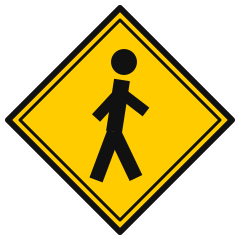
- A hiking trail crossing
- A playground ahead
- Pedestrians are prohibited
- A pedestrian crosswalk ahead
You begin to feel sleepy on a long highway drive. What should you do?
- Stop and rest
- Open a window and keep going
- Turn up the radio
- Drive faster to arrive sooner
You park facing uphill next to a curb. Which way do you turn your front wheels?
- Left, then right again
- Away from the curb
- Straight ahead
- Toward the curb
Where should the chest clip of a car seat harness be placed?
- At armpit level
- At the neck
- At the belly button
- Below the hips
You stop at a railway crossing inside Winnipeg, a restricted speed area. How far from the nearest rail must you stay?
- At least 15 metres
- At least 5 metres
- At least 2 metres
- At least 30 metres
A 14-year-old is convicted of auto theft. When does the licence suspension start?
- On their 16th birthday
- Immediately
- When they apply for a licence
- When they turn 18
A steady amber arrow appears after a green arrow. What does it warn you of?
- The arrow will flash green again
- Pedestrians have finished crossing
- Oncoming traffic may get a green signal next
- Your turn is now protected for longer
What does this sign mean?

- Road closed to trucks only
- No stopping at any time
- Stop sign ahead
- Do not enter
What does a triangle-shaped sign with its tip pointing down mean?
- A slow-moving vehicle is ahead
- A school area begins
- A hazard is just ahead
- You must yield the right-of-way
After passing your road test, how long must you stay in the Intermediate Stage before getting a Full licence?
- 15 months
- 12 months
- 24 months
- 9 months
In a work area, a sign reads 'Maximum 40 km/h when meeting traffic'. What does it require?
- Drive 40 km/h only when workers are present
- Drive at least 40 km/h at all times
- No more than 40 km/h while passing oncoming vehicles
- Keep 40 m behind oncoming traffic
You enter the intersection on a green light to turn left, but oncoming traffic keeps coming. When might you finish the turn?
- Only while the light is still green
- Never; back out of the intersection
- Only after the next green light
- During the amber or red light, when safe
What is the correct order of actions before changing lanes?
- Shoulder check, move, then signal
- Move, signal, then check mirrors
- Mirror, signal, shoulder check, then move
- Signal, move, then check mirrors
How often should you check your tire pressure?
- Only when a tire looks low
- Once a year, at the same time as your oil change
- Only before winter
- At least once a month and after long trips
At a railway crossing, who always has the right-of-way?
- Vehicles on the main road
- The first vehicle to arrive
- Emergency vehicles only
- The train
All Manitoba Class 5 practice tests
- Manitoba Class 5 Mock Exam 1 – 30 QuestionsTimed practice · 30 minutes · answers explained
- Manitoba Class 5 Mock Exam 2 – 30 QuestionsTimed practice · 30 minutes · answers explained
- Manitoba Class 5 Mock Exam 3 – 30 QuestionsTimed practice · 30 minutes · answers explained
- Manitoba Class 5 Mock Exam 4 – 30 QuestionsTimed practice · 30 minutes · answers explained
- Manitoba Class 5 Mock Exam 5 – 30 QuestionsTimed practice · 30 minutes · answers explained
- Sign shapes and regulatory signsWhat each sign shape and colour means, stop, yield and four-way stop rules, the 24-hour clock on signs, turn and lane-use signs, speed and school-zone signs, parking and snow-route signs.
- Warning, construction and guide signsYellow diamond warning signs for curves, lanes, hills, crossings and hazards, orange construction and maintenance signs, doubled speeding fines, and green guide and information signs.
- Traffic signals and pedestrian signalsRed, amber and green lights, where to stop on red, turns on red, flashing lights, green and amber arrows, the green left-arrow shown with a red light, and the transit priority signal.
- Pavement markings and reserved lanesYellow and white lines, solid and broken lines, stop lines, painted left-turn islands, diamond reserved lanes, contra-flow lanes, bicycle lanes and sharrows.
- Graduated licensing and getting your licenceLearner, Intermediate and Full stages, supervising driver rules, passenger limits, zero alcohol and drugs, knowledge and road test rules, new residents and keeping your licence valid.
About this practice test
How many questions are in Manitoba Class 5 practice test 1?
30 original multiple-choice practice questions covering backing up and parking, starting, lane changes, turns and roundabouts, graduated licensing and getting your licence, alcohol, drugs and impaired driving penalties, speed, following distance, passing and expressways, driving emergencies and collisions, pavement markings and reserved lanes, pedestrians and cyclists, right-of-way, emergency vehicles and work zones, night, winter and poor driving conditions, warning, construction and guide signs, distraction, fatigue, suspensions and your driving record, vehicle equipment, seatbelts and child seats, school buses, transit buses, railways and school zones, traffic signals and pedestrian signals, sign shapes and regulatory signs. Each answer includes an explanation. This mixed practice set does not reproduce the official exam format or predict an official score.
Are the questions the same every time?
Yes. Practice test 1 always has the same 30 questions, so you can repeat it until you get them all right. The other 12 sets use different questions.
Are these real test questions?
No. The official question bank is not published. These are original questions written from the official handbook, which is what the real Manitoba Class 5 test is based on.