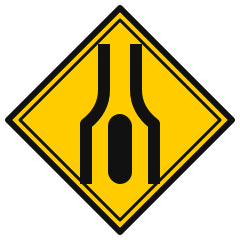
What does this sign warn you of?
Manitoba Class 5 Practice Test 6
30 questions on warning, construction and guide signs, traffic signals and pedestrian signals, alcohol, drugs and impaired driving penalties, distraction, fatigue, suspensions and your driving record, vehicle equipment, seatbelts and child seats and more.
- No sign-up
- Every answer explained
- Independent · not a government site
- Set 6 of 13
- 30 questions
- Instant feedback
All 30 questions in this test
Every question and its answer choices. The correct answers and explanations appear when you take the test above.
What does this sign warn you of?
- The lanes cross over ahead
- A divided highway begins ahead
- The road is closed ahead
- A divided highway ends ahead
You are stopped at a red light and want to turn right. No sign forbids it. What may you do?
- Turn right only on a green arrow
- Wait for the light to turn green
- Turn right without stopping, as long as it is clear
- Turn right after a complete stop, when it is clear
Police suspect a driver is under the influence of a drug. What roadside suspension can the driver receive immediately?
- 72 hours
- 7 days
- 24 hours
- 3 months
A driver is caught using a hand-held device while driving for the second time. How long is the suspension?
- 30 days
- 7 days
- 15 days
- 3 days
Raising your highway speed from 100 to 120 km/h can increase fuel use by up to how much?
- 20 per cent
- 5 per cent
- 10 per cent
- 50 per cent
You arrive at a collision scene and have no flares. How should you warn approaching traffic?
- Stand in the middle of the lane
- Honk your horn continuously
- Turn on your four-way flashers
- Park across both lanes
While reversing into a parallel parking space, at what angle to the curb should your car be before you straighten the wheels?
- About 90 degrees
- About 30 degrees
- About 45 degrees
- About 15 degrees
During the road test's backing exercise, how many tries are you given?
- Five tries or ten minutes
- Two tries or two minutes
- One try only
- Three tries or four minutes
Your car stalls on a highway. Where should you place flares or reflective signs?
- 10 metres behind the car only
- 60 metres in front of and behind the car
- 150 metres behind the car, on the shoulder only
- 30 metres in front only
What does a green U-turn arrow allow?
- A U-turn only when no cars are waiting
- A U-turn, after yielding to others
- A left turn without yielding to anyone
- A right turn on a red light
You are getting out of a car parked on a busy street. What should you do before opening your door?
- Signal to the right first
- Shoulder check for buses and other traffic
- Sound your horn to warn any traffic coming up behind
- Turn on your headlights first
Using a roadside marker, you reach it three seconds after the car ahead passes it. What does this tell you?
- You are following too closely
- You are too far back
- It is correct only on gravel
- Your distance is correct
Under the Driver Improvement and Control Program, who counts as a novice driver?
- Anyone in their first year of a Full licence
- Anyone under 25
- Anyone with under five years of driving experience
- Only learner drivers
After drinking, what is the only thing that will sober you up?
- Black coffee
- Fresh air
- Time
- A cold shower
A car in the lane beside you has stopped for a pedestrian at a crosswalk. What must you do?
- Pass it carefully on the left
- Pass if the pedestrian is far away
- Honk so the pedestrian hurries
- Do not pass it; stop if needed
What does a sharrow (a chevron with a bicycle symbol) on the road mean?
- The lane is for bicycles only
- Bike parking is ahead
- Cyclists and motorists share the lane
- Bicycles are not allowed
What are the three R's that apply to drivers and cyclists?
- Same roads, same rights, same rules
- Ride, relax, return
- Read, record, report
- Respect, react and retreat from danger
Below what tread depth must you replace a tire?
- 1.6 millimetres
- 1 millimetre
- 4 millimetres
- 3.2 millimetres
You have the right-of-way at an uncontrolled intersection. What does the handbook still expect of you?
- Nothing more; others must stop
- Take care to avoid a collision
- Speed up to claim your turn
- Sound your horn as you enter
At a roundabout, who has the right-of-way?
- The vehicle on the left
- Vehicles entering the roundabout
- Vehicles already in the roundabout
- Large trucks only
What do yellow lines on the road separate?
- Bike lanes from car lanes
- Traffic moving in opposite directions
- Parking spaces from travel lanes
- Traffic moving in the same direction
Where is passing on the right permitted?
- Anywhere traffic is slow
- On a two-lane highway
- On the road shoulder
- On a one-way street
You are approaching an intersection where this sign is posted over your lane. What does it require?
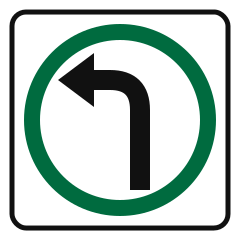
- Left turns are not allowed
- Traffic may go straight or left
- All traffic must turn left
- Left turns only on a green arrow
The light changes from green before you have entered the intersection to turn left. What should you do?
- Turn only if you signalled first
- Go if oncoming traffic stops
- Do not attempt the turn
- Turn quickly before it goes red
What does this sign tell you?
- A playground is closed
- You are in a school area
- A pedestrian corridor is ahead
- A hospital zone is ahead
You are in the GDL program and fail the knowledge test. How long must you wait to try again?
- 14 days
- 30 days
- 1 day
- 7 days
Only a double solid line separates you from a school bus stopped on the other side with red lights flashing. Must you stop?
- Only if the bus is on your side
- Only if children are visible
- No; the double line separates the two directions
- Yes; painted lines are not a median
In a zipper merge, what must a driver staying in the through lane do?
- Close the gap to the car ahead
- Move onto the shoulder
- Let in two vehicles
- Let in one vehicle
What is the maximum speed of farm tractors, combines and similar equipment?
- 60 km/h
- 40 km/h
- 25 km/h
- 50 km/h
What does the number on the small tab under this sign tell you?

- The distance to the curve in kilometres
- The number of curves ahead
- The maximum recommended speed for the curve
- The minimum speed on the curve
All Manitoba Class 5 practice tests
- Manitoba Class 5 Mock Exam 1 – 30 QuestionsTimed practice · 30 minutes · answers explained
- Manitoba Class 5 Mock Exam 2 – 30 QuestionsTimed practice · 30 minutes · answers explained
- Manitoba Class 5 Mock Exam 3 – 30 QuestionsTimed practice · 30 minutes · answers explained
- Manitoba Class 5 Mock Exam 4 – 30 QuestionsTimed practice · 30 minutes · answers explained
- Manitoba Class 5 Mock Exam 5 – 30 QuestionsTimed practice · 30 minutes · answers explained
- Sign shapes and regulatory signsWhat each sign shape and colour means, stop, yield and four-way stop rules, the 24-hour clock on signs, turn and lane-use signs, speed and school-zone signs, parking and snow-route signs.
- Warning, construction and guide signsYellow diamond warning signs for curves, lanes, hills, crossings and hazards, orange construction and maintenance signs, doubled speeding fines, and green guide and information signs.
- Traffic signals and pedestrian signalsRed, amber and green lights, where to stop on red, turns on red, flashing lights, green and amber arrows, the green left-arrow shown with a red light, and the transit priority signal.
- Pavement markings and reserved lanesYellow and white lines, solid and broken lines, stop lines, painted left-turn islands, diamond reserved lanes, contra-flow lanes, bicycle lanes and sharrows.
- Graduated licensing and getting your licenceLearner, Intermediate and Full stages, supervising driver rules, passenger limits, zero alcohol and drugs, knowledge and road test rules, new residents and keeping your licence valid.
About this practice test
How many questions are in Manitoba Class 5 practice test 6?
30 original multiple-choice practice questions covering warning, construction and guide signs, traffic signals and pedestrian signals, alcohol, drugs and impaired driving penalties, distraction, fatigue, suspensions and your driving record, vehicle equipment, seatbelts and child seats, driving emergencies and collisions, backing up and parking, school buses, transit buses, railways and school zones, speed, following distance, passing and expressways, pedestrians and cyclists, pavement markings and reserved lanes, right-of-way, emergency vehicles and work zones, starting, lane changes, turns and roundabouts, sign shapes and regulatory signs, graduated licensing and getting your licence, night, winter and poor driving conditions. Each answer includes an explanation. This mixed practice set does not reproduce the official exam format or predict an official score.
Are the questions the same every time?
Yes. Practice test 6 always has the same 30 questions, so you can repeat it until you get them all right. The other 12 sets use different questions.
Are these real test questions?
No. The official question bank is not published. These are original questions written from the official handbook, which is what the real Manitoba Class 5 test is based on.
