Where are yield signs usually placed?
Manitoba Class 5 overview
Manitoba Class 5 Practice Test 7
30 questions on sign shapes and regulatory signs, graduated licensing and getting your licence, alcohol, drugs and impaired driving penalties, right-of-way, emergency vehicles and work zones, warning, construction and guide signs and more.
- No sign-up
- Every answer explained
- Independent · not a government site
- Set 7 of 13
- 30 questions
- Instant feedback
0/30
All 30 questions in this test
Every question and its answer choices. The correct answers and explanations appear when you take the test above.
Where are yield signs usually placed?
- Only in school zones
- Where a lane or road merges with another
- At the end of a divided highway
- At every railway crossing
What is the minimum time you must spend in the Learner Stage?
- 9 months
- 15 months
- 12 months
- 6 months
You hold a licence from a country outside Canada and the U.S. What is the longest you may drive on it in Manitoba?
- One year
- 30 days
- Three months
- Six months
Impaired drivers account for about what share of traffic deaths in Manitoba?
- About two-thirds
- About one-third
- About half
- About one-tenth
How do drivers use the lanes in a zipper merge?
- Merge as early as possible
- Only trucks use the closing lane
- The closing lane must stop and wait for a gap to open
- Use both lanes to the merge point, then take turns
In the zone this sign marks, what happens to fines for speeding?
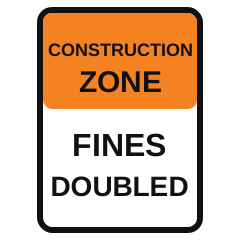
- They are replaced by a warning
- They are tripled
- They apply only when workers are present
- They are doubled
Which of these can lead to a Driver Improvement and Control intervention?
- An at-fault collision
- The type of car you drive
- Your age
- Your gender
You are already in the intersection when the light turns amber. What should you do?
- Turn right to get out of the way
- Back up behind the stop line
- Stop where you are
- Continue through the intersection
You are passing a stopped police car with its lights flashing, on a highway posted at 100 km/h. How fast may you go?
- 50 km/h
- 40 km/h
- 60 km/h
- 80 km/h
Which vehicles may stop at every railway crossing, so you should be ready to stop behind them?
- School buses and hazardous-material carriers
- Taxis and food delivery cars
- Motorcycles, mopeds and bicycles with trailers
- Pickup trucks and cargo vans
You stop at a railway crossing on a rural highway outside any restricted speed area. How far from the nearest rail should you stay?
- At least 15 metres
- At least 50 metres
- At least 30 metres
- At least 5 metres
Under normal conditions, how far ahead can you see on low beams?
- 110 metres
- 30 metres
- 60 metres
- 150 metres
When are studded tires illegal in Manitoba?
- All year round
- Between March 1 and November 1
- Between May 15 and September 15
- Between April 30 and October 1
You cannot shoulder check and must rely on your mirrors. How many lanes may you change at a time?
- None; lane changes are not allowed
- One lane at a time
- Two lanes at a time
- Any number while signalling
A front tire blows out. What should you do?
- Brake hard right away
- Hold the wheel firmly and ease off the gas
- Steer sharply onto the shoulder and brake right away
- Shift into neutral and coast
There is a solid line on the left of your lane. What does it mean?
- Passing is allowed if safe
- The next lane is for bicycles
- The lane ends ahead
- Do not pass or change lanes
You leave a one-way street with a left turn and enter a two-way street. Where should your car end up?
- In the lane just right of the centre line
- In the lane nearest the right curb
- Just left of the centre line
- In the parking lane
You are following another vehicle at night. Within what distance must you switch to low beams?
- 60 metres
- 30 metres
- 150 metres
- 450 metres
Your car is touching live wires and is on fire, so you must leave. How should you get out?
- Crawl out through an open window
- Jump clear, never touching car and ground at once
- Slide out while holding the door frame for balance
- Step out slowly and walk away fast
You are passing a large truck. When is it safe to pull back in front of it?
- As soon as your rear bumper clears its front bumper
- When you see its whole cab in your mirror
- When the truck driver honks
- After counting two seconds
You are reversing straight back or to the right. Which way should you look?
- Only in the rearview mirror
- Over your right shoulder
- Over your left shoulder
- Only in the side mirror
Where may cannabis be carried in a vehicle?
- On the passenger seat
- In the driver's door pocket, if it is sealed
- In the glove box
- In a secure compartment such as the trunk
When should you switch on an engine block heater in winter?
- Ten minutes before driving
- About four hours before you drive
- All night long
- Only below minus 35°C
What does a green arrow mean?
- Go only in the arrow's direction
- Only buses may go in that direction
- Go in any direction after yielding
- Stop first, then go in that direction
If you must stop while entering an expressway, where is the right place to do it?
- Just before the start of the merge lane
- On the expressway shoulder
- In the middle of the merge lane
- At the end of the merge lane
What does this sign require you to do?

- Slow down, and stop if needed to let others go
- Go first; cross traffic must yield to you
- Speed up to merge ahead of traffic
- Stop completely every time
You are driving next to a with-flow diamond lane and need to turn right. What may you do?
- Never enter it; turn from your lane
- Enter it and stay in it for several blocks if needed
- Enter it, then turn at the next intersection
- Enter it only after the intersection
There are no painted lines where a sidewalk meets the road at an intersection. Is there a crosswalk?
- Yes, an unmarked crosswalk
- No, only painted crosswalks count
- Only if a sign is posted
- Only near a school
On conviction for using a hand-held device while driving, what is the fine?
- $203
- $1,000
- $450
- $672
How close to a fire hydrant may you park?
- No closer than 9 metres
- No closer than 3 metres
- No closer than 1 metre
- No closer than 6 metres
All Manitoba Class 5 practice tests
- Manitoba Class 5 Mock Exam 1 – 30 QuestionsTimed practice · 30 minutes · answers explained
- Manitoba Class 5 Mock Exam 2 – 30 QuestionsTimed practice · 30 minutes · answers explained
- Manitoba Class 5 Mock Exam 3 – 30 QuestionsTimed practice · 30 minutes · answers explained
- Manitoba Class 5 Mock Exam 4 – 30 QuestionsTimed practice · 30 minutes · answers explained
- Manitoba Class 5 Mock Exam 5 – 30 QuestionsTimed practice · 30 minutes · answers explained
- Sign shapes and regulatory signsWhat each sign shape and colour means, stop, yield and four-way stop rules, the 24-hour clock on signs, turn and lane-use signs, speed and school-zone signs, parking and snow-route signs.
- Warning, construction and guide signsYellow diamond warning signs for curves, lanes, hills, crossings and hazards, orange construction and maintenance signs, doubled speeding fines, and green guide and information signs.
- Traffic signals and pedestrian signalsRed, amber and green lights, where to stop on red, turns on red, flashing lights, green and amber arrows, the green left-arrow shown with a red light, and the transit priority signal.
- Pavement markings and reserved lanesYellow and white lines, solid and broken lines, stop lines, painted left-turn islands, diamond reserved lanes, contra-flow lanes, bicycle lanes and sharrows.
- Graduated licensing and getting your licenceLearner, Intermediate and Full stages, supervising driver rules, passenger limits, zero alcohol and drugs, knowledge and road test rules, new residents and keeping your licence valid.
About this practice test
How many questions are in Manitoba Class 5 practice test 7?
30 original multiple-choice practice questions covering sign shapes and regulatory signs, graduated licensing and getting your licence, alcohol, drugs and impaired driving penalties, right-of-way, emergency vehicles and work zones, warning, construction and guide signs, distraction, fatigue, suspensions and your driving record, traffic signals and pedestrian signals, school buses, transit buses, railways and school zones, night, winter and poor driving conditions, vehicle equipment, seatbelts and child seats, starting, lane changes, turns and roundabouts, driving emergencies and collisions, pavement markings and reserved lanes, speed, following distance, passing and expressways, backing up and parking, pedestrians and cyclists. Each answer includes an explanation. This mixed practice set does not reproduce the official exam format or predict an official score.
Are the questions the same every time?
Yes. Practice test 7 always has the same 30 questions, so you can repeat it until you get them all right. The other 12 sets use different questions.
Are these real test questions?
No. The official question bank is not published. These are original questions written from the official handbook, which is what the real Manitoba Class 5 test is based on.