Unless a sign says otherwise, what is the maximum speed in urban areas?
Manitoba Class 5 overview
Manitoba Class 5 Practice Test 2
30 questions on speed, following distance, passing and expressways, starting, lane changes, turns and roundabouts, backing up and parking, sign shapes and regulatory signs, alcohol, drugs and impaired driving penalties and more.
- No sign-up
- Every answer explained
- Independent · not a government site
- Set 2 of 13
- 30 questions
- Instant feedback
0/30
All 30 questions in this test
Every question and its answer choices. The correct answers and explanations appear when you take the test above.
Unless a sign says otherwise, what is the maximum speed in urban areas?
- 50 km/h
- 70 km/h
- 60 km/h
- 40 km/h
Where should you never change lanes?
- On a multi-lane street
- Near a bus stop
- In an intersection
- On a one-way street
When you stop parallel to the curb, at most how far from it should your vehicle be?
- 15 centimetres
- 1 metre
- 75 centimetres
- 45 centimetres
What does this sign mean?
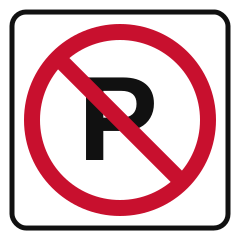
- Parking permitted as indicated
- Parking for disabled persons only
- Parking is prohibited
- Pay parking ahead
Which of these is a place where U-turns are prohibited?
- At any intersection
- On a curve
- On a road with a broken centre line
- On a one-way street
At what blood alcohol concentration do you get an immediate three-month Administrative Licence Suspension?
- .08 or over
- .05 or over
- .12 or over
- .10 or over
A warning sign shows the reserved lane is the curb lane of the cross-street. You are turning right onto that street. Which lane do you enter?
- The curb lane
- The lane next to the median
- The second lane from the curb
- Whichever lane is empty
Visibility becomes so poor that you can barely see. What should you do?
- Follow the taillights ahead closely
- Pull carefully off the pavement and stop
- Speed up to get through it
- Stop in your lane
You want to turn left into a private driveway across a double solid line. Is this allowed?
- Only if no sign forbids it
- Only outside city limits
- Yes, it is permitted
- No, it is never permitted
Two vehicles approach an intersection that has no signs or signals. Who must yield?
- The vehicle on the right yields to the left
- The vehicle on the left yields to the one on the right
- The slower vehicle yields
- The vehicle turning yields to everyone
At a four-way stop, after stopping and yielding to pedestrians, how do you show you intend to go?
- Tap your horn twice
- Flash your headlights
- Turn on your hazard lights
- Roll slowly forward
You face a red light and there is a marked crosswalk. Where do you stop?
- At the edge of the intersection
- Wherever you can see cross traffic
- Past the crosswalk, at the corner
- Before the marked crosswalk
Between midnight and 5 a.m., what allows an Intermediate driver to carry back-seat passengers?
- Written permission from a parent
- Holding the licence for a full year without tickets
- Driving only inside Winnipeg
- A qualified supervising driver in the front seat
Between which dates must your vehicle be able to keep its windows free of frost?
- December 1 to February 28
- November 1 to March 31
- September 1 to May 31
- October 1 to April 30
Is it acceptable to drive so slowly that you hold up the normal flow of traffic?
- Yes, slower is always safer
- Yes, on any road with a limit under 50 km/h
- Yes, if you use your hazards
- No, you should not block normal traffic
In a reduced-speed school zone where the regular limit is under 80 km/h, how low can the speed limit be?
- 40 km/h
- 30 km/h
- 50 km/h
- 20 km/h
You plan to turn right at the next driveway, and a cyclist is ahead on your right. What should you do?
- Pass them quickly, then turn right
- Stay behind and yield, then turn
- Honk so they move over
- Turn in front of them
How many levels down the Driver Safety Rating scale does a Tiered Administrative Licence Suspension move you?
- 1 level
- 5 levels
- 10 levels
- 2 levels
You are stopped at a red light and an ambulance with siren on is blocked behind you. What should you do?
- Turn off your engine
- Back up to make room
- Stay stopped until the light changes
- Carefully go through to clear its path
At night, a cyclist is coming toward you. What should you do?
- Turn on your hazards
- Sound your horn
- Flash your high beams
- Dim your headlights
A driver does not complete a course required by the DI&C Program. What happens?
- Nothing happens
- Their insurance is waived
- They pay a small fine
- Their licence is cancelled
What does a broken line on the left of your lane allow?
- Passing or changing lanes when safe
- Parking along the line outside rush hours
- U-turns at any point
- Passing only on the right
A learner lets their licence lapse for two months. What happens to those two months?
- They do not count toward the stage
- They count at half rate
- The stage restarts from zero
- They still count toward the stage
On a highway outside a city, town or village, when is it illegal to park at a curve?
- Only after dark
- If it can't be seen from 60 m each way
- At any time of day or night
- When the curve has a speed tab
What does this sign tell you?

- The road is closed for good
- The construction zone ends
- The lane is for exiting only
- A detour is ahead
In Winnipeg, warning lights are flashing at a crossing with no gates. The train is stopped far away. May you cross?
- Yes, after a full stop, if it is safe
- No, never while the lights flash
- Only if a flagperson waves you on
- Yes, without needing to stop
A live power line has fallen on your car. What should you do?
- Touch the door frame to test it
- Get out and run
- Stay inside and try to drive away from it
- Step out slowly onto the ground
The light is green. Who must you still yield to?
- No one, since a green light gives you the right-of-way
- Pedestrians and vehicles already in the intersection
- Only vehicles approaching from your right
- Only emergency vehicles with sirens
Visibility is reduced by snow. At what visibility distance must your headlights be on?
- 150 metres
- 100 metres
- 60 metres
- 30 metres
Why is texting while driving especially dangerous?
- It drains your car battery
- It distracts only your passengers, not the driver
- It takes your eyes, hands and mind off driving
- It is allowed at red lights
All Manitoba Class 5 practice tests
- Manitoba Class 5 Mock Exam 1 – 30 QuestionsTimed practice · 30 minutes · answers explained
- Manitoba Class 5 Mock Exam 2 – 30 QuestionsTimed practice · 30 minutes · answers explained
- Manitoba Class 5 Mock Exam 3 – 30 QuestionsTimed practice · 30 minutes · answers explained
- Manitoba Class 5 Mock Exam 4 – 30 QuestionsTimed practice · 30 minutes · answers explained
- Manitoba Class 5 Mock Exam 5 – 30 QuestionsTimed practice · 30 minutes · answers explained
- Sign shapes and regulatory signsWhat each sign shape and colour means, stop, yield and four-way stop rules, the 24-hour clock on signs, turn and lane-use signs, speed and school-zone signs, parking and snow-route signs.
- Warning, construction and guide signsYellow diamond warning signs for curves, lanes, hills, crossings and hazards, orange construction and maintenance signs, doubled speeding fines, and green guide and information signs.
- Traffic signals and pedestrian signalsRed, amber and green lights, where to stop on red, turns on red, flashing lights, green and amber arrows, the green left-arrow shown with a red light, and the transit priority signal.
- Pavement markings and reserved lanesYellow and white lines, solid and broken lines, stop lines, painted left-turn islands, diamond reserved lanes, contra-flow lanes, bicycle lanes and sharrows.
- Graduated licensing and getting your licenceLearner, Intermediate and Full stages, supervising driver rules, passenger limits, zero alcohol and drugs, knowledge and road test rules, new residents and keeping your licence valid.
About this practice test
How many questions are in Manitoba Class 5 practice test 2?
30 original multiple-choice practice questions covering speed, following distance, passing and expressways, starting, lane changes, turns and roundabouts, backing up and parking, sign shapes and regulatory signs, alcohol, drugs and impaired driving penalties, warning, construction and guide signs, night, winter and poor driving conditions, pavement markings and reserved lanes, right-of-way, emergency vehicles and work zones, traffic signals and pedestrian signals, graduated licensing and getting your licence, vehicle equipment, seatbelts and child seats, school buses, transit buses, railways and school zones, pedestrians and cyclists, distraction, fatigue, suspensions and your driving record, driving emergencies and collisions. Each answer includes an explanation. This mixed practice set does not reproduce the official exam format or predict an official score.
Are the questions the same every time?
Yes. Practice test 2 always has the same 30 questions, so you can repeat it until you get them all right. The other 12 sets use different questions.
Are these real test questions?
No. The official question bank is not published. These are original questions written from the official handbook, which is what the real Manitoba Class 5 test is based on.