Your car has gone into water. About how long do the occupants have to get out?
Manitoba Class 5 overview
Manitoba Class 5 Practice Test 9
30 questions on driving emergencies and collisions, speed, following distance, passing and expressways, graduated licensing and getting your licence, warning, construction and guide signs, vehicle equipment, seatbelts and child seats and more.
- No sign-up
- Every answer explained
- Independent · not a government site
- Set 9 of 13
- 30 questions
- Instant feedback
0/30
All 30 questions in this test
Every question and its answer choices. The correct answers and explanations appear when you take the test above.
Your car has gone into water. About how long do the occupants have to get out?
- About five seconds
- About half an hour
- About ten minutes
- About one minute
What is the leading type of collision at expressway entrances?
- Head-on collisions
- Side-swipe collisions
- Rollovers
- Rear-end collisions
Your birthday is March 10. When is your licence anniversary date, when the yearly charge is due?
- June 10
- July 9
- March 10
- November 10
On this sign, what does the angle of the track symbol tell you?
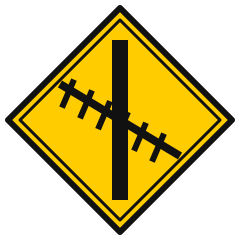
- How many tracks there are
- The angle at which the tracks cross the road
- Which way the next train will come
- How fast trains travel there
On a cold winter morning, about how long do most engines need to warm up?
- About 2 minutes
- About 30 seconds
- About 5 minutes
- About 10 minutes
On Manitoba's winter (ice) roads, what is the recommended speed for vehicles of seven tonnes or more?
- 70 km/h
- 15 km/h
- 50 km/h
- 30 km/h
Where does the handbook say it is not safe to pass a cyclist?
- In a construction zone narrowed to one lane
- On a straight road with a clear view
- On a road with a broken line
- In daylight on a wide lane
How close to a pedestrian corridor may you park or stop?
- No closer than 9 metres
- No closer than 3 metres
- No closer than 15 metres
- No closer than 30 metres
Your car is parked facing down a slope beside the curb. How should the front wheels be turned?
- It does not matter
- Toward the curb
- Away from the curb
- Straight ahead
When is it illegal to pass another moving vehicle in a school area?
- Only on winter school days
- Within 15 minutes of classes opening or closing
- Only at lunchtime
- Within 30 minutes of classes opening
Can you be charged with impaired driving if your blood alcohol is below .08?
- Only if you are under 18
- Only if you cause a crash that injures someone
- Yes, if your ability to drive is impaired
- No, never below .08
A friend drives your car while suspended and it is impounded. Who pays the towing and storage costs?
- MPI
- The police service
- Your friend only
- You, the owner
You are established in the intersection waiting to turn left, and the light turns red. What do you do?
- Back up behind the stop line
- Complete the turn when it is safe
- Turn right instead
- Stay put until the next green
The transit priority signal is always shown together with which light?
- A flashing amber light
- A flashing red light
- A green left arrow
- A steady red light
Why should you avoid using cruise control on some roads?
- It burns more fuel than normal on open highways
- It is illegal in cities
- It is unsafe on slippery or winter roads
- It wears out the brakes
At a stop sign, pedestrians have finished crossing but your view of cross traffic is blocked. What should you do?
- Back up a short distance and wait
- Creep forward to see, then go when safe
- Turn on your hazard lights and go
- Accelerate quickly across the street before anyone comes
Before backing up, what does the handbook tell you to check for especially carefully?
- The radio volume
- The fuel gauge and the dashboard warning lights
- Small children who may be out of sight
- The tire pressure on all four wheels
A solid white line separates two lanes going your way. What does it mean?
- The lane is for buses only
- Lane changing is permitted
- Lane changing is not permitted
- A stop line is just ahead
Your car catches fire, probably from an electrical short. What should you do first?
- Open the hood wide
- Pour water on the engine
- Turn off the ignition
- Keep driving to a garage
Passing on a two-lane road, how fast are you closing the gap with an oncoming vehicle?
- At your own speed
- At half your speed
- At the posted limit for that road
- At the sum of both speeds
What else can happen if you speed past a stopped emergency vehicle, besides a fine?
- You can move down the Driver Safety Rating scale
- You must retake the road test
- Your vehicle registration is cancelled
- Nothing more; only a fine applies
When should you slow down for a curve?
- As you leave the curve
- In the middle of the curve
- Only if you start to skid
- Before you enter it
Which statement about the knowledge test is true?
- You may use the handbook on your phone
- A helper may read the handbook to you
- You may bring printed notes
- It is not an open-book test
What does this sign tell you?

- Turn right at the next street
- Keep to the right of the sign
- Right lane ends ahead
- Slower traffic keep right
How are the beginning and end of a construction zone marked?
- With orange flags on every pole along the road
- With flashing purple lights
- With painted red lines
- With traffic control devices like signs
A small square sign with the number 2 is mounted under a railway crossing sign. What does it tell you?
- Only two vehicles may cross at once
- The next train comes in two minutes
- Stop two metres from the rail
- There are two sets of tracks
At what distance from an oncoming vehicle must you dim your high beams?
- At least 60 metres
- At least 450 metres
- At least 150 metres
- At least 300 metres
How can you recognize members of a school safety patrol?
- By red stop paddles only
- By their high-visibility vests and flags
- By police-style uniforms with peaked caps
- By orange hard hats
A driver gets a second warn-range suspension within 10 years. How long is it?
- 7 days
- 30 days
- 60 days
- 15 days
What does a flashing amber light mean?
- The light is about to turn red
- Slow down and be ready to stop
- Stop completely before proceeding
- Speed up to clear the intersection
All Manitoba Class 5 practice tests
- Manitoba Class 5 Mock Exam 1 – 30 QuestionsTimed practice · 30 minutes · answers explained
- Manitoba Class 5 Mock Exam 2 – 30 QuestionsTimed practice · 30 minutes · answers explained
- Manitoba Class 5 Mock Exam 3 – 30 QuestionsTimed practice · 30 minutes · answers explained
- Manitoba Class 5 Mock Exam 4 – 30 QuestionsTimed practice · 30 minutes · answers explained
- Manitoba Class 5 Mock Exam 5 – 30 QuestionsTimed practice · 30 minutes · answers explained
- Sign shapes and regulatory signsWhat each sign shape and colour means, stop, yield and four-way stop rules, the 24-hour clock on signs, turn and lane-use signs, speed and school-zone signs, parking and snow-route signs.
- Warning, construction and guide signsYellow diamond warning signs for curves, lanes, hills, crossings and hazards, orange construction and maintenance signs, doubled speeding fines, and green guide and information signs.
- Traffic signals and pedestrian signalsRed, amber and green lights, where to stop on red, turns on red, flashing lights, green and amber arrows, the green left-arrow shown with a red light, and the transit priority signal.
- Pavement markings and reserved lanesYellow and white lines, solid and broken lines, stop lines, painted left-turn islands, diamond reserved lanes, contra-flow lanes, bicycle lanes and sharrows.
- Graduated licensing and getting your licenceLearner, Intermediate and Full stages, supervising driver rules, passenger limits, zero alcohol and drugs, knowledge and road test rules, new residents and keeping your licence valid.
About this practice test
How many questions are in Manitoba Class 5 practice test 9?
30 original multiple-choice practice questions covering driving emergencies and collisions, speed, following distance, passing and expressways, graduated licensing and getting your licence, warning, construction and guide signs, vehicle equipment, seatbelts and child seats, night, winter and poor driving conditions, pedestrians and cyclists, backing up and parking, school buses, transit buses, railways and school zones, alcohol, drugs and impaired driving penalties, distraction, fatigue, suspensions and your driving record, starting, lane changes, turns and roundabouts, traffic signals and pedestrian signals, sign shapes and regulatory signs, pavement markings and reserved lanes, right-of-way, emergency vehicles and work zones. Each answer includes an explanation. This mixed practice set does not reproduce the official exam format or predict an official score.
Are the questions the same every time?
Yes. Practice test 9 always has the same 30 questions, so you can repeat it until you get them all right. The other 12 sets use different questions.
Are these real test questions?
No. The official question bank is not published. These are original questions written from the official handbook, which is what the real Manitoba Class 5 test is based on.