Where should you never change lanes?
Manitoba Class 5 overview
Manitoba Class 5 Mock Exam 2
Same format as the real test. Answers stay hidden until you submit.
- No sign-up
- Every answer explained
- Independent · not a government site
- 30 questions
- 30 min
- Pass mark 24/30
0/30
All 30 questions in this test
Every question and its answer choices. The correct answers and explanations appear when you take the test above.
Where should you never change lanes?
- On a multi-lane street
- Near a bus stop
- In an intersection
- On a one-way street
You see this sign. What should you prepare to do?

- Stop for a school bus
- Yield at a sign ahead
- Stop at a railway crossing
- Stop at a stop sign ahead
What is the leading type of collision at expressway entrances?
- Head-on collisions
- Side-swipe collisions
- Rollovers
- Rear-end collisions
Without anti-lock brakes, what is the advantage of threshold braking in an emergency?
- You stop in a shorter distance
- It saves wear on your tires
- It works only with anti-lock brakes
- You keep steering control while stopping
In a work area, a sign reads 'Maximum 40 km/h when meeting traffic'. What does it require?
- Drive 40 km/h only when workers are present
- Drive at least 40 km/h at all times
- No more than 40 km/h while passing oncoming vehicles
- Keep 40 m behind oncoming traffic
On average, about how many people are killed each year on Manitoba roads in collisions linked to distracted driving?
- 8
- 128
- 28
- 58
On a sign that uses the 24-hour clock, what does 0:00 mean?
- Midnight
- Any time of day
- 1 a.m.
- Noon
What does this sign require you to do?

- Slow down, and stop if needed to let others go
- Go first; cross traffic must yield to you
- Speed up to merge ahead of traffic
- Stop completely every time
What does this sign warn you of?

- A slippery road ahead
- A single curve to the right
- A winding road ahead
- A road that narrows ahead
A friend drives your car while suspended and it is impounded. Who pays the towing and storage costs?
- MPI
- The police service
- Your friend only
- You, the owner
What does this sign mean?
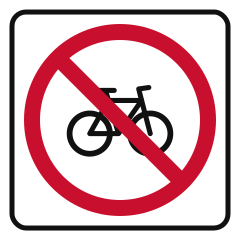
- Cycling is prohibited
- A bicycle route
- A bicycle lane ahead
- Bicycle parking
A solid and a broken yellow line run side by side, with the solid line on your side. Can you pass?
- Yes, but only in daylight
- Yes, if the road ahead is clear
- Only to pass a cyclist
- No, passing is not permitted
What does this sign warn you of?

- A wildlife park ahead
- A farm ahead
- Hunting allowed near the road
- A deer crossing area ahead
You are hosting a party. What does the handbook suggest to prevent impaired driving?
- Serve one for the road
- Close the bar an hour before the party ends
- Let guests drive home slowly on quiet side roads
- Offer only salty snacks
You are on a rural highway with no speed limit signs. What is the most you may drive?
- 110 km/h
- 80 km/h
- 100 km/h
- 90 km/h
A school bus ahead turns on its flashing overhead amber lights. What does this mean?
- It is safe to pass it now
- It is about to stop; prepare to stop
- The children are already off
- It is about to turn left; pass it on the right
You arrive at a collision scene and have no flares. How should you warn approaching traffic?
- Stand in the middle of the lane
- Honk your horn continuously
- Turn on your four-way flashers
- Park across both lanes
Between which dates must your vehicle be able to keep its windows free of frost?
- December 1 to February 28
- November 1 to March 31
- September 1 to May 31
- October 1 to April 30
How can you recognize a pedestrian corridor?
- Only a red stop line
- Green flashing lights mounted on poles at each corner
- Only a yellow diamond sign
- Overhead lit signs with flashing amber lights
Two vehicles approach an intersection that has no signs or signals. Who must yield?
- The vehicle on the right yields to the left
- The vehicle on the left yields to the one on the right
- The slower vehicle yields
- The vehicle turning yields to everyone
Unless a sign says otherwise, what is the maximum speed in urban areas?
- 50 km/h
- 70 km/h
- 60 km/h
- 40 km/h
How close to a pedestrian corridor may you park or stop?
- No closer than 9 metres
- No closer than 3 metres
- No closer than 15 metres
- No closer than 30 metres
What are the three R's that apply to drivers and cyclists?
- Same roads, same rights, same rules
- Ride, relax, return
- Read, record, report
- Respect, react and retreat from danger
Your vehicle has no anti-lock brakes and you must stop on an icy road. How should you brake?
- Shift into neutral and coast
- Pull the parking brake
- Slam the brakes fully and hold until you stop
- Steady pressure without locking the wheels
If you must stop while entering an expressway, where is the right place to do it?
- Just before the start of the merge lane
- On the expressway shoulder
- In the middle of the merge lane
- At the end of the merge lane
Which sign shape is used only for stop signs?
- Diamond
- Octagon (eight sides)
- Pentagon (five sides)
- Triangle pointing down
Passing on a two-lane road, how fast are you closing the gap with an oncoming vehicle?
- At your own speed
- At half your speed
- At the posted limit for that road
- At the sum of both speeds
What does a double solid yellow line mean?
- No passing for traffic going either way
- Passing allowed during daylight only
- A reserved lane is beside you
- No passing for traffic on the right only
Which of these is a Criminal Code offence?
- Driving with a BAC of .05
- Driving with low tire pressure
- Parking near a fire hydrant
- Driving with a BAC of .08 or more
You plan to turn right at the next driveway, and a cyclist is ahead on your right. What should you do?
- Pass them quickly, then turn right
- Stay behind and yield, then turn
- Honk so they move over
- Turn in front of them
Keep practising
- Manitoba Class 5 Mock Exam 1 – 30 QuestionsTimed practice · 30 minutes · answers explained
- Manitoba Class 5 Mock Exam 3 – 30 QuestionsTimed practice · 30 minutes · answers explained
- Manitoba Class 5 Mock Exam 4 – 30 QuestionsTimed practice · 30 minutes · answers explained
- Manitoba Class 5 Mock Exam 5 – 30 QuestionsTimed practice · 30 minutes · answers explained
- Manitoba Class 5 Practice Test 130 questions with explanations
- Manitoba Class 5 Practice Test 230 questions with explanations
- Manitoba Class 5 Practice Test 330 questions with explanations
- Manitoba Class 5 Practice Test 430 questions with explanations