The transit priority signal is always shown together with which light?
Manitoba Class 5 overview
MPI Road Signs Practice Test
60 Manitoba road sign, signal and pavement marking questions for the MPI Class 5 knowledge test, each with the handbook rule explained. Free, no sign-up.
- No sign-up
- Every answer explained
- Independent · not a government site
- 60 questions
- Instant feedback
- Free, no sign-up
MPI says its Class 5 knowledge test checks three things: traffic laws, safe driving practices and road signs. It does not publish how many questions the test has, so the safe plan is to know every sign in Chapter 4 of the MPI Driver's Handbook. This page isolates that chapter: 60 questions drawn only from the signs side of our bank, covering sign shapes and regulatory signs, warning, construction and guide signs, traffic and pedestrian signals, and pavement markings and reserved lanes.
Many of the harder sign questions are about a detail rather than the picture: which lane to turn into when a reserved bus lane is in the curb lane, what flashing amber lights on a Prepare to Stop sign mean, or what the number on a square plate under a railway crossing sign tells you. The explanations spell those details out and cite the handbook page. The real test has a 30-minute limit, so once you score 54 or more here, practise under time with a full mock exam.
0/60
All 60 questions in this test
Every question and its answer choices. The correct answers and explanations appear when you take the test above.
The transit priority signal is always shown together with which light?
- A flashing amber light
- A flashing red light
- A green left arrow
- A steady red light
What does this sign warn you of?

- A slippery road ahead
- A single curve to the right
- A winding road ahead
- A road that narrows ahead
What markings designate a contra-flow reserved lane?
- Double solid yellow lines and white diamonds
- Painted bicycle symbols
- A single solid white line
- Double broken white lines and diamonds
What does this sign require you to do?

- Slow down, and stop if needed to let others go
- Go first; cross traffic must yield to you
- Speed up to merge ahead of traffic
- Stop completely every time
What does a flashing amber light mean?
- The light is about to turn red
- Slow down and be ready to stop
- Stop completely before proceeding
- Speed up to clear the intersection
What should you do when you see construction and maintenance signs?
- Change lanes right away
- Slow down to a safe speed
- Switch on your high beams
- Keep your speed to clear the area fast
What do white lane lines separate?
- Reserved bus lanes only
- Traffic moving in the same direction
- Road edges from ditches
- Traffic moving in opposite directions
Two vehicles stop at a four-way stop at the same moment. Who yields?
- The vehicle on the right yields to the left
- The vehicle on the left yields to the one on the right
- Whichever driver waves first goes
- The vehicle turning yields to all others
You are on a one-way street at a red light and want to turn left onto another one-way street. What is allowed?
- Never turn left on a red light
- Turn left without stopping, as long as the way is clear
- Turn left after stopping, if no sign forbids it
- Turn left only with a green arrow
What does this sign warn you of?

- The road narrows ahead
- A divided highway begins
- The right lane ends ahead
- Merging roadways ahead
You are on a two-lane road divided by a single broken yellow line. What does it mean?
- You must not cross it to turn
- Passing is never permitted
- Only trucks may pass
- Passing is permitted when safe
What does this sign tell you?

- Two-way traffic ahead
- Do not pass
- Passing permitted
- Slower traffic keep right
What does a green arrow mean?
- Go only in the arrow's direction
- Only buses may go in that direction
- Go in any direction after yielding
- Stop first, then go in that direction
What does this striped marker show?

- An obstruction near the road
- A designated snow route
- The edge of a railway crossing
- A school bus stop
A cyclist is riding in a bike lane bounded by solid lines. May the cyclist leave the lane?
- Only when the light is red
- No, the solid lines keep them in
- Yes, for example to turn or change lanes
- Only at marked intersections
Which sign shape is used only for stop signs?
- Diamond
- Octagon (eight sides)
- Pentagon (five sides)
- Triangle pointing down
There are no crosswalk lines at an intersection where your light is red. Where should your vehicle stop?
- Right beside the signal pole
- Just before the sidewalk
- In the centre of the intersection
- Past the sidewalk, at the curb line
What does a diamond-shaped sign warn you about?
- A rule you must obey
- The start of a school area
- Services such as gas, food or lodging nearby
- Possible danger on or near the road ahead
A solid and a broken yellow line run side by side, with the solid line on your side. Can you pass?
- Yes, but only in daylight
- Yes, if the road ahead is clear
- Only to pass a cyclist
- No, passing is not permitted
At a four-way stop, after stopping and yielding to pedestrians, how do you show you intend to go?
- Tap your horn twice
- Flash your headlights
- Turn on your hazard lights
- Roll slowly forward
A green left arrow is lit by itself and the red light is not on. Can you turn right?
- Only after making a complete stop
- Yes, if it is safe and no sign prohibits it
- No, only left turns are allowed
- Only from a reserved lane
What does this sign warn you of?

- A traffic island ahead
- A divided highway begins ahead
- A divided highway ends ahead
- Two-way traffic ahead
In a contra-flow reserved lane, which way do the designated vehicles travel?
- Either way, depending on the time
- Only toward downtown
- Opposite to the other traffic
- The same way as other traffic
What does this sign mean?

- Road closed to trucks only
- No stopping at any time
- Stop sign ahead
- Do not enter
What does a green U-turn arrow allow?
- A U-turn only when no cars are waiting
- A U-turn, after yielding to others
- A left turn without yielding to anyone
- A right turn on a red light
What does the number on the small tab under this sign tell you?

- The distance to the curve in kilometres
- The number of curves ahead
- The maximum recommended speed for the curve
- The minimum speed on the curve
There is a solid line on the left of your lane. What does it mean?
- Passing is allowed if safe
- The next lane is for bicycles
- The lane ends ahead
- Do not pass or change lanes
You see this emblem on the back of a vehicle ahead. What does it tell you?

- The vehicle is carrying fuel
- The vehicle is about to turn
- The vehicle is an oversize load
- The vehicle is slow-moving
What does a flashing red light mean?
- Stop only if traffic is coming
- Slow down and proceed with caution
- The light is about to turn green
- Stop completely, then go when safe
What is the purpose of construction and maintenance signs?
- To show official truck routes
- To warn of road work areas ahead
- To show detour distances only
- To mark the end of a speed zone
What does a broken line on the left of your lane allow?
- Passing or changing lanes when safe
- Parking along the line outside rush hours
- U-turns at any point
- Passing only on the right
You come to this sign at an intersection. What must you do?

- Yield only to traffic on your left
- Stop only if other cars are coming
- Slow down and go if it looks clear
- Come to a complete stop
You face a red light and there is a marked crosswalk. Where do you stop?
- At the edge of the intersection
- Wherever you can see cross traffic
- Past the crosswalk, at the corner
- Before the marked crosswalk
What does this sign warn you of?

- A school crossing guard ahead
- Road work ahead
- A detour ahead
- A flagperson ahead
Is a driver ever allowed to cross a painted bike lane?
- No, never
- Only if no cyclist is within 100 m
- Yes, for example to park or to turn
- Only at night
You plan to turn right at an intersection where this sign is posted. What should you do?
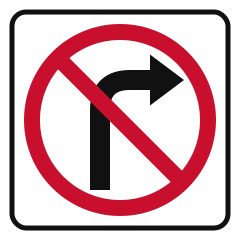
- Do not turn right here
- Turn right only on a green arrow
- Turn right only after stopping
- Turn right from the left lane
You are already in the intersection when the light turns amber. What should you do?
- Turn right to get out of the way
- Back up behind the stop line
- Stop where you are
- Continue through the intersection
What does this sign warn you of?
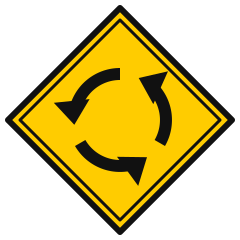
- A detour ahead
- No turns allowed
- A roundabout ahead
- A U-turn route ahead
What does a sharrow (a chevron with a bicycle symbol) on the road mean?
- The lane is for bicycles only
- Bike parking is ahead
- Cyclists and motorists share the lane
- Bicycles are not allowed
What does this sign mean?

- Two-way traffic
- No left turn
- Winding road ahead
- No U-turn allowed
A green left arrow is lit together with a red light. You want to turn right. What should you do?
- Turn right if no sign prohibits it
- Wait; a right turn is not allowed on this signal
- Turn right after a full stop
- Turn right after yielding to pedestrians
You pass a diamond-shaped sign. What should you do?
- Sound your horn as a warning
- Move into the left lane
- Slow down so you keep full control
- Stop and check for cross traffic
What does a double solid yellow line mean?
- No passing for traffic going either way
- Passing allowed during daylight only
- A reserved lane is beside you
- No passing for traffic on the right only
What does a triangle-shaped sign with its tip pointing down mean?
- A slow-moving vehicle is ahead
- A school area begins
- A hazard is just ahead
- You must yield the right-of-way
A signal shows a white vertical bar on a black background. What does it mean?
- Pedestrians may now cross
- All traffic may go straight
- Only transit buses may go
- The signal is out of order
What does this sign warn you of?
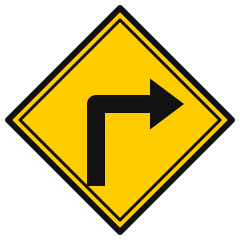
- A side road joins from the right
- A detour to the right
- A very sharp right turn ahead
- A gentle right curve ahead
You are driving next to a with-flow diamond lane and need to turn right. What may you do?
- Never enter it; turn from your lane
- Enter it and stay in it for several blocks if needed
- Enter it, then turn at the next intersection
- Enter it only after the intersection
While you check for traffic at a yield sign, what crash does the handbook warn you to avoid?
- Rolling backward into the car behind
- Running into the car ahead of you
- Being passed on the right
- Clipping a cyclist on your left
You are stopped at a red light and want to turn right. No sign forbids it. What may you do?
- Turn right only on a green arrow
- Wait for the light to turn green
- Turn right without stopping, as long as it is clear
- Turn right after a complete stop, when it is clear
A warning sign shows 'Low structure clearance 4.1 m'. What is it telling you?
- Keep 4.1 m behind the vehicle ahead
- Overhead clearance ahead is 4.1 m
- The road narrows to 4.1 m wide
- Trucks over 4.1 m long are banned
Where must you stop when a white stop line is painted across your lane?
- On top of the line
- Just past the line
- Before the line
- At the crosswalk beyond it
What must you do when you see this sign?

- Keep going; trains yield to cars
- Stop only if a gate is lowered
- Wait for a flagperson to wave you on
- Slow down, look both ways and yield to trains
The light turns amber as you approach and you can stop safely. What should you do?
- Honk and go through
- Keep going at the same speed
- Slow down and stop
- Speed up to make the light
What does this sign warn you of?
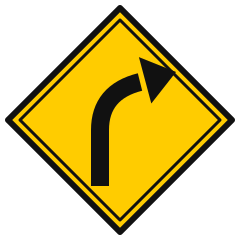
- A side road on the right
- A curve to the right ahead
- The right lane ends ahead
- A right turn is required
What do yellow lines on the road separate?
- Bike lanes from car lanes
- Traffic moving in opposite directions
- Parking spaces from travel lanes
- Traffic moving in the same direction
What does this sign mean?
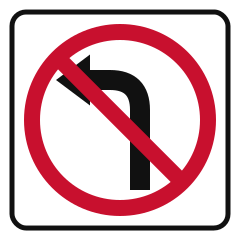
- Left turn only
- No left turn
- Left lane ends ahead
- No U-turn
You enter the intersection on a green light to turn left, but oncoming traffic keeps coming. When might you finish the turn?
- Only while the light is still green
- Never; back out of the intersection
- Only after the next green light
- During the amber or red light, when safe
What does this sign warn you of?

- The pavement ends
- A hill ahead
- A narrow bridge ahead
- A bump in the road ahead
How are with-flow reserved lanes marked on the pavement?
- Green paint and bicycle symbols along the lane
- A single solid yellow line
- Double broken white lines and diamond symbols
- Red chevrons along the lane
At a four-way stop, which vehicle should go first?
- The vehicle going straight
- The vehicle on the left
- The vehicle that stopped first
- The largest vehicle
FAQ
MPI road signs test: common questions
How many road sign questions are on the MPI test?
MPI does not publish the number of questions or a breakdown by topic. The whole test is widely reported as 30 questions with a pass mark of about 80 per cent, so confirm with MPI and learn every sign in Chapter 4 of the handbook.
Can I take the MPI knowledge test in another language?
Yes. The Class 5 test is offered in English, French and 28 other languages, with audio for all of them, so you can listen to each question as well as read it.
What happens if I fail the MPI knowledge test?
If you are in the Graduated Driver Licensing program, you must wait seven days before trying again, and only one test of the same class is allowed per day. Use that week to drill the topics where you lost marks.
Keep practising
- Manitoba questions and answers (printable PDF)100 MPI Class 5 practice questions with a separate answer key and handbook references. Print them or save them as a PDF from your browser. Free, no sign-up.
- Manitoba road signs chartEvery sign drawing from our MPI Class 5 practice questions on one page: sign shapes, regulatory, warning, construction and cycling signs with their meanings.
- How to get a learner's licence in Manitoba
- Manitoba Class 5 study guide
- Manitoba Class 5 Mock Exam 1 – 30 QuestionsTimed practice · 30 minutes · answers explained
- Manitoba Class 5 Mock Exam 2 – 30 QuestionsTimed practice · 30 minutes · answers explained
- Manitoba Class 5 Practice Test 130 questions with explanations
- Manitoba Class 5 Practice Test 230 questions with explanations
- Manitoba Class 5 Practice Test 330 questions with explanations
Practice by topic
- Sign shapes and regulatory signsWhat each sign shape and colour means, stop, yield and four-way stop rules, the 24-hour clock on signs, turn and lane-use signs, speed and school-zone signs, parking and snow-route signs.
- Warning, construction and guide signsYellow diamond warning signs for curves, lanes, hills, crossings and hazards, orange construction and maintenance signs, doubled speeding fines, and green guide and information signs.
- Traffic signals and pedestrian signalsRed, amber and green lights, where to stop on red, turns on red, flashing lights, green and amber arrows, the green left-arrow shown with a red light, and the transit priority signal.
- Pavement markings and reserved lanesYellow and white lines, solid and broken lines, stop lines, painted left-turn islands, diamond reserved lanes, contra-flow lanes, bicycle lanes and sharrows.
- Graduated licensing and getting your licenceLearner, Intermediate and Full stages, supervising driver rules, passenger limits, zero alcohol and drugs, knowledge and road test rules, new residents and keeping your licence valid.
- Starting, lane changes, turns and roundaboutsHand position, starting from the curb, lane changes and blind spots, hand signals, curves, signalling distances, right and left turns, U-turns and roundabouts.
- Speed, following distance, passing and expresswaysDefault speed limits, the four-second following rule, safe passing and when passing is banned, the No-Zone around trucks, and entering and leaving an expressway.
- Right-of-way, emergency vehicles and work zonesUncontrolled intersections, private driveways, funeral processions, yielding to emergency vehicles, the slow-down-and-move-over speeds, construction zones and the zipper merge.
- School buses, transit buses, railways and school zonesStopping for school buses, sharing the road with transit buses, railway crossing distances and rules, and reduced-speed school and playground zones.
- Pedestrians and cyclistsMarked and unmarked crosswalks, pedestrian signals and push buttons, pedestrian corridors, people who are blind, sharing the road with cyclists and the one-metre passing rule.
- Backing up and parkingBacking safely, three-point turns, parallel and angle parking, the backing skill test, parking on hills, leaving a vehicle running and where parking is illegal.
- Vehicle equipment, seatbelts and child seatsRequired brakes, lights, tires, mirrors, horn and windows, dashboard gauges, seatbelt rules, rear-facing, forward-facing and booster seats, and fuel-efficient driving.
- Night, winter and poor driving conditionsIce and snow, headlight laws, fog and reduced visibility, night driving distances, gravel and winter roads, hills, farm equipment, animals on the road and pilot vehicles.
- Driving emergencies and collisionsRunning off the pavement, blowouts, skids, emergency braking, wet brakes, breakdowns, a car in water or touching power lines, and what to do and report after a collision.
- Alcohol, drugs and impaired driving penaltiesHow alcohol and drugs affect driving, cannabis rules, the novice zero-tolerance restriction, tiered roadside suspensions for .05 to .079, and the three-month suspension at .08 or refusal.
- Distraction, fatigue, suspensions and your driving recordHand-held device penalties, drowsy driving, driving while suspended, Criminal Code suspensions, the Driver Improvement and Control Program and the Driver Safety Rating scale.