BC Class 6 / 8 Motorcycle overview

BC Class 6 / 8 Motorcycle: Warning, construction and railway signs

Yellow diamond warning signs, object markers, orange construction signs, information and destination signs, and the signs that warn of a railway crossing.

  • 20 questions
  • Topic drill
0/20
Warning, construction and railway signs · Question 1Score 0/0
Yellow diamond with a truck on a slope

What does this sign tell you to expect?

Study reference: Learn to Ride Smart (ICBC, March 2026 edition), Ch. 4 Signs, signals and road markings — Warning signs, object markers, construction signs, information and destination signs, railway signs, pp. 39–42

All 20 questions in this test

Every question and its answer choices. The correct answers and explanations appear when you take the test above.

  1. What does this sign tell you to expect?

    Yellow diamond with a truck on a slope
    1. A runaway lane ahead
    2. A truck entrance on the right
    3. A steep hill; slow down
    4. A rough road surface
  2. What shape and colour are most warning signs?

    1. A green rectangle
    2. A yellow diamond
    3. A white rectangle
    4. A red octagon
  3. What does this sign warn of?

    Yellow diamond with a small red octagon and an arrow
    1. A yield sign ahead
    2. A stop sign ahead
    3. A closed lane ahead
    4. A red light camera ahead
  4. What colour is a school crosswalk sign in B.C.?

    1. Blue with white symbols
    2. White with a red border
    3. Fluorescent yellow-green
    4. Orange with black symbols
  5. A curve sign has a tab showing 50 km/h. What should you do?

    Yellow diamond with a curved arrow, above a small yellow plate reading 50 km/h
    1. Brake hard once you are leaning into the curve
    2. Treat it as the minimum speed for the curve
    3. Slow to about the speed shown, or less in poor conditions
    4. Keep your speed if the posted limit is higher
  6. What does this sign warn of?

    Yellow diamond with a black deer
    1. Deer may be on the road
    2. A wildlife park entrance
    3. A farm crossing for cattle
    4. A hunting area beside the road
  7. On a B.C. destination sign, what unit are the distances in?
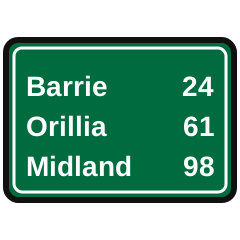
    Green rectangle listing three place names, each with a number on the right
    1. Kilometres
    2. Minutes of travel
    3. Metres
    4. Miles
  8. Where would you see an object marker like this one?

    Tall yellow panel with diagonal black stripes
    1. At the end of a school or playground zone
    2. On an obstruction you must pass with care
    3. On the back of a slow-moving farm vehicle
    4. Above a lane that is reserved for buses
  9. You pass a sign warning of a soft shoulder ahead. What should you do?

    1. Use the shoulder if the lane is busy
    2. Move to the shoulder to let trucks pass
    3. Stay off the shoulder
    4. Ride on the shoulder only at low speed
  10. What does this sign warn you about?

    Yellow diamond with a wavy arrow
    1. A lane that ends ahead
    2. A detour to the left
    3. A winding road ahead
    4. A slippery surface ahead
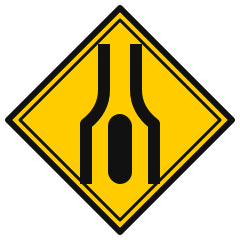
  11. What does this sign warn you about?

    Yellow diamond with two black lines that pinch inward in the middle
    1. The pavement ends in a short distance
    2. Two-way traffic is coming up ahead
    3. A divided road is beginning ahead
    4. A narrow structure, often a bridge
  12. What does this sign warn you about?

    Yellow diamond with two lines, the right one bending in toward the left
    1. The right lane ends ahead
    2. A lane is added on the right
    3. A divided highway begins
    4. The road becomes one-way
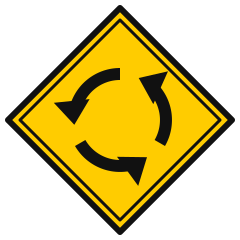
  13. What does this sign warn of?

    Yellow diamond with three curved arrows forming a circle
    1. A detour around a closed road
    2. A U-turn area ahead
    3. A roundabout ahead
    4. A traffic circle you may skip
  14. What does this sign warn of?

    Orange diamond with a person holding a flag
    1. A traffic-control person ahead
    2. Workers digging beside the road
    3. A school patrol ahead
    4. A crosswalk with a guard ahead
  15. What does this sign warn of?

    Yellow diamond with a car and wavy tire marks
    1. A steep hill ahead
    2. A slippery road ahead
    3. A winding road ahead
    4. A gravel shoulder ahead
  16. What does a lighted arrow board in a work zone mean?

    Black rectangle with yellow lights forming an arrow pointing left
    1. Move over in the direction of the arrow
    2. Workers are on the left shoulder only
    3. Speed up to clear the work area
    4. The lane beside you ends in exactly 1 km
  17. What does this sign warn of?

    Yellow diamond with two lines coming together after a centre island
    1. A median ahead you may pass on either side
    2. A divided highway ends; keep right
    3. A one-way street begins ahead
    4. Two lanes merge into one ahead
  18. What colour are construction zone signs?

    1. Yellow-green
    2. Orange
    3. Brown
    4. Blue
  19. What does this sign warn of?

    Yellow diamond showing a traffic light
    1. A school crosswalk ahead
    2. A stop sign at the next corner
    3. Traffic lights ahead
    4. A railway crossing ahead
  20. A railway crossing has a gate. When may you cross?

    White X-shaped sign reading RAILWAY CROSSING
    1. After the gate is fully raised and it is safe
    2. When the train's last car has passed
    3. When the gate starts to rise
    4. When the bell stops ringing

Warning, construction and railway signs: key rules to remember

Our summary of what the official handbook says on this topic, in our own words. Read it before or after the practice questions above, then check the original chapter. Read the official chapter ↗

Warning signs

  • Most warning signs are yellow diamonds; they warn of a possible hazard ahead.
  • Winding road ahead.
  • Sharp curve ahead with a speed tab: slow to the suggested speed.
  • Curve ahead: slow down.
  • Signal lights ahead; a version with flashing lights tells you to prepare to stop when the lights are flashing.
  • Hidden side road ahead.
  • Merging traffic ahead.
  • Right lane ends ahead.
  • Added lane: another road joins with its own lane on the right.
  • Divided highway ends ahead: keep right.
  • Two-way traffic ahead; road narrows ahead; narrow structure (often a bridge) ahead.
  • Bump or rough road ahead.
  • Slippery road ahead (shown with skid marks).
  • Steep hill ahead: slow down.
  • Stop sign ahead; roundabout ahead.

More warning signs

  • Pedestrian crosswalk ahead.
  • School crosswalk ahead: this sign is fluorescent yellow-green.
  • School bus stop ahead; cyclists may be on the road.
  • Fire truck entrance ahead; truck crossing ahead.
  • Recommended exit speed: ride slower than this in poor conditions.
  • Pavement ends ahead.
  • Watch for deer ahead; opening bridge ahead; watch for rocks on the road ahead.
  • Remove sunglasses, snow shed ahead, tunnel ahead and use headlights ahead signs.

Object markers

  • Object markers are mounted on obstructions; pay close attention to them.
  • A hazard marker can show which side to pass on: keep right, keep left, or either side.
  • A hazard or danger ahead marker can tell you to turn right or left.

Construction signs

  • Construction signs warn of road work and maintenance; you must obey them.
  • In a work zone: obey traffic-control persons, stay within the posted speed, keep well back from equipment and pass only when it is safe.
  • Signs include construction ahead, detour ahead, traffic-control person ahead, crew working (obey the posted speed), survey crew (obey the posted speed), and soft shoulder ahead (stay off the shoulder).
  • A lighted arrow board means follow the direction of the arrow.
  • Blasting ahead: follow the instructions on the sign.
  • An end of construction zone speed limit sign marks where the work zone limit stops.
  • A sign can give notice of the fine for speeding in a work zone.

Information and destination signs

  • These signs give destinations, route numbers and services.
  • On destination signs, distances are in kilometres.
  • Examples: directional sign, Trans-Canada Highway route marker, primary highway marker, hospital nearby, gas available, accommodation ahead and travel information ahead.

Railway signs

  • Public railway crossings are marked with signs or pavement markings and may have mechanical or electric warning devices.
  • You must always yield to trains.
  • Railway crossing ahead sign: be ready to stop.
  • Railway crossing on a side road ahead: be ready to stop.
  • Railway crossing sign with a stop sign: stop, then go when it is safe.
  • Crossing with a gate: stay stopped until the gate is fully raised.

Study the Warning, construction and railway signs rules as flashcards →

Other topics

Full practice tests